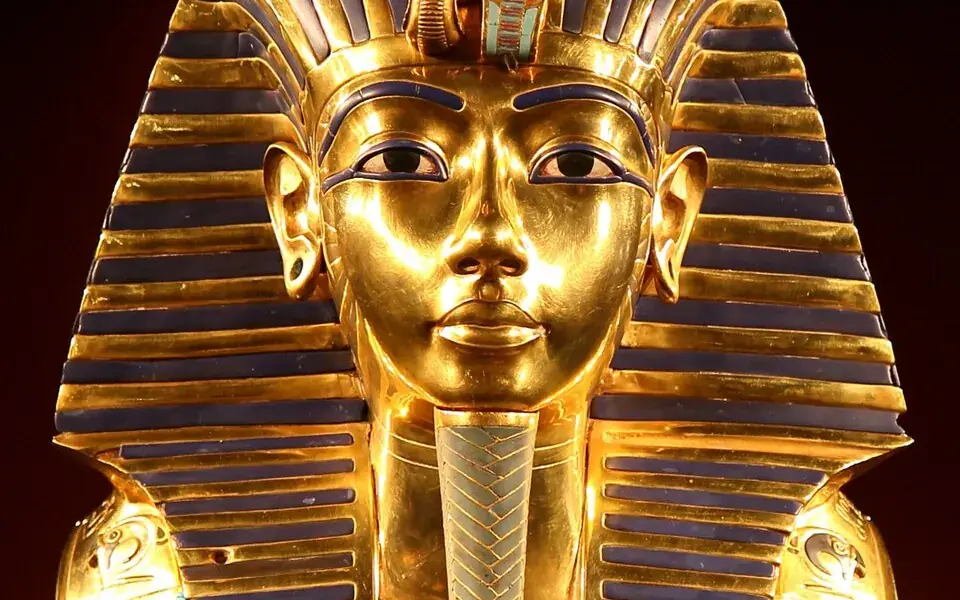
Tutankhamun's reign was brief, but his tomb, discovered in 1922, retained a wealth of funerary objects. Its preservation made his name an emblem of ancient Egyptian archaeology.
Objects such as the gold mask reveal royal funeral customs and craftsmanship. Although the tomb had been entered before, it was not thoroughly looted like many other royal tombs.
Reign
Tutankhamun became pharaoh between 8 and 9 years of age following the short reigns of Akhenaten's successors, Smenkhkare and Neferneferuaten. It is uncertain whether Smenkhkare's reign outlasted Akhenaten's; the female ruler Neferneferuaten is now thought to have either been co-regent shortly before Akhenaten's death or to have had a sole reign of two or three years before the accession of Tutankhamun, which means that she was Tutankhamun's predecessor according to Athena van der Perre and Nozumu Kawai. On acceding to the throne, Tutankhamun took the throne name Nebkheperure. He reigned for about nine years.
During Tutankhamun's reign, the position of Vizier was split between Upper and Lower Egypt. The principal vizier for Upper Egypt was Usermontu. Another figure named Pentju was also vizier, but it is unclear which lands. It is not entirely known if Ay, Tutankhamun's successor, actually held this position. A gold foil fragment from KV58 seems to indicate, but not certainly, that Ay was referred to as a Priest of Maat along with an epithet of "vizier, doer of maat." The epithet does not fit the usual description used by the regular vizier but might indicate an informal title. It might be that Ay used the title of vizier in an unprecedented manner. Nevertheless, the interpretation of this document as referring to a vizier is debated, and the vizier title may not be sufficient to add to Ay's well-documented titles.
Rediscovery
The concession rights for excavating the Valley of the Kings were held by Theodore Davis from 1905 until 1914. In that time, he had unearthed ten tombs, including the nearly intact but non-royal tomb of Queen Tiye's parents, Yuya and Thuya. As he continued working there in the later years, he uncovered nothing of major significance. Davis did find several objects in KV58 referring to Tutankhamun, which included knobs and handles bearing his name, most significantly the embalming cache of the king (KV54). He believed this to be the pharaoh's lost tomb and published his findings as such with the line; "I fear the Valley of the Tombs is exhausted". In 1907, Howard Carter was invited by William Garstin and Gaston Maspero to excavate for George Herbert, 5th Earl of Carnarvon in the Valley.
The Earl of Carnarvon and Carter had hoped this would lead to their gaining the concession when Davis gave it up, but had to be satisfied with excavations in different parts of the Theban Necropolis for seven more years.
By February 1923, the antechamber had been cleared of everything but two sentinel statues. A day and time were selected to unseal the tomb with about twenty appointed witnesses that included Lord Carnarvon, several Egyptian officials, museum representatives, and the staff of the Government Press Bureau. On 17 February 1923 at just after two o'clock, the seal was broken.
Contents
Tutankhamun's tomb is the only royal tomb in the Valley of the Kings found in near-intact condition. There were 5,398 items found in the tomb, including a solid gold coffin, face mask, thrones, archery bows, trumpets, a lotus chalice, two Imiut fetishes, gold toe stalls, furniture, food, wine, sandals, and fresh linen underwear. Howard Carter took 10 years to catalog the items. Analysis from the 1960s onwards suggests a dagger recovered from the tomb had an iron blade made from a meteorite; study of artifacts of the time including other artifacts from Tutankhamun's tomb could provide valuable insights into metalworking technologies around the Mediterranean at the time.
Complete study of the iron artefacts from the tomb (besides the blade of a richly decorated golden dagger, small iron chisel blades set into wooden handles, an Eye of Horus amulet, and a miniature headrest) demonstrated that all were made of similar material. Only in 2022, a complex technological and material study of the Tutankhamun's mask was published. Many of Tutankhamun's burial goods show signs of being adapted for his use after being originally made for earlier owners, probably Smenkhkare or Neferneferuaten or both. The golden Nut pectoral (Carter no. 261p1) or (Cairo JE61944) was reused for the funeral of Tutankhamun.