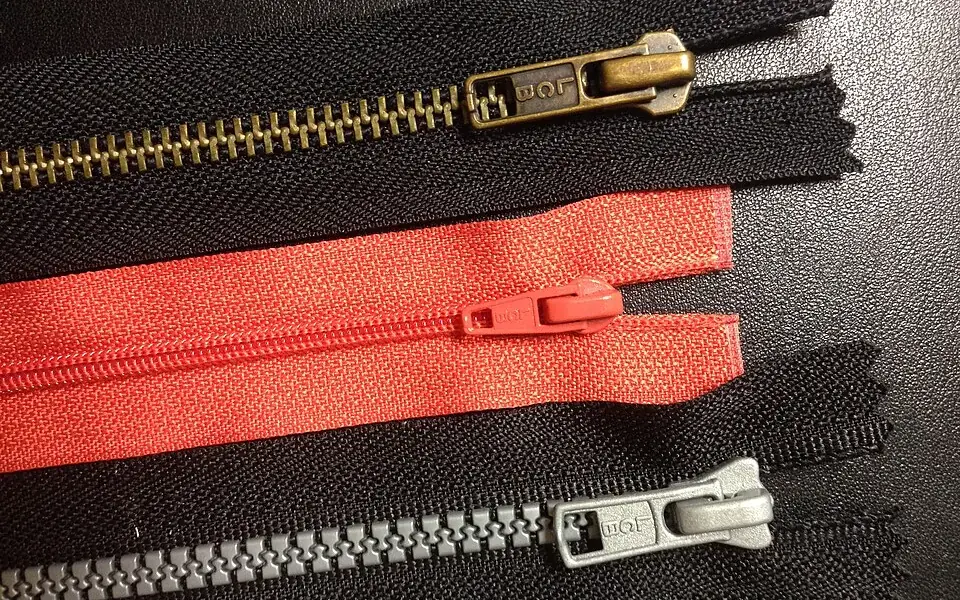
A zipper uses a slider to bring together or separate the successive teeth along two sides. Early patents underwent repeated improvements before the structure became convenient for clothing and luggage.
Its adoption depended on manufacturing precision, durability, and clothing design. This small fitting illustrates how industrial products develop through gradual refinement.
Patents, improvements, and adoption
In 1851, Elias Howe received a patent for an "Improvement in Fastenings for Garments". He did not try seriously to market it, thus missing the recognition that he might otherwise have received. Howe's device was more like an elaborate drawstring than a true slide fastener. During this year Howe aimed to create automatic garment fasteners after his sewing machine became widely popular. Elias Howe Jr. played an important role in zipper development but he did not create the original concept of this invention.
Forty-two years later, in 1893, Whitcomb L. Judson patented a "Shoe-Fastening". Judson decided to develop a new shoelace alternative which replaced the standard boot laces for men and women. Judson secured a second patent through his "clasp-locker" design on August 29th of 1893. The initial prototype functioned despite having mechanical problems that resulted in jamming occurrences. Judson along with his partner Lewis Walker had implemented the device directly into their own boots. The device served as a (more complicated) hook-and-eye shoe fastener. With the support of businessman Colonel Lewis Walker, Judson launched the Universal Fastener Company to manufacture the new device. Judson's "clasp locker" had its public debut at the 1893 Chicago World's Fair and met with little commercial success. He exhibited his clasp-locker at the World's Fair in Chicago of 1893 but the invention received minimal public attention. Judson is sometimes given credit as the inventor of the zipper, but his device was not used in clothing.
The Universal Fastener Company moved to Hoboken, New Jersey, in 1901, reorganized as the Fastener Manufacturing and Machine Company. Gideon Sundbäck, a Swedish-American electrical engineer, was hired to work for the company in 1906. The company moved to Meadville, Pennsylvania, where it operated for most of the 20th century under the name Talon, Inc. Sundbäck worked on improving the fastener, and, in 1909, he registered a patent in Germany. The US rights to this invention were in the name of the Meadville company (operating as the Hookless Fastener Co.), but Sundbäck retained non-U.S. rights and used these in subsequent years to set up Lightning Fastener Co. in St. Catharines, Ontario, Canada. Sundbäck's work with this firm has led to the common misperception that he was Canadian and that the zipper originated in that country. Sundbäck redesigned the Judson fastener to create a more durable design, and the zipper first went on sale in 1913.
In 1916, newspapers in Australia reported displays of the "new hookless fastener", a device from America that "the world has been waiting for" by a live model in the store window of Raynor's of Melbourne.
Sundbäck increased the number of fastening elements from four per inch (about one every 6.4 mm) to ten or eleven (around every 2.5 mm), introduced two facing rows of teeth that pulled into a single piece by the slider and increased the opening for the teeth guided by the slider. The patent for the "Separable Fastener" was issued in 1917. Gideon Sundbäck also created the manufacturing machine for the new device. The "S-L" or "strapless" machine took a special Y-shaped wire and cut scoops from it, then punched the scoop dimple and nib, and clamped each scoop on a cloth tape to produce a continuous zipper chain. Within the first year of operation, Sundbäck's machinery was producing a few hundred feet (around 100 meters) of fastener per day.
In March of the same year, Mathieu Burri, a Swiss inventor, improved the design by adding a lock-in system attached to the last teeth, but his version never got into production due to conflicting patents.
In 1923, during a trip to Europe, Sundbäck sold his European rights to Martin Othmar Winterhalter, who improved the design by using ribs and grooves instead of Sundbäck's joints and jaws and started producing with his company Riri on a large scale first in Germany, then in Switzerland.