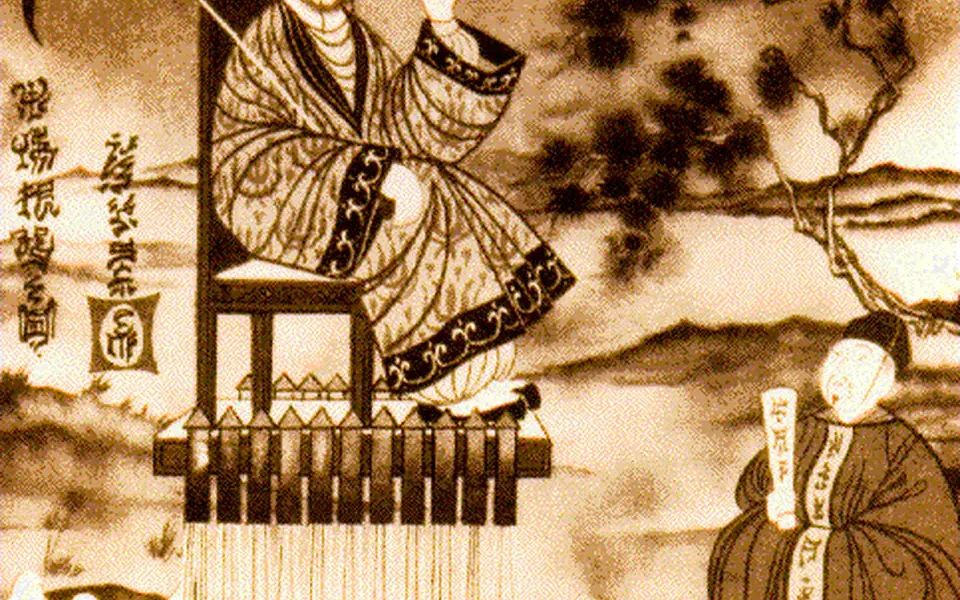
The legend that Wan Hu tied himself to rockets and tried to fly often appears in stories about spaceflight. Its details lack reliable supporting evidence from contemporary historical records in China.
The story is best read as an example of how legends spread. It should not be treated as a verified account of a crewed rocket experiment.
The evidence behind the legend
Wan Hu is an alleged Chinese official said to be the first man to attempt to use a rocket to launch into outer space, first described in the early 20th century in American publications, with no known prior Chinese accounts. Credited as possibly the "world's first astronaut" and "the first martyr in man's struggle to achieve space flight", the International Astronomical Union named the crater Wan-Hoo on the far side of the Moon after him in 1970.
According to some Chinese sources, "Wan Hu" was a title granted to him by the imperial court during the early Ming dynasty, and his real name was Tao Chengdao. As a Ming official, he was interested in technological innovation, particularly concerning rockets. He is said to have died in 1390.
While the legend is well-known, there is no direct evidence surviving to substantiate it. According to Joseph Needham, the story is dubious and may have been invented during or after the Chinoiserie period, considering the lack of firm historical reference. However, Li Chengzhi has argued for the story's plausibility, saying that it may have come from oral transmission by European missionaries who came to China during the late Ming and Qing dynasties, or based on records in an ancient Chinese document that has been subsequently lost.
Basic story
The story concerns an imperial Chinese official, referred to as Wan Hu. In order to realize his dream of reaching the heavens, he sat on a chair with 47 rockets tied to it, holding a kite in each of his hands, and flying into the sky after his servants were ordered to light the fuses to the rockets. But the rockets then exploded. When the air cleared, Wan Hu was gone. There are also variations of this story.
"Wang Tu"
An early printed precursor appeared in the 2 October 1909 issue of Scientific American in an article by John Elfreth Watkins. It used the name Wang Tu and placed the supposed aviator around 2000 BCE. That date is thousands of years earlier than gunpowder-based rockets in China, illustrating the chronology problems in this version. Watkins's article also included other fictional stories of ancient flight. The later, more familiar account changed the name and historical setting while retaining the spectacular rocket-chair episode.
"Wan Hu"
The legend of "Wan Hu" was widely disseminated by an unreferenced account in Rockets and Jets by American author Herbert S. Zim in 1945.
Another book from the same year, The Coming Age of Rocket Power by George Edward Pendray, sets the story in "About the year 1500" and describes it as an "often repeated tale of those early days" of rocket propulsion.
Origins
The dating of the invention of the first gunpowder rocket, otherwise known as the gunpowder-propelled fire arrow, is disputed. The History of Song attributes the invention to two different people at different times: Feng Zhisheng in 969 and Tang Fu in 1000. However, Joseph Needham argues that rockets could not have existed before the 12th century, since the gunpowder formulas listed in the Wujing Zongyao are not suitable as rocket propellant.
Rockets may have been used as early as 1232, when reports appeared describing fire arrows and 'iron pots' that could be heard for 5 leagues (25 km, or 15 miles) when they exploded upon impact, causing devastation for a radius of 600 meters (2,000 feet), apparently due to shrapnel. A "flying fire-lance" that had re-usable barrels was also mentioned to have been used by the Jin dynasty (1115–1234). Rockets are recorded to have been used by the Song navy in a military exercise dated to 1245. Internal-combustion rocket propulsion is mentioned in a reference to 1264, recording that the 'ground-rat,' a type of firework, had frightened the Empress-Mother Gongsheng at a feast held in her honor by her son the Emperor Lizong.