The Panama Canal opened in 1914. Its locks raise and lower ships between the seas on either side and the elevated lakes, rather than providing a level waterway throughout.
Operating the locks requires managing water levels and consumption. The canal shortened voyages between the Atlantic and Pacific, and its construction also involved challenges such as disease prevention.
United States construction of the Panama canal, 1904–1914
The US formally took control of the canal property on 4 May 1904, inheriting from the French a depleted workforce and a vast jumble of buildings, infrastructure, and equipment, much of it in poor condition. A US government commission, the Isthmian Canal Commission (ICC), was established to oversee construction; it was given control of the Panama Canal Zone, over which the United States exercised sovereignty. The commission reported directly to Secretary of War William Howard Taft and was directed to avoid the inefficiency and corruption that had plagued the French 15 years earlier.
On 6 May 1904, President Theodore Roosevelt appointed John Findley Wallace, formerly chief engineer and finally general manager of the Illinois Central Railroad, as chief engineer of the Panama Canal Project. Overwhelmed by the disease-plagued country and forced to use often dilapidated French infrastructure and equipment, as well as being frustrated by the overly bureaucratic ICC, Wallace resigned abruptly in June 1905. The ICC brought on a new chairman, Theodore P. Shonts, and a new chief engineer was appointed, John Frank Stevens, a self-educated engineer who had built the Great Northern Railroad who would remain in the position a mere two years. Stevens was not a member of the ICC; he increasingly viewed its bureaucracy as a serious hindrance, bypassing the commission and sending requests and demands directly to the Roosevelt administration in Washington, DC.
One of Stevens' first achievements in Panama was in building and rebuilding the housing, cafeterias, hotels, water systems, repair shops, warehouses, and other infrastructure needed by the thousands of incoming workers. Stevens began the recruitment effort to entice thousands of workers from the United States and other areas to come to the Canal Zone to work. Workers from the Caribbean – called "Afro-Panamanians" – came in large numbers and many settled permanently. Stevens tried to provide accommodation in which the workers could work and live in reasonable safety and comfort. He also re-established and enlarged the railway, which was to prove crucial in transporting millions of tons of soil from the cut through the mountains to the dam across the Chagres River.
Colonel William C. Gorgas had been appointed by Wallace as chief sanitation officer of the canal construction project in 1904. Gorgas implemented a range of measures to minimize the spread of deadly diseases, particularly yellow fever and malaria, which had recently been shown to be mosquito-borne following the work of Cuban epidemiologist Carlos Finlay, American pathologist Walter Reed and Scottish physician Sir Ronald Ross. Investment was made in extensive sanitation projects, including city water systems, fumigation of buildings, spraying of insect-breeding areas with oil and larvicide, installation of mosquito netting and window screens, and elimination of stagnant water. Despite opposition from the commission (one member said his ideas were barmy), Gorgas persisted, and when Stevens arrived, he threw his weight behind the project. After two years of extensive work, the mosquito-spread diseases were nearly eliminated.
Layout
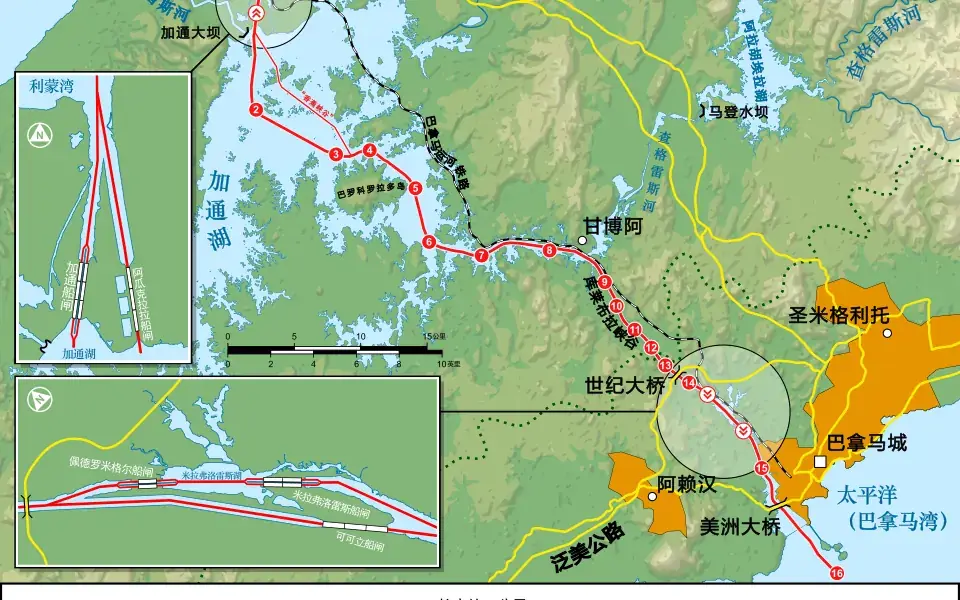
While globally the Atlantic Ocean is east of the isthmus and the Pacific is west, the general direction of the canal passage from the Atlantic to the Pacific is from northwest to southeast, because of the shape of the isthmus at the point the canal occupies. The Bridge of the Americas (Spanish: Puente de las Américas) at the Pacific side is about a third of a degree east of the Colón end on the Atlantic side. Still, in formal nautical communications, the simplified directions "southbound" and "northbound" are used.
The canal consists of artificial lakes, several improved and artificial channels, and multiple sets of locks. The original locks take ships up to panamax size and the new expansion locks up to neopanamax size. An additional artificial lake, Alajuela Lake (known during the American administration as Madden Lake), acts as a reservoir for the canal.
Thus, the total length of the canal is 80 km (50 mi). In 2017 it took ships an average of 11.38 hours to pass between the canal's two outer locks.