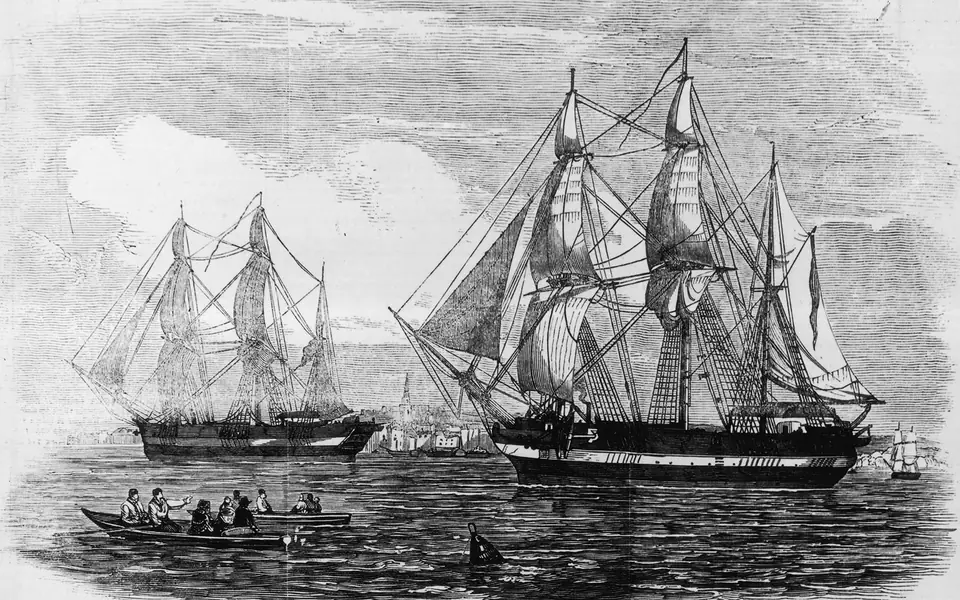
An expedition equipped for success
On May 19, 1845, two Royal Navy ships left Greenhithe, England, to search for a Northwest Passage through the Arctic. Sir John Franklin commanded the expedition aboard HMS Erebus, accompanied by HMS Terror under Francis Crozier. The departure looked like the beginning of a difficult but achievable undertaking. Large sections of the northern coastline had already been mapped by Europeans, and the ships carried extensive supplies. Neither ship returned. One of the most revealing accounts of their fate would eventually be found on a single sheet of paper, with a desperate update crowded around an earlier message.
The expedition’s equipment helps explain its initial confidence. Erebus and Terror were former bomb vessels, strongly built for their original naval role and further reinforced for polar conditions. Both had already served on James Clark Ross’s Antarctic expedition. For the new voyage, railway locomotive engines were adapted to provide auxiliary steam power, with propellers that could be raised to reduce the danger of ice damage. Heating apparatus and stoves offered further advantages. These preparations were substantial, but technology could not guarantee that a vessel trapped in moving sea ice would reach open water again.
Two messages on one sheet
Franklin left Britain with 134 officers and men. After five were sent home from Greenland, 129 continued into the Arctic. Letters dispatched during this early stage became the last correspondence many families received. The expedition spent the winter of 1845–46 at Beechey Island, where three men were buried. It subsequently moved south. In September 1846, the ships became trapped northwest of King William Island. Remaining aboard initially offered shelter and provisions, but the passing seasons changed the calculation. A ship that could no longer carry its people home could also become a place they eventually had to abandon.
The paper later known as the Victory Point Note records that change with unusual force. Its original message, dated May 1847, reported on the expedition’s movements and gave an optimistic assessment. Writing added in April 1848 reported that Franklin had died on June 11, 1847, and that nine officers and fifteen men were now dead. It also recorded the abandonment of both vessels on April 22, 1848. The remaining 105 were under Crozier’s command and intended to head toward the Back River. A planned journey written on a page, however, does not establish how far each individual subsequently traveled.
Witnesses whom Britain struggled to hear
Searchers faced an enormous region and very little direct information. Inuit accounts and objects acquired from Inuit provided essential evidence, although some British commentators treated that knowledge with hostility. In 1854, John Rae obtained reports of starving Europeans and recovered items linked to the expedition. The reports included evidence of cannibalism, a claim that provoked particular resistance in Britain. Parks Canada’s history recounts Charles Dickens’s attempts to discredit Rae’s informants. The episode shows how assumptions about national character and racial superiority could obstruct an investigation even when witnesses and material evidence offered valuable leads.
A search financed by Franklin’s wife, Jane, and led by Francis McClintock recovered further traces. Lieutenant William Hobson found the Victory Point record in 1859. Elsewhere, searchers encountered abandoned possessions, human remains, and a boat mounted on a sledge. These discoveries established the scale of the catastrophe without supplying a complete account of its final stages. It is tempting to arrange every object into one continuous story, but a surviving book or piece of cutlery cannot by itself reveal the owner’s last actions. The distinction between evidence and reconstruction remains central to understanding the expedition.
The wrecks and the questions that remain
The ships themselves remained missing for more than a century and a half. Parks Canada began a renewed program of searches in 2008, working with partners and drawing on Inuit knowledge alongside modern survey methods. Erebus was located in 2014, south of King William Island, in a region described in Inuit testimony. Terror was discovered in 2016 in Terror Bay. The finds were far more than dramatic answers to a famous riddle. Preserved shipboard spaces and objects offered archaeological evidence that nineteenth-century searchers had never been able to examine directly.
Finding both wrecks did not make every uncertainty disappear. The precise sequence of events after the recorded abandonment, and the experiences of individual men, cannot simply be read from the ships’ final positions. The story instead demonstrates how different forms of knowledge can work together: a dated document, oral accounts, recovered possessions, surveys, and underwater archaeology. It also changes the familiar image of an empty Arctic awaiting discovery. Inuit already lived in and understood this region. Their observations helped preserve the history of visitors whose own written record had become so painfully incomplete.