A bakery inside a larger dispute
A ruined pastry shop seems an improbable reason to send warships across the Atlantic. Yet the conflict between France and Mexico in 1838–1839 still carries the memorable name Pastry War. Behind that label stood something much larger than an argument over cakes: compensation claims, access to commerce, and the power of a European navy to pressure a recently independent republic. The fighting brought bombardment to the fortress of San Juan de Ulúa, beside Veracruz. Understanding why a bakery became the war's shorthand means looking past the anecdote to the competing interests that made it politically useful.
The best-known claimant was a French pastry maker called Remontel, whose business was in Tacubaya, near Mexico City. Accounts of the dispute describe a shop damaged during political disturbances and a demand for 60,000 pesos. That claim was part of a larger collection of French complaints about losses to property and business. It should not be confused with the 600,000 pesos France demanded from the Mexican government overall. Nor should a familiar retelling be treated as a precise inventory of what happened inside the bakery. The shop's grievance became famous because it gave a complicated confrontation an easily remembered name.
Commercial pressure becomes a blockade
The National Museum of Interventions places the episode within French commercial ambitions in the Americas and rivalry with Britain. Mexico had achieved independence in 1821, but political conflict and financial weakness made dealing with foreign claims difficult. Accepting responsibility for losses during upheavals also raised a wider question: what further claims might follow? France's ultimatum expired in April 1838, and a blockade centered on Veracruz began on April 16. Closing a trading gateway put pressure on people far beyond the disputed shop. The apparent absurdity of the nickname can obscure how seriously commerce and national authority were at stake.
Months of pressure did not produce a settlement. Negotiations at Xalapa in November failed, and on November 27 the French squadron under Rear Admiral Charles Baudin opened fire on San Juan de Ulúa. The fortress capitulated the following day. Its island position made it a formidable-looking defender of the port, but appearances were not the same as an effective defense. The Mexican navy's historical account examines the importance of surrounding shoals, the approaches available to attacking ships, and the handling of the fort. Geography, command decisions, and naval force mattered more to this battle than any pastry-shop bill.
A landing, an injury, and a peace agreement
The conflict also gave Antonio López de Santa Anna a chance to rebuild his standing after his defeat in Texas. He took command of Mexican defensive operations in early December. French forces landed at Veracruz on December 5, and Santa Anna was wounded in the fighting; his injured leg was amputated. The injury became an enduring feature of his public story, but it should not turn the whole campaign into another colorful personal anecdote. For Veracruz, the important sequence was a commercial blockade followed by bombardment and a landing. The dispute had moved from diplomatic pressure to violence on Mexican soil.
British mediation helped bring the confrontation to an end. On March 9, 1839, Mexico and France signed a peace agreement at Veracruz. The Mexican representatives included Guadalupe Victoria and Manuel Eduardo de Gorostiza, while Baudin represented France. The agreement committed Mexico to the 600,000-peso indemnity and provided for the return of San Juan de Ulúa. Saying that Mexico agreed to pay is more exact than imagining a single immediate transfer that settled every difficulty. The blockade and fighting had already disrupted trade, and the republic's strained finances gave the promised payment consequences beyond the negotiations themselves.
Two pictures of the same war
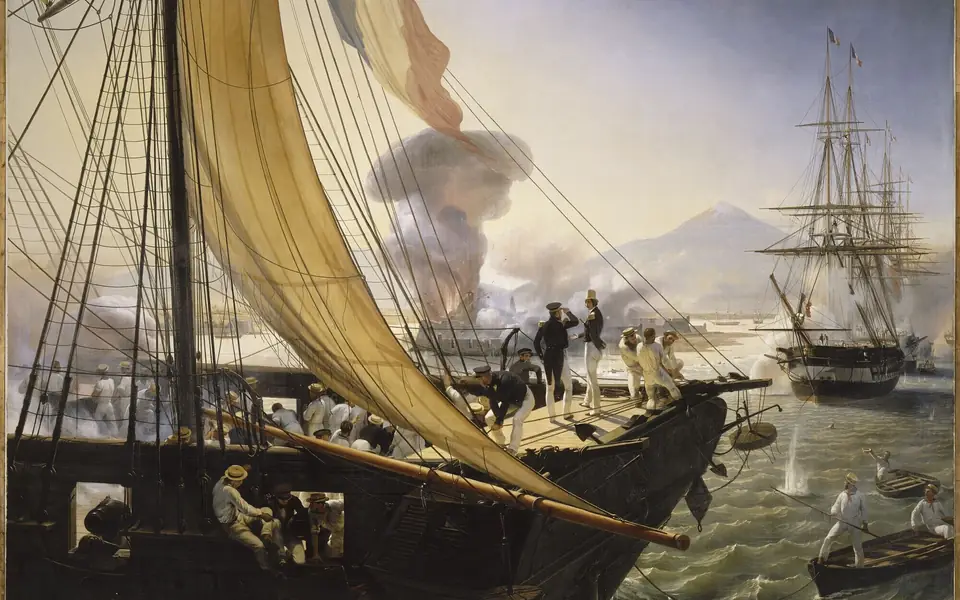
A surviving image helps explain how the campaign was remembered in France. Horace Vernet painted the capture of San Juan de Ulúa in 1841, following a commission from King Louis-Philippe for the historical museum at Versailles. The scene places the Prince of Joinville aboard the corvette Créole as the fort explodes in the distance. This is a dramatic interpretation made after the event, not a photograph or an impartial view from the shore. Its royal commission matters: the expedition could be presented to French viewers through the actions of a prince and the spectacle of a naval victory.
The pastry maker and the royal painting offer two very different ways into the same war. One compresses diplomacy into a small commercial grievance; the other enlarges a military episode into national glory. Neither alone explains why Mexico's port was blockaded or why its government resisted France's demands. The 1838–1839 intervention was also distinct from the later French campaign associated with Emperor Maximilian. Its particular story concerns compensation, commerce, and coercion in the early republic. Remembering those stakes preserves what the entertaining name leaves out: a dispute over whose claims could be enforced, by what means, and at whose expense.