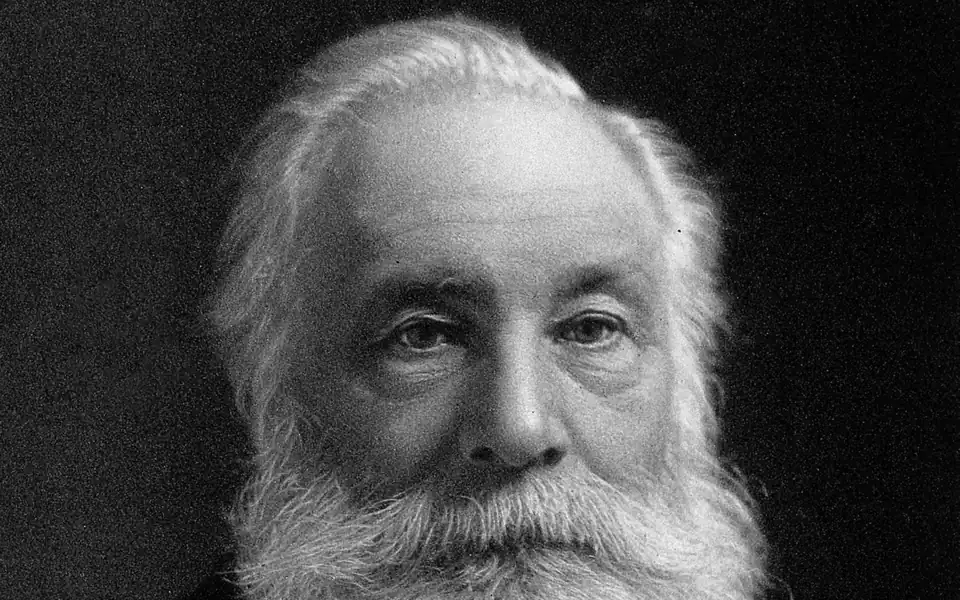
A medicine that became a color
During the Easter vacation of 1856, William Henry Perkin was trying to make a medicine and ended up changing the colors people wore. The eighteen-year-old chemistry student was experimenting at home in London when an unsuccessful reaction produced a dark residue. Investigation revealed something more promising than its appearance suggested: material that could color silk purple. Perkin had not made quinine, the treatment he had hoped to reproduce. He had found the basis of mauve, the first commercially successful synthetic organic dye.
Perkin was already an experienced experimenter for his age. At the City of London School, teacher Thomas Hall had encouraged his interest in practical science. He subsequently studied at the Royal College of Chemistry under August Wilhelm Hofmann and became Hofmann's assistant. His father's preference for architecture had given way to a vocation involving bottles and reactions. The home laboratory extended his formal training into evenings and holidays, allowing him to pursue questions beyond the immediate requirements of a class.
A stain worth investigating
Quinine was an attractive target because it was obtained from cinchona bark and had important medical uses. But knowing the elements present in a substance did not reveal how to arrange them into the right molecule. Perkin's unsuccessful experiments included oxidizing aniline, a chemical associated with coal tar. The resulting black material might easily have been discarded. Instead, he investigated its color and found that an extract imparted a strong purple to silk. That test connected an unexpected laboratory result with a possible practical use.
The names attached to the discovery carried their own marketing appeal. The University of Chicago Library records that the dye was initially sold as Tyrian purple before becoming known as mauve. An ancient luxury color thus helped introduce a modern manufactured one. Fashion provided a receptive setting, but a vivid sample was only the beginning. Customers needed material that could be supplied consistently and used in actual dyeing processes. The commercial problem was therefore larger than repeating a striking experiment for an audience.
From a flask to a factory
Perkin patented his discovery in August 1856 and chose manufacturing despite Hofmann's reservations. His father and brother supported the venture, and a factory opened at Greenford Green in 1857. A building contractor's practical knowledge was useful alongside the young chemist's experimental skill. The move required money, equipment, raw materials, and methods suitable for production. It also required learning how the product behaved on textiles. The familiar story of an accidental discovery therefore includes a second, much more deliberate story about making it usable.
Mauve helped demonstrate that chemicals derived from coal tar could become desirable consumer products. Other synthetic colors followed, and the emerging dye industry encouraged close connections between scientific research and manufacture. Perkin eventually sold his business in 1874, when he was thirty-six, and continued chemical investigations. His discovery became an important early example of an industry built around organic synthesis. It did not mean that every modern chemical enterprise sprang from one flask, but it showed how laboratory experimentation could open a substantial new market.
The chemistry behind the fashion
There was another surprise hidden in the purple. The American Chemical Society notes that mauveine is a mixture of related molecules rather than one perfectly simple substance. The structures of two important components, mauveines A and B, were not established until 1994. A useful industrial product could thus be made and sold long before chemists fully resolved its composition. That gap between practical control and structural understanding is part of the discovery's interest, rather than a reason to dismiss the earlier work.
In 1906, the Society of Chemical Industry marked the discovery's fiftieth anniversary by awarding Perkin the first medal bearing his name. The celebration looked back on both an unexpected observation and the sustained work that followed it. A failed attempt to obtain medicine had supplied a new way to make color. What transformed the accident into history was Perkin's decision to examine the residue, test it on cloth, and pursue the difficult steps between an interesting stain and a product people could buy.