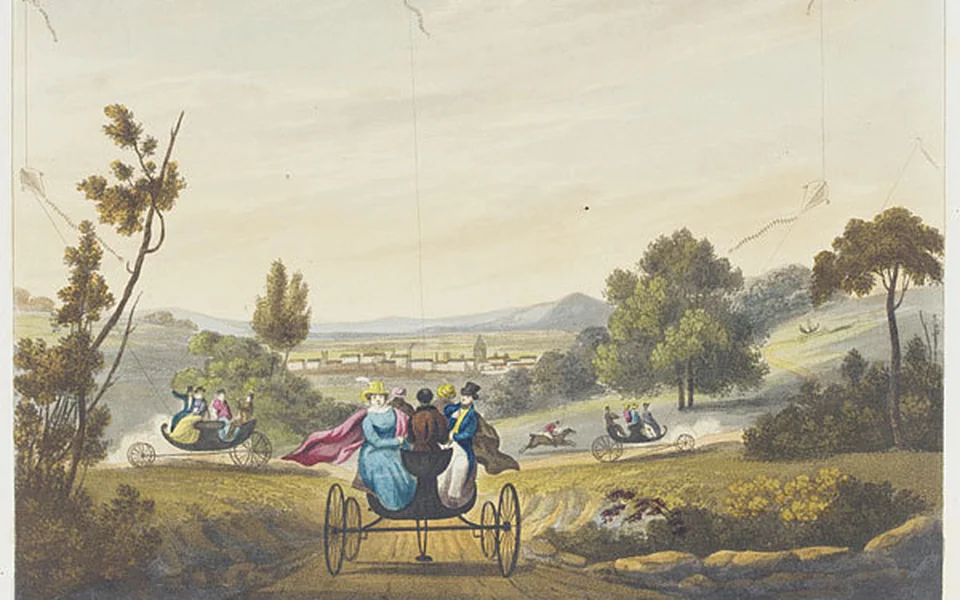
A carriage with its engine overhead
Imagine approaching a carriage on an English road in the 1820s and finding no horses in front of it. Its power might instead be overhead, transmitted through long lines from two kites. George Pocock, a Bristol schoolmaster with an enthusiasm for invention, promoted just such a vehicle. He called it the charvolant and described it in his 1827 book, The Aeropleustic Art. The illustrated volume presented wind as a practical source of travel power, bringing the familiar behavior of a child's toy into an unexpectedly ambitious transport scheme.
Pocock taught at Prospect Place Academy in Bristol. According to his own account, the project grew from noticing that a kite could drag a stone attached to its string. He explored larger loads and eventually attached kites to vehicles. The progression was easy to understand: if a kite could pull an object along the ground, a sufficiently powerful arrangement might pull people too. But turning that observation into a road vehicle required more than simply enlarging a toy and tying it to a seat.
Controlling a moving kite
The charvolant used controllable lines to manage the kites while passengers traveled in a lightweight carriage. A folding kite could be stowed when it was not needed. Contemporary mechanical descriptions also distinguish steering the wheels from adjusting the airborne source of traction. A drag could slow or stop the vehicle. These separate controls mattered because the carriage had to follow a road, whereas the pull of its kites depended on the moving air. The operator therefore had to coordinate the behavior of equipment in two different places.
The Science Museum's description of an 1827 plate explains Pocock's claim that side lines could angle the kite to obtain useful pull from wind crossing the route. It also notes the book's lack of clarity about travel against a headwind. That difference is crucial when reading an inventor's promises. Demonstrating motion in a favorable wind establishes that the machine can work under some conditions. It does not establish that it will take passengers reliably to every destination at the time they need to arrive.
Journeys and a turnpike puzzle
Pocock claimed speeds of around twenty miles an hour and described journeys between Bristol and Marlborough. The University of Glasgow's copy of his book includes his account of beating a stagecoach despite its earlier departure. Such reports are best understood as the inventor's testimony rather than independently measured performance guarantees. He was making a case for his machine, and entertaining stories helped that case. His descriptions combine practical observations with the pleasure of watching an improbable vehicle draw astonished attention along an ordinary road.
Turnpikes supplied an especially memorable part of the publicity. Pocock said his horseless carriage perplexed toll collectors because the charges he encountered were framed around horses. Bristol's museum account likewise describes the attraction of passing without an established charge for a kite-pulled vehicle. The episode exposes a small mismatch between an existing administrative system and an unfamiliar machine. It should not be expanded into a claim that all British road tolls everywhere were identical, or that such an advantage could have survived any widespread adoption unchanged.
The promise inside the picture
The book's pictures were as ambitious as its anecdotes. One plate imagined several charvolants traveling in different directions with the same wind; another displayed the patent kite and carriage. These are illustrations of a proposed transport system, rather than photographs of everyday traffic. A modern viewer can see both the attractive idea and its unresolved demands: the long lines, the airspace needed above the route, and the requirement to manage changes in wind while sharing roads. The illustration makes the scheme legible without proving its universal practicality.
The charvolant attracted demonstrations and curiosity but did not become ordinary transport. Its historical interest lies partly in that gap between successful motion and dependable service. Pocock had identified a real source of power and built a striking way to use it. He also had to persuade readers that its awkward conditions could be managed. His carriage belongs to a period of competing ideas about movement, when a schoolmaster could picture the future of the road with its motive power floating high above the passengers.