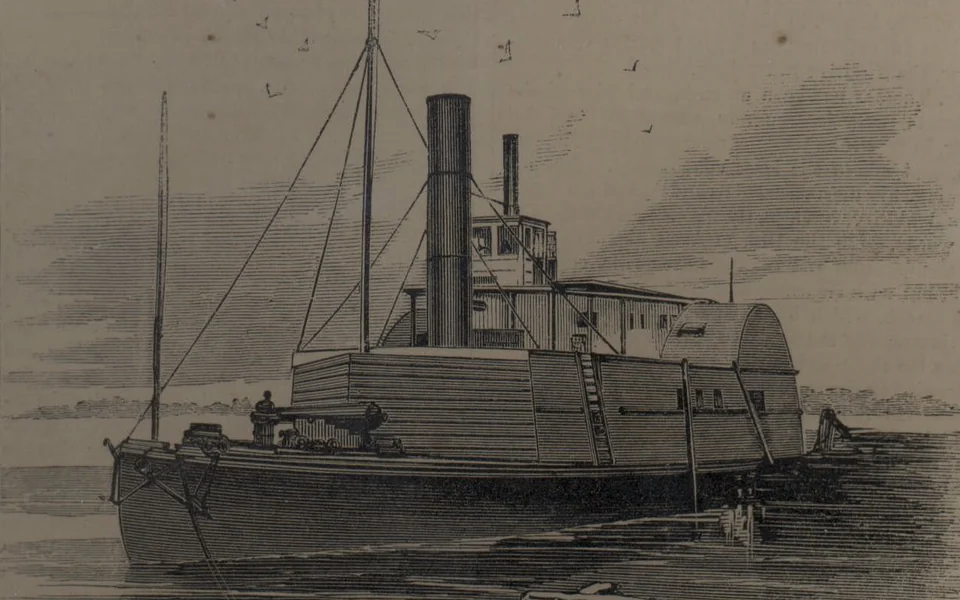
A pilot inside an armed harbor
Before dawn on May 13, 1862, a Confederate transport steamer began moving through Charleston Harbor. Its appearance was reassuringly familiar to the sentries guarding the water. The Planter routinely carried military supplies between Confederate installations, and the man guiding it knew the required signals. What the guards did not know was that the ship's white officers had gone ashore and its enslaved crew had seized their opportunity. Robert Smalls was leading an escape that would carry families, a valuable vessel, and military information toward the Union blockade.
Smalls had acquired his expertise through years of waterfront work. Born enslaved in Beaufort, South Carolina, in 1839, he was sent to Charleston while still a boy and worked in several maritime occupations. He learned the channels and coastal waters through practical experience. When the Civil War began, the Confederate military used the Planter to move troops, ammunition, and equipment around the harbor. Smalls's navigational knowledge made him essential to this work, even as the legal system denied him control over his own life and family.
A familiar ship on an unfamiliar mission
The escape depended on cooperation. After the officers left the vessel on the night of May 12, Smalls and his fellow freedom seekers prepared to leave. They also collected family members before making for the open water. The National Park Service describes approximately sixteen people making the journey. Remembering those passengers changes the scale of the gamble. This was a collective attempt to leave slavery, with women and children facing the same Confederate guns as the men working the boat. A mistaken signal could expose everyone aboard.
Smalls wore the captain's straw hat and supplied the expected signals as the vessel passed Confederate defenses, including Fort Sumter. Another experienced pilot, Abram Allston, helped by taking the wheel. The disguise mattered at a distance, where a familiar silhouette and expected behavior could delay suspicion. His deeper protection was competence: the steamer followed a route and routine he already understood. Once beyond the Confederate batteries, the freedom seekers replaced their Confederate colors with a white flag. Now the danger changed. They needed the Union blockaders to recognize surrender before treating an approaching Confederate vessel as a threat.
From escape to Union service
The Planter reached the USS Onward, and the people aboard placed themselves under Union protection. The steamer brought more than an extraordinary newspaper story. It carried guns and military supplies, while Smalls could explain Confederate movements and harbor defenses. His knowledge of the Stono River and abandoned positions had immediate operational value. The very expertise that had sustained an enslaver's military transport system could now be used against that system. Congress subsequently authorized prize money for the capture, making the federal response tangible as well as celebratory.
Smalls continued to work for Union forces during the war, navigating vessels in waters he knew closely. In April 1865, he piloted the Planter on a return to Fort Sumter for the ceremony restoring the United States flag there. That voyage supplied a striking reversal of the earlier escape: the same harbor landmark that had threatened the freedom seekers now hosted a public celebration of Confederate defeat. Yet the end of the war did not settle the practical questions of education, employment, political power, or safety for formerly enslaved people.
Freedom beyond the waterfront
His later career brought those questions into public office. Smalls participated in South Carolina's 1868 constitutional convention, served in the state legislature, and entered the United States House of Representatives in 1875. Across parts of five congressional terms, he supported improvements for coastal communities and defended Black civil rights. His political life encountered violent intimidation and efforts to suppress Black voting. The ability to leave a harbor had been one kind of freedom; making citizenship meaningful required institutions and protections that could survive organized opposition on land.
An 1862 engraving of the Planter shows the working vessel that made the escape possible. It is a contemporary illustration, rather than a photograph of the flight itself. The distinction helps keep the remarkable event grounded in what the evidence actually records. Smalls's achievement combined planning, trust, nerve, and a pilot's detailed understanding of routine. The story is often remembered through one famous name, but its success belonged to people who coordinated their actions and brought their families with them through a guarded route toward freedom.