A new emperor appears in print
On September 17, 1859, readers of San Francisco's Daily Evening Bulletin encountered an extraordinary political announcement. Joshua Norton proclaimed himself emperor of the United States and called for representatives of the states to meet and improve the nation's laws. No constitutional procedure had produced this appointment, and Norton possessed no machinery for enforcing it. Yet publication gave the declaration an audience. Over the following two decades, a man with little money would become one of the city's most recognizable public figures, sustaining an imperial identity through print, clothing, and personal encounters.
Norton had previously occupied a very different position in San Francisco. Born in England and raised in South Africa, he reached California during the Gold Rush era and established himself in commerce and property. A disastrous purchase of Peruvian rice in 1852, followed by litigation, contributed to his financial collapse. Additional cargoes arrived and undermined the price he had expected to obtain. The business story explains an important reversal in his circumstances, but it does not supply a reliable medical diagnosis. Modern accounts cannot confidently reduce his later identity to one dramatic psychological event.
A newspaper becomes an imperial office
The original proclamation did more than announce a title. It proposed an assembly and framed imperial authority as a way of repairing national troubles. Read as a document, it shows Norton adopting the language of public office and directing it toward a public problem. That mixture of grand form and practical grievance continued in later notices. Some demanded sweeping political changes; others concerned the services and streets around him. His empire remained imaginary, but the subjects he chose could be ordinary civic issues familiar to the people reading the same newspapers.
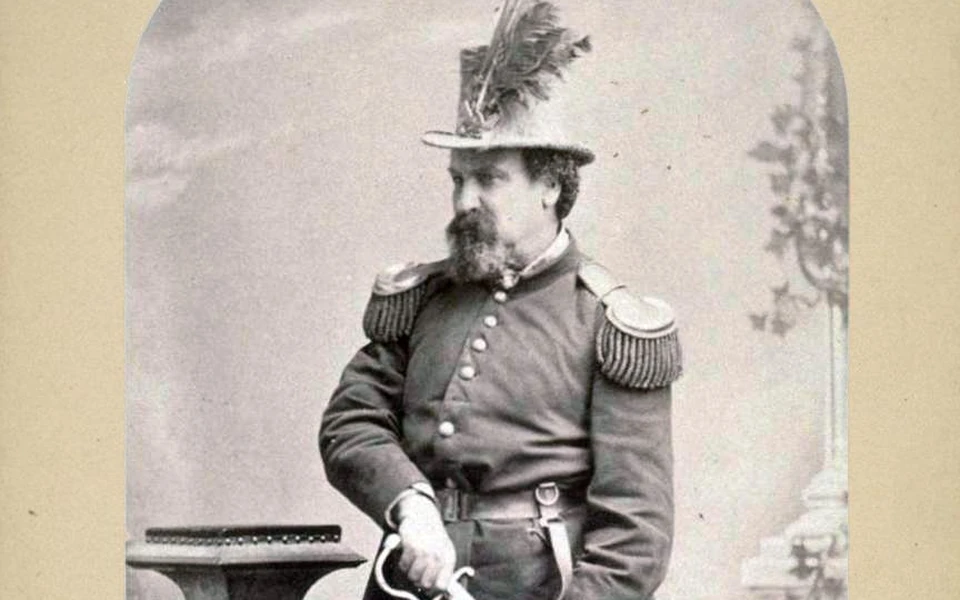
An emperor also needed to be recognizable outside a newspaper column. Norton wore military clothing, elaborate shoulder ornaments, and distinctive hats, making his presence unmistakable on the street. Portrait photographs preserve that carefully assembled appearance. His life depended on public generosity and support from acquaintances, supplemented by sales of imperial paper notes. The surviving objects do not turn him into a sovereign with a real treasury. They reveal how a public character could use the forms of authority, including a uniform and printed promises, while living in very modest circumstances.
A bridge ordered into existence
Among Norton's most substantial proposals were his 1872 calls for a crossing between Oakland and San Francisco by way of Goat Island, now Yerba Buena Island. The Pacific Appeal printed proclamations advocating a bridge and, separately, investigation of an underwater railway tunnel. The route was more than a vague wish that distant shores might somehow be joined. It named places and demanded surveys or construction. These notices are especially useful because readers can examine the language themselves, rather than rely entirely on later memories of what the emperor supposedly foresaw.
His March bridge proclamation included a condition that construction should not damage navigation in the bay. A September notice complained that the authorities had ignored his earlier demands and threatened their arrest. Nothing in these texts gave Norton the engineering resources or legal authority to complete a crossing. The combination is nevertheless revealing: he could raise a practical infrastructure question while expressing frustration through theatrical commands. The eventual Bay Bridge, opened in 1936, made the older proclamations newly resonant, although Norton neither designed that structure nor directed the project that built it.
A public figure and the stories around him
Newspaper attention also makes his history difficult to separate from invention. Editors published fabricated proclamations, and later retellings added attractive anecdotes. The much-repeated story that he imposed a fine for saying Frisco lacks a secure contemporary source. Norton researchers have also challenged exaggerated descriptions of the procession at his funeral. These cautions do not require discarding the public affection he attracted. They ask a more useful question of each anecdote: is this an identifiable contemporary record, a later recollection, or a story repeated because it perfectly suits a familiar character?
Norton died in January 1880, still without the wealth his imperial title suggested. His continued presence in San Francisco's memory rests partly on that mismatch between ceremonial grandeur and material poverty. The portrait accompanying this story records a real person wearing his chosen public identity; the proclamations record real interventions in civic conversation. Together they support a history more interesting than an uncomplicated joke about America's emperor. A person without formal power found ways to be seen and heard, while the city helped turn his everyday visibility into an enduring local tradition.