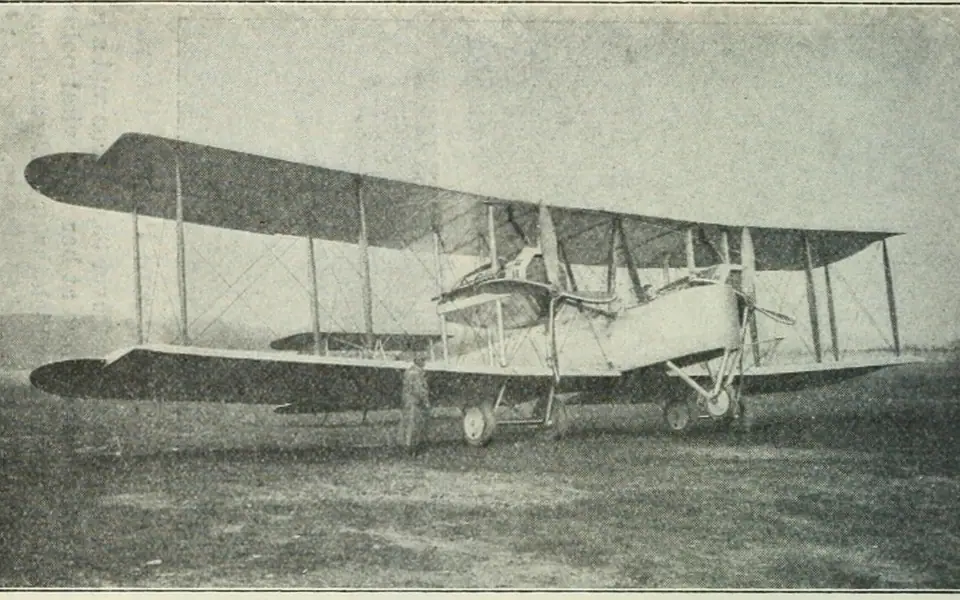
An ocean crossed, a bog mistaken for a field
On June 15, 1919, a Vickers Vimy came down nose first in a bog near Clifden in western Ireland. Its pilot, John Alcock, and navigator, Arthur Whitten Brown, had left St. John's, Newfoundland, the previous afternoon. The unhappy-looking landing completed the first nonstop flight across the Atlantic Ocean. After roughly sixteen hours in the air, the two men had demonstrated that an airplane could cross the ocean without stopping to refuel. Their achievement ended on soft ground, but it began with a much larger organization of ships, workshops, mechanics, and people preparing a field.
The challenge had been waiting since before the First World War. In 1913 the Daily Mail offered a £10,000 prize for a transatlantic flight, then suspended the competition during the conflict. Newfoundland's position made it an attractive starting point when attempts resumed. It lay closer to Europe than other parts of North America, and prevailing winds favored an eastward crossing. Several teams gathered there in 1919. Choosing Newfoundland did not mean finding a ready airport: participants had to identify suitable fields, improve their surfaces, assemble shipped aircraft, and wait for weather that made departure possible.
A bomber and the work before departure
The Vimy made the scale of the venture visible. Originally designed as a heavy bomber, it used a largely wooden structure covered with fabric and two Rolls-Royce Eagle engines. The Science Museum's surviving aircraft record gives its fuel capacity as 3,932 litres. Such details place the flight between familiar images of fragile early airplanes and the enormous demands of ocean travel. The machine needed enough fuel for a journey with no intermediate landing. Its military origins also reveal a wider transition: aircraft developed for wartime purposes were being adapted to journeys imagined as peaceful connections between continents.
Documents in Cambridge University Library's Vickers archive recover some of the less spectacular preparation. A May 1919 shipping receipt records the aircraft, a hangar, and drums of fuel consigned to St. John's aboard the Glendevon. After arrival, the Vimy was assembled near Quidi Vidi and made a trial flight on June 9. A telegram reported progress, including difficulty with the wireless transmitter. Mechanics, carpenters, and riggers accompanied the expedition. Their presence matters because the photograph of two men in a cockpit can conceal the number of skilled hands required to put those men there.
Navigation, weather, and a difficult arrival
Crossing the ocean separated the crew from that support. Fog, ice, mechanical trouble, and failed wireless communication made the flight an exercise in judgment under uncertainty. Brown's navigation logs and chart, preserved by the Royal Air Force Museum, provide a material record of the effort to stay on course. The crew also carried food, warm drinks, and toy cat mascots. Brown's cat was called Twinkletoes; Alcock's was Lucky Jim. These small possessions bring the venture back to human scale. A long flight involved sustaining concentration and comfort as well as calculating direction and controlling the airplane.
Ireland offered land without offering an easy conclusion. The men mistook boggy ground for a suitable landing field, and the Vimy's nose dug in. Both survived unhurt. Accounts from major museums and heritage bodies give slightly different elapsed times, so treating the crossing as an achievement of about sixteen hours is more secure than pretending that every historical record agrees to the minute. The essential sequence is well established: departure on June 14, arrival on June 15, and an uninterrupted flight from Newfoundland to Ireland. The damaged airplane had fulfilled its purpose even though its arrival looked like an accident.
Remembering the people behind the flight
Celebration produced objects and documents of its own. King George V knighted the aviators, while people in St. John's presented Alcock with a silver cup now held by the Science Museum Group. It records the pride of a community that had watched the preparations closely. Cambridge's archive also preserves evidence that the flyers recognized the workers behind their success: they gave part of their prize money to the Vickers works, and the company added to it to provide a bonus. Public memory could center on two names while the participants themselves acknowledged a broader industrial contribution.
Their particular claim was the first nonstop crossing by airplane. The American Navy's NC-4 flying boat had already crossed the Atlantic in stages that May, using intermediate stops. Keeping those achievements distinct gives each its proper place. The Vimy did not immediately create routine passenger service, but it showed that one long flight could join the two sides of the ocean. Its preservation in the Science Museum lets visitors inspect the physical machine behind that proposition. Logs, shipping papers, and the commemorative cup add another lesson: a famous aviation first was also a project of navigation, logistics, manufacturing, and shared work.