An eruption before the missing summer
In the summer of 1816, farmers in parts of Europe and North America confronted weather that seemed to have misplaced the season. Frost damaged crops in New England, while unusually cold, wet conditions troubled European harvests. The disaster's most important volcanic cause lay far from either region. Mount Tambora, on the Indonesian island of Sumbawa, had erupted the previous April, with its most violent explosions on April 10–11, 1815. What happened around that tropical mountain eventually became part of the explanation for a northern growing season remembered as the Year Without a Summer.
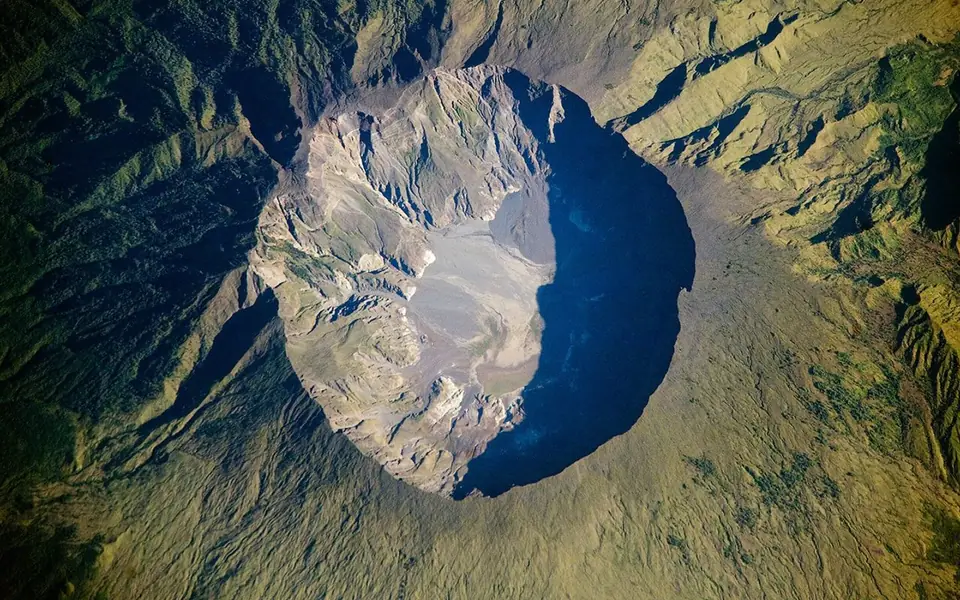
The first catastrophe belonged to the people living near Tambora. Hot mixtures of gas and volcanic debris swept down the mountain and destroyed villages. Flows entering the sea generated tsunamis, extending the destruction beyond the slopes. The summit itself changed dramatically, leaving a caldera about six kilometers across. This local devastation should remain central to the story, even when distant European weather attracts more attention. A farmer thousands of kilometers away might experience an unfamiliar frost; a community on Sumbawa could lose its homes, fields, and people before the wider atmospheric effects had developed.
How sulfur changed the sunlight
The connection between an eruption and a later cold summer depends on more than a cloud of visible ash. Much volcanic ash settles out within days or weeks. Sulfur dioxide reaching the stratosphere can undergo chemical changes that produce fine sulfate aerosols. These particles reflect some incoming sunlight back into space, reducing the energy available to warm the lower atmosphere and surface. An eruption can therefore affect places untouched by its falling debris. The mechanism also explains why the climatic disturbance can outlast the spectacular explosions that first announce a volcanic disaster.
Yet the phrase Year Without a Summer should not be read as a uniform description of every place and day. Regional circulation and ordinary weather variability still mattered. A 2019 attribution study examined the exceptional European season using observations and climate models. Similar atmospheric pressure patterns could explain much of the unusual wetness, but only around a quarter of the exceptional cold. Adding Tambora's volcanic influence made the cold conditions much more likely in the simulations. That result supports a powerful volcanic contribution without making every storm or failed field the direct product of one mountain.
From damaged crops to weather diaries
For households dependent on a successful harvest, a disrupted summer became a problem of food and prices. Repeated New England frosts damaged major crops, and agricultural failures helped push some farmers toward migration. In Europe, harvest losses brought rising food prices and unrest. The effects joined a physical event to social conditions: cold could damage grain, but access to food also depended on what families could buy or obtain. A small change in seasonal averages could conceal a devastating sequence of bad days arriving when crops were especially vulnerable. The crisis was lived through meals, markets, and decisions about staying or leaving.
Reconstructing that sequence requires records more precise than a memorable nickname. A research project described in a 2015 paper assembled more than fifty series of observations taken several times a day, concentrating on 1815–1817. Material came from European and North American land observatories and from ships in the tropics. Investigators recovered measurements preserved in weather diaries, newspapers, and contemporary magazines. They corrected pressure readings for factors such as temperature, gravity, and station elevation. Those practical adjustments help turn scattered nineteenth-century entries into evidence that can be compared across places and used to examine particular weather situations.
A crater and a connected history
The accompanying photograph offers a different kind of evidence. Taken by the International Space Station's Expedition 20 crew in 2009, it shows Tambora's immense caldera long after the eruption. Layers of volcanic deposits remain visible along the rim, while later deposits and volcanic activity have altered the floor. The image records the surviving landscape, rather than the eruption itself or the weather of 1816. Its scale gives the historical account a physical anchor: the atmospheric event that affected distant harvests began with a violent rearrangement of a real mountain and the destruction of nearby communities.
Tambora's aftermath connects histories that are often told separately: an Indonesian eruption, a European subsistence crisis, North American farming decisions, and the slow preservation of weather measurements. The connection becomes more convincing when each kind of evidence keeps its limits. A crater cannot reveal the price of bread, and a cold diary entry cannot by itself identify a volcano. Together with geological investigation and climate research, however, these records show how an environmental shock could cross oceans and enter everyday life. The apparently missing summer was part of a much larger chain of events.