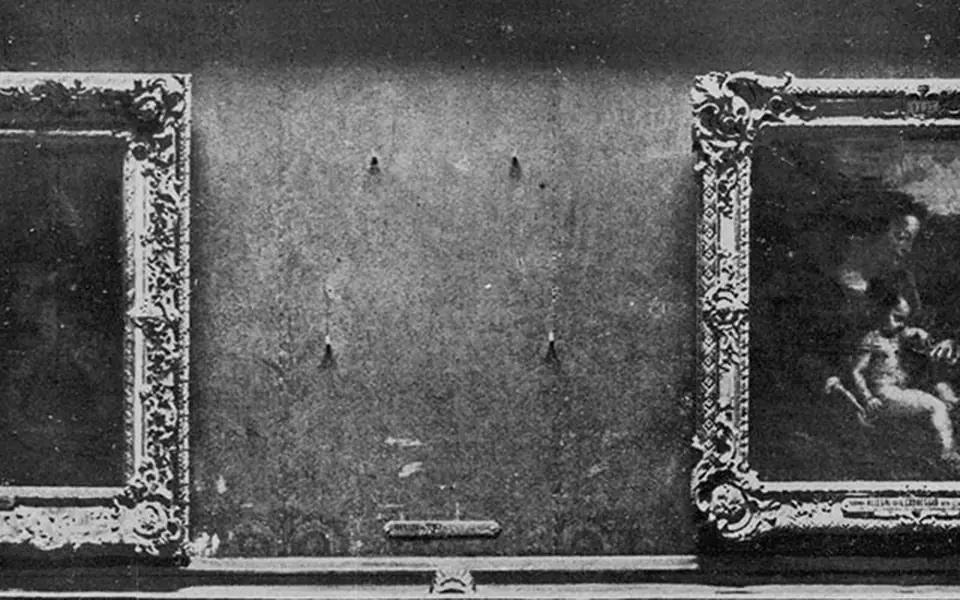
A famous portrait disappears
On August 21, 1911, Leonardo da Vinci's Mona Lisa was stolen from the Louvre. The painting's disappearance created a mystery far larger than its modest wooden panel. News traveled beyond museum visitors and art specialists, while promised rewards failed to bring an immediate solution. For more than two years, the portrait remained missing. Its absence became part of its public identity: people who might never have studied Leonardo's technique encountered the woman's face as an image associated with an astonishing failure of security at one of the world's best-known museums.
The man responsible, Vincenzo Peruggia, was a glazier who had previously worked at the Louvre. His connection with the building helps explain why this was not simply a stranger overcoming an unfamiliar fortress. Museum collections depend on workers who install, move, protect, and maintain objects, and such practical access can create opportunities alongside its ordinary purposes. Peruggia later described entering and leaving as though he were an employee on duty. The painting had already been admired before the theft; its subsequent celebrity should not obscure the artistic reputation that made its disappearance important in the first place.
Newspapers and a letter to Florence
Newspapers transformed the missing portrait into a continuing public story. The Library of Congress gathers contemporary coverage through its Chronicling America guide, allowing readers to follow reports of the theft, changing security measures, the recovery, and the later trial. These articles are evidence of what audiences were told, rather than a guarantee that every rumor was correct. Their repeated attention nevertheless mattered. A work confined to a gallery could now appear in newspapers far from Paris, accompanied by speculation about its location. The circulation of the story widened the audience for the image itself.
The decisive approach came from the thief. In November 1913, Peruggia wrote to the Florentine dealer Alfredo Geri using the name Leonard V. He had found Geri through a newspaper advertisement and proposed returning the painting to Italy. The correspondence combined claims of national feeling with a proposed financial transaction. Those two elements should remain together, rather than letting a later patriotic explanation replace the evidence of negotiation. Geri wanted the work examined before an agreement. Their exchange brought a hidden object back into contact with people capable of recognizing it.
A hotel inspection and an expanding case file
Peruggia reached Florence on December 10 and stayed at the Hotel Tripoli. The following afternoon he met Geri and Giovanni Poggi, director of the Uffizi galleries, without understanding Poggi's official role. At the hotel, he produced the painting from its container. Poggi proposed taking it to the Uffizi for closer examination, using the limited light as a reason. Peruggia agreed and waited for further contact. On December 12, police arrested him. The sequence preserved by the State Archives of Florence separates the inspection and removal of the painting from the arrest that followed a day later.
The investigation generated a different kind of portrait: documents describing movements, belongings, and explanations. Police seized a suitcase and a wooden chest with a false bottom from the hotel room. The case file also brought together French reports, testimony, letters, and photographs of the empty museum space and the discarded frame. Peruggia insisted that he had acted alone, while investigators examined possible connections to friends and relatives. Their suspicions should not automatically become established accomplices in a retelling. The surviving paperwork shows authorities testing a confession against a wider body of evidence.
The public journey back to France
Recovery did not mean an immediate journey back to the Louvre. The portrait was publicly displayed at the Uffizi from December 14 to 18, 1913, then traveled to Rome, where it was formally handed to the French ambassador on December 21. Further Italian displays followed, including a crowded appearance in Milan. The painting left Milan for France on December 30. This carefully managed return turned a criminal recovery into a sequence of public and diplomatic occasions. An object that had disappeared into private concealment reentered view through galleries, official custody, trains, and organized audiences.
The story is sometimes compressed into the claim that theft invented the Mona Lisa's fame. That overlooks the painting's earlier status while missing the more interesting change: an admired artwork became the focus of an international news narrative. The Louvre itself describes the recovered painting's greater renown. Photographs of its vacant place preserve another aspect of that transformation, because even an empty wall could stand for the missing portrait. Peruggia removed a physical object from a museum, but the reports, reproductions, investigation, and public return helped carry its recognizable image much farther than he could have transported the panel.