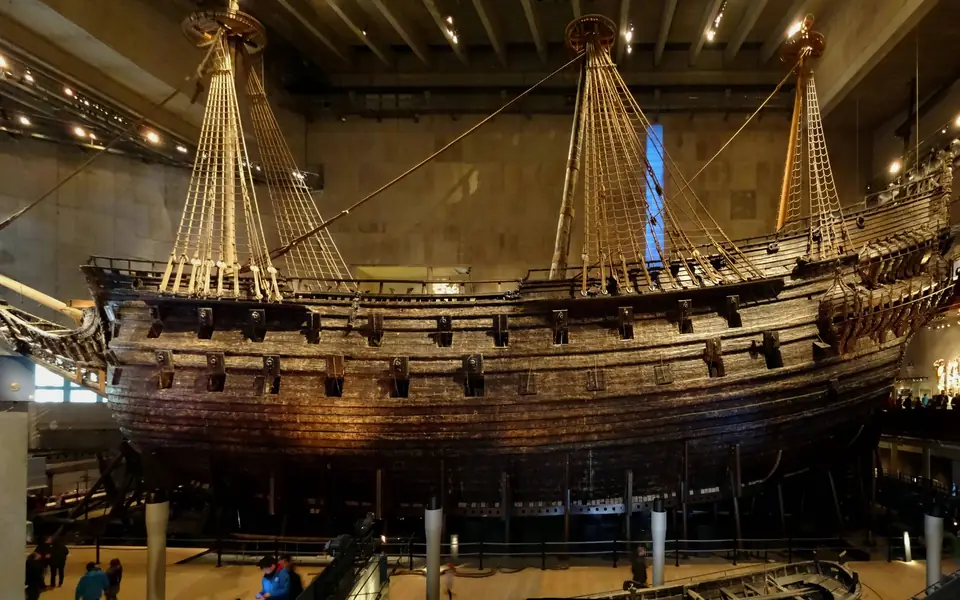
A launch with warning signs
On August 10, 1628, Stockholm watched a splendid new warship set out and then disappear into the harbor. Vasa traveled only about 1,300 meters before a gust heeled the ship and water entered its open gunports. Within minutes, a vessel built to advertise Swedish power lay on the bottom. The disaster gave the ship a second, very different career. Centuries later it would become an extraordinary archaeological object, surviving long enough for modern engineers to confront a problem its builders had never anticipated: how to preserve an entire wooden warship in a museum.
The warning had been visible before departure. During a stability demonstration, thirty men ran from side to side across the deck, causing alarming rolling. The test was stopped. The ship nevertheless sailed, carrying heavy upper works on a hull that could not provide adequate stability. The later inquiry heard officers and builders defend their actions. Vasa's sinking was therefore more than a sudden encounter with bad weather. It exposed a failure to turn an observed danger into a decision that kept the vessel in port. Its ornate appearance and formidable armament offered no protection against the physical consequences of an unstable design.
Finding and raising the wreck
Recovering valuable equipment began long before recovering the hull. Divers using a diving bell brought up most of the cannon in the 1660s. The ship itself remained submerged. In 1956, Anders Franzén's search produced plugs of waterlogged oak, and divers confirmed that a large ship with two levels of gunports lay below. Franzén then helped assemble the technical and institutional support needed for a much more ambitious operation. The task involved many kinds of expertise. Finding a wreck did not establish that it could be raised safely, much less that it would survive afterward.
Divers excavated passages beneath the hull so lifting cables could be threaded underneath. Pontoons supplied the lifting force: filling them with water lowered them, while pumping water out made them rise with their burden. The ship was freed from the mud in 1959 and moved underwater toward shallower water. Further work prepared the damaged hull for its final ascent. On April 24, 1961, Vasa emerged into daylight after 333 years below. The long operation depended on controlled stages, rather than one spectacular pull by an oversized crane.
The challenge after the rescue
Once aboard, archaeologists faced a dense deposit of objects and mud. Pumps removed water while divers inspected the hull and plugged leaks. Excavation recovered evidence of ordinary shipboard life alongside the imposing structure. Objects had to be recorded and treated according to their materials. A ship could preserve relationships among things that would become much harder to understand if they were simply collected as separate curiosities. The excavation consequently mattered as much as the lift itself: recovering wood and equipment without their context would have sacrificed part of what made the wreck exceptional.
Drying posed the next danger. Waterlogged wood can shrink and crack badly when its water evaporates. Conservators selected polyethylene glycol, a water-soluble polymer, to support the weakened material. The hull was sprayed with the treatment from 1962 until 1979, followed by years of controlled drying. Smaller wooden objects could be treated in tanks, while other materials required different methods. Preservation became a major experiment whose lessons informed later wreck projects. Vasa's short voyage thus led to decades of patient work. The museum ship represents two achievements at once: seventeenth-century craftsmanship that survived a disastrous design, and modern conservation that made that survival visible.