A city reached through the sky
On June 26, 1948, American transport aircraft began carrying supplies into western Berlin. Two days earlier, Soviet authorities had blocked the principal surface routes connecting the Western occupation sectors with western Germany. An emergency that might have produced a military confrontation instead produced an extraordinary transport operation. For people watching the aircraft arrive, the cargo mattered more immediately than the diplomatic arguments: food had to reach kitchens, and fuel had to keep essential services working. Yet every successful delivery also demonstrated that the Western powers could maintain their position in a city surrounded by Soviet-controlled territory.
Berlin's vulnerability came from the settlement after the Second World War. Germany was divided into occupation zones, while its former capital was separately divided into four sectors despite lying deep inside the Soviet zone. Wartime cooperation had given way to disputes over reconstruction, political authority, and the future German economy. Western plans for a new state and competing currency reforms sharpened those disagreements in 1948. The blockade therefore did not surround an independent West German capital. It restricted access to the western sectors of a jointly occupied city whose status remained unresolved.
An international route and its destinations
Air access offered a route through the crisis because agreed corridors linked Berlin with the western zones. The American operation acquired the name Vittles; the British effort became Plainfare. The Royal Air Force Museum dates the first American supply airlift to June 26 and the beginning of British operations to June 28. This sequence matters because a familiar photograph of one aircraft can make the entire undertaking look like a single national mission. During the following months, crews from Australia, South Africa, and New Zealand also joined the expanding British effort.
Keeping a city supplied required more than finding aircraft with enough empty space. Coal formed a large part of the necessary cargo, making the airlift an energy operation as well as a food operation. Existing airports also had limits. Tempelhof served the American sector and Gatow the British sector, while a third airport was built at Tegel in the French sector. The Allied Museum records approximately nineteen thousand men and women completing Tegel in only three months. The supply route depended on people building and maintaining its destinations, alongside those flying toward them.
Unloading and organizing the airlift
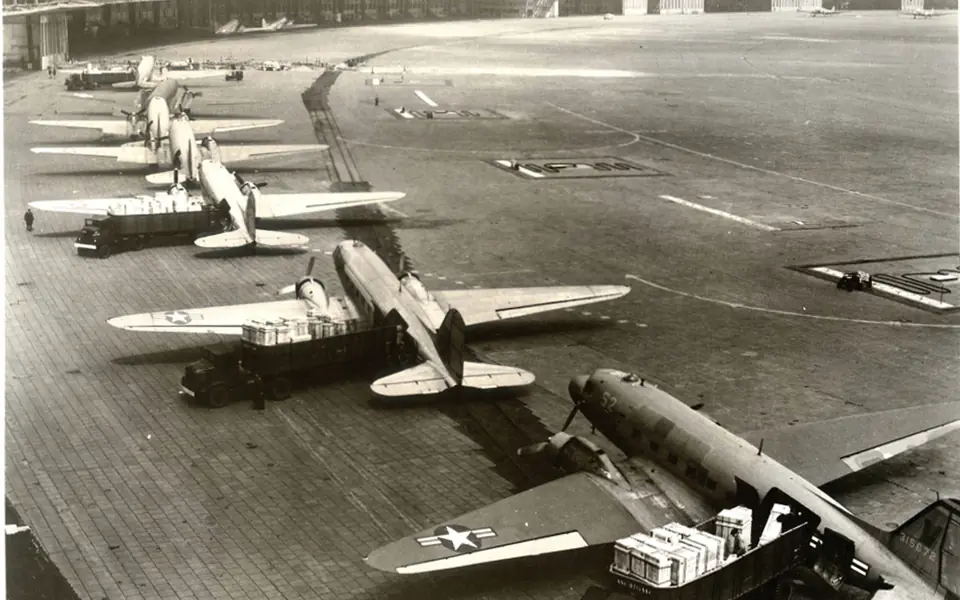
An archival Air Force photograph shows C-47 transports waiting in an unloading line at Tempelhof, with trucks drawn up beside them. Its original caption emphasizes the variety arriving in the smaller aircraft, from engine crates to milk bottles. That ordinary detail explains a central difficulty. Ground crews had to receive unfamiliar loads quickly, while keeping the next aircraft moving. The cargo was useful only after leaving the airplane and entering the city's distribution system. The photograph turns an apparently simple line of parked transports into evidence of coordinated work on the ground.
William H. Tunner helped make the operation increasingly systematic. Larger C-54 transports carried more cargo, while using aircraft with similar performance made scheduling easier. Radio, radar, and ground-controlled approaches helped crews continue in difficult weather. Fast unloading also reduced the time aircraft occupied scarce airport space. Pilots remained near their machines while vehicles brought refreshments, operational information, and maintenance assistance. This was a chain in which delays could spread: an aircraft held on the ground could disrupt the arrivals behind it. Reliable repetition mattered at least as much as any individual feat of flying.
Small parachutes and two different endings
Human contact gave the immense operation a more intimate memory. Pilot Gail Halvorsen began dropping small parcels of sweets attached to makeshift parachutes for children near Tempelhof. The gesture developed into Operation Little Vittles, drawing donations and public attention. These parcels never replaced the coal and food on which the city depended, but they gave people a visible sign of concern from crews who otherwise passed overhead. The larger achievement remained dangerous. Bad weather, fatigue, and accidents killed aircrew and other workers, a cost that belongs beside the familiar images of children waiting for candy.
The blockade ended on May 12, 1949, but the airlift continued so that supplies could accumulate against renewed disruption. Those are different endings: reopening a railway did not instantly make the emergency transport system unnecessary. American airlift flights ended in September, with the final British flights following in October. Berlin remained divided, and the underlying Cold War conflict continued. The operation's importance lies partly in that limited result. It did not settle Europe's political future, but a vast organization of flying, construction, unloading, and distribution sustained a population while avoiding a battle over the blocked roads.