A uniform on a civil rights stage
At the March on Washington for Jobs and Freedom on August 28, 1963, Josephine Baker appeared in uniform with the decorations of her wartime service. Audiences knew her as a performer who had transformed Parisian entertainment, but the clothing presented another part of her history. The same woman who had made a career from being noticed had also used her public reputation to conceal intelligence work. Her presence in Washington connected a childhood in segregated Missouri, a European stage career, resistance to Nazi domination, and a continuing struggle for equal rights in the country where she was born.
Baker was born Freda Josephine McDonald in St. Louis on June 3, 1906. Poverty and racial discrimination limited the possibilities around her, and work began early. Performance nevertheless offered a path she could develop through practice. She joined traveling entertainers and later found work in New York, including chorus roles associated with the flourishing Black theatrical culture of the Harlem Renaissance. Comic timing helped her distinguish herself within an ensemble. A deliberately surprising movement or expression could draw an audience's attention to a dancer who otherwise occupied the background. That experience made humor, as well as physical skill, central to her stage identity.
Paris, performance, and citizenship
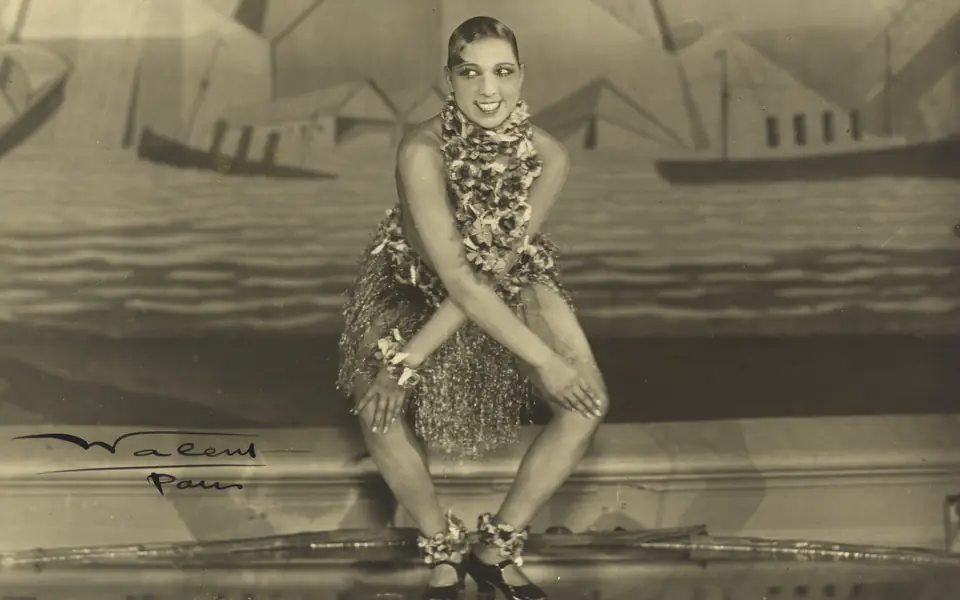
In 1925 she traveled to Paris, where La Revue Nègre brought her rapid success. French audiences were fascinated by American jazz and by imagined versions of African cultures. That fascination offered opportunities while also carrying colonial stereotypes. Baker's famous costumes and energetic dancing belonged to this complicated setting, rather than to a society entirely free of racism. She developed a performance style that could answer expectations with comedy and exaggeration, making herself a distinctive artist within a show assembled for a largely white audience. Her subsequent singing and film work expanded a career that is too often reduced to one costume or one photograph.
France became more than a touring destination. In November 1937, Baker married Jean Lion and sought French nationality through a declaration recorded at Crèvecœur-le-Grand. The Archives nationales preserves documents from that process, including the declaration dated November 30. Such records anchor a story sometimes retold with conflicting dates. They also show the usefulness of looking beyond the celebrity image to the administrative evidence of a life. Citizenship, marriage, property, and travel involved paperwork as well as personal choices. Baker's attachment to France would soon take a form that placed her artistic reputation in the service of a much more dangerous undertaking.
Fame as a tool of resistance
During the Second World War, Baker worked with French intelligence and supported the Resistance. Her fame created access to social gatherings where useful information circulated, while touring offered a plausible reason for travel. Accounts from the French national archives describe reports and photographs hidden with her clothing and coded material carried among musical scores in invisible ink. The mechanism depended on expectations about an entertainer's belongings: costumes, luggage, and sheet music looked like ordinary tools of her profession. She also sheltered people at Les Milandes and performed to support military morale. Intelligence gathering and public entertainment were connected activities within her wartime service.
Those efforts received official recognition, including the Resistance Medal and the Legion of Honour. The honours did not remove the discrimination Baker encountered when she returned to the United States. She opposed segregated audiences and used the commercial value of her appearances to press venues toward change. The National Park Service records her work with the National Council of Negro Women, including a benefit performance in Washington in 1952. These relationships placed her within organized activism, alongside people whose work rarely attracted comparable celebrity attention. An international reputation gave her influence, but organizations and local campaigns provided the collective setting in which that influence could matter.
Speaking for equal treatment
Her 1963 appearance at the March on Washington made those connections especially visible. Wearing her French military uniform brought the authority of wartime service into a gathering demanding jobs and freedom. Baker was among the few women given an opportunity to address the audience, in a movement whose prominent women frequently faced restricted speaking roles. She contrasted the welcome available to a celebrated performer abroad with the humiliations imposed by segregation at home. The comparison challenged the idea that professional achievement was enough to secure equal treatment. Her career could open palace doors while racial barriers still obstructed ordinary American hotels and restaurants.
Baker's personal ambitions also reached beyond the stage. At Les Milandes she raised adopted children from different backgrounds and presented the family as an example of people living together across national and racial divisions. Maintaining the estate proved financially difficult, and she eventually lost it, continuing to perform despite that setback. She died in April 1975 after a late return to the Paris stage. France honoured her at the Panthéon in 2021, recognizing a life that joined art, resistance, and civil rights. Her history is richest when these activities remain connected: a public identity could provide pleasure, create opportunity, shelter secret work, and make injustice harder to ignore.