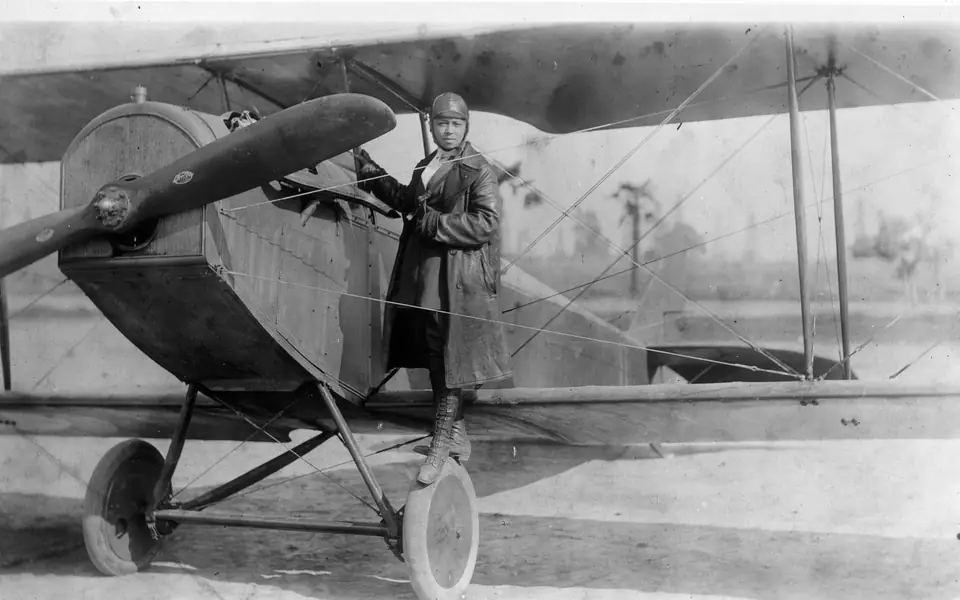
A license earned beyond American barriers
On June 15, 1921, Bessie Coleman received an international pilot’s license after training in France. The certificate recognized a skill that American instructors had refused to help her acquire because she was Black and a woman. Smithsonian historians identify her as the first African American woman and the first woman with Native American ancestry to earn a pilot’s license. Other women had already qualified as pilots; her distinction concerns barriers that made their route unavailable to her. Coleman’s achievement began with crossing an ocean, but its purpose would extend beyond her own cockpit.
Coleman was born in Atlanta, Texas, in 1892, into a large family, and later joined relatives in Chicago. There she worked as a manicurist, a trade that offered an income while she considered a different future. Accounts of wartime aviation, including her brother’s descriptions of women flying in France, encouraged her interest. The contrast was striking: aircraft promised movement across boundaries, while the institutions teaching people to operate them maintained familiar exclusions. Aspiration alone could not solve that problem. She needed instruction, money, and a place prepared to admit her.
Training for a profession, then for a spectacle
Robert S. Abbott, publisher of the influential Black newspaper the Chicago Defender, advised her to look to France. Coleman studied French and gathered savings and support before traveling abroad in 1920. The Caudron Brothers School of Aviation accepted her, providing a serious course of instruction rather than a ceremonial opportunity. She learned in a dual-controlled trainer and completed the training needed for her certificate. The surviving license supplies a precise date for the milestone. It also represents months of practical preparation, language learning, and financial effort that a simple list of aviation firsts can overlook.
Returning with a license did not make every kind of flying equally safe or every career accessible. Coleman sought further European training for the aerobatic work that could support her in the United States. During the barnstorming era, pilots attracted paying crowds through exhibitions rather than the scheduled passenger services familiar today. Loops, dives, parachuting, and other performances turned flight into a public spectacle. Coleman became known as Queen Bess and Brave Bessie, names that helped audiences recognize a performer whose professional reputation depended on skill as well as publicity.
The cost of flying and the terms of admission
Exhibition flying carried substantial physical and financial risk. Barnstormers used aircraft such as Curtiss Jennies, surplus machines associated with military training during the First World War. Buying an airplane did not remove the expense of maintaining it, and a damaged machine could interrupt both flying and earnings. In 1923, Coleman survived a crash after an engine stall, suffering serious injuries while her aircraft was destroyed. Recovery meant rebuilding the resources behind her career as well as healing her body. Her lecturing continued during a period when regular flying was harder to sustain.
Coleman used her position to challenge exclusion on the ground, although the results were sometimes partial. The National Women’s History Museum describes a performance in Waxahachie where organizers planned separate entrances for Black and white spectators. She insisted on a shared entrance as a condition of appearing. Organizers agreed, but the audience remained segregated inside. That outcome matters: reducing one barrier did not erase the wider system. At a proposed whites-only event in Orlando, her threat to withdraw helped secure admission for Black spectators. Her negotiating power came from the crowd she could attract.
Telling her story and extending her ambition
Performing also meant arranging appearances and controlling how her story reached the public. A February 1926 letter to Norman Studios, reproduced by the National Women’s History Museum, describes her efforts to interest a filmmaker in her life and in footage of her flights. It presents a working professional seeking another outlet for an established reputation. The proposed film did not materialize. The letter nevertheless complicates the image of a pilot concerned only with daring maneuvers: Coleman understood that lectures, motion pictures, and personal appearances could carry her aviation work to audiences beyond an airfield.
On April 30, 1926, Coleman died during a preparatory flight in Jacksonville, Florida. William Wills was flying while she examined the ground for a parachute landing place; she was unfastened, and the aircraft’s loss of control threw her out. Wills also died. Her ambition to open a school for Black aviators remained unfinished, but it continued through others, including William Powell’s aviation organizing and a school named in her honor. Her license had proved that exclusion from instruction was not evidence of inability. Her broader legacy joined that demonstration to the practical work of widening access.