A familiar syrup, an enormous reservoir
Molasses sounds like an unlikely source of a city disaster. Its everyday reputation is thick, sweet, and slow. Yet shortly after midday on January 15, 1919, a large storage tank in Boston’s North End failed, releasing roughly 2.3 million gallons across Commercial Street. The flood damaged buildings and the elevated railway and ultimately killed twenty-one people. Familiar kitchen experience offered little preparation for the behavior of an enormous liquid mass released from height. The catastrophe was strange in its material, but brutally ordinary in its consequences for people living and working nearby.
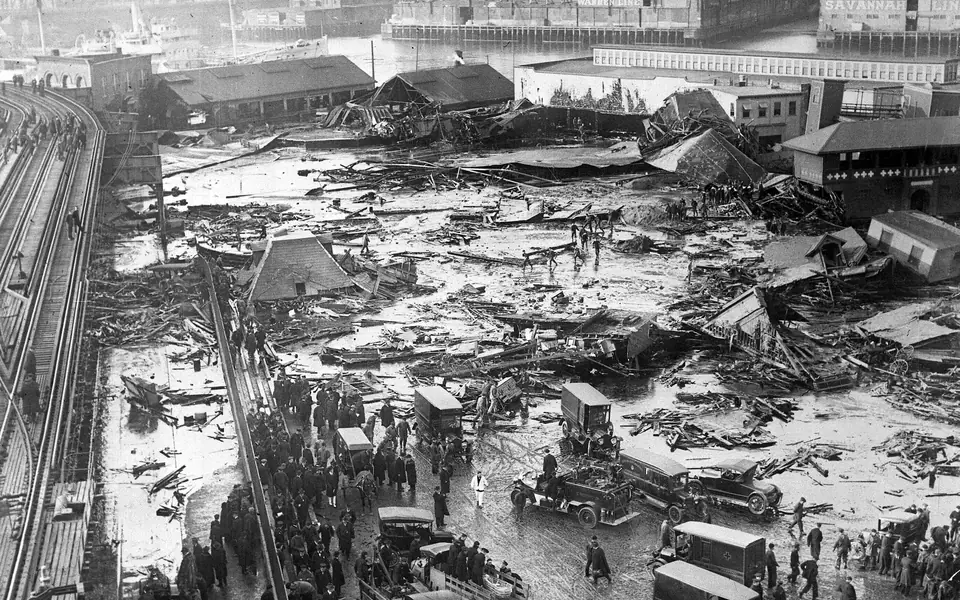
The tank stood on the waterfront where molasses arrived by ship and could be transferred onward by rail. Its purpose was tied to distilling alcohol, rather than merely supplying household baking. Industrial convenience had placed a huge reservoir beside an active neighborhood. Boston City Archives photographs show the facility before the collapse, then the broken infrastructure and wreckage afterward. The images help explain why an incident inside one company’s storage system became a public disaster: the waterfront’s transport routes, workplaces, and residences were closely connected, with little physical separation from the tank.
The tank and the people around it
The structure had a history that investigators could examine. It was built in 1915, and accounts describe leakage during its years in service. A major shipment was pumped in on January 12, 1919, leaving the tank close to capacity. When it gave way three days later, the release did not proceed like syrup poured cautiously from a bottle. The liquid suddenly lost its enclosing walls. Broken steel and escaping molasses entered the surrounding area together, producing destruction that witnesses compared with an explosion or a wave from the sea.
Initial reporting struggled to establish the scale of the loss. The Boston Post on January 16 described wrecked buildings, twisted railway supports, dead animals, and people caught in the sticky flood. Its overnight count of the dead was still incomplete. That difference between an early report and the final toll matters. Contemporary newspapers preserve the urgency of discovery, but their first numbers were not the settled result of the rescue and recovery effort. Twenty-one people died, and about 150 were injured; the victims included both adults carrying out daily work and children.
Why thick liquid could become a fast wave
The apparent contradiction between viscosity and speed later attracted fluid researchers. In a 2016 American Physical Society presentation, Nicole Sharp, Jordan Kennedy, and Shmuel Rubinstein examined the disaster using fluid dynamics and the material’s response to temperature. Their abstract describes molasses as substantially denser than water and much more viscous. Contemporary estimates of the initial wave’s height and speed were part of the evidence they considered. These were historical estimates, not readings from instruments placed in the street, but they conveyed a violent release rather than a gentle spread.
The research also helps distinguish the beginning of a flood from its aftermath. A large reservoir can drive a fast initial flow even when its contents resist motion. As the material spreads and cools, resistance can increase, making escape and rescue more difficult. The investigators explored those changing conditions rather than treating molasses as a substance with one fixed, everyday behavior. A victim’s danger could come from impact, collapsing structures, or becoming trapped in the remaining syrup. The same material that moved rapidly at first could later hold people and debris in place.
Investigating responsibility
Responsibility was disputed after the collapse. The company advanced the possibility of sabotage, but a prolonged legal investigation concluded that the tank’s construction was defective. The Massachusetts account records the 1925 finding against United States Industrial Alcohol, the owner, after extensive testimony. The significance was not that an unusual accident had been given a tidy ending. Residents and other claimants had to establish that this was a failure of an industrial structure for which an enterprise could be held responsible, rather than an inexplicable disaster imposed on the neighborhood.
The surviving photographs are often used because a street covered in molasses is hard to imagine. They also show something less exotic: damaged transport, ruined work sites, and a community forced to recover. The event is best remembered through both kinds of evidence. Physical research explains why the flood could be so dangerous; archives and court history show the people, business decisions, and aftermath around it. The kitchen comparison makes the story surprising, but the deeper issue is how an ordinary commercial material became hazardous when stored on a scale its surroundings could not safely absorb.