A small deployment with a large nickname
On November 2, 1932, three Australian artillery soldiers arrived in the Campion district of Western Australia to help farmers deal with emus damaging wheat crops. The assignment would become famous as the Emu War. The name invites an image of a nation fighting a feathered enemy, but the actual deployment was very small. An officer and two men had been sent to perform a wildlife-control job using military equipment. The mismatch between the task’s agricultural purpose and its martial appearance supplied newspapers with an irresistible story almost immediately.
For farmers, the situation was serious. Soldier settlement after the First World War had encouraged returned servicemen to build new livelihoods on the land. The Depression then pushed down wheat prices, making crop losses harder to bear. Emus moving into cultivated country consumed or damaged grain and broke fencing. Farmers asked Defence Minister George Pearce for assistance, and he approved a military response. The appeal treated machine guns as a practical answer to crop losses. Familiarity with a powerful weapon, however, did not establish that it suited dispersed animals in open country.
The birds and the changed landscape
The emus were responding to conditions rather than conducting a campaign. The Australian Museum describes them as mobile birds whose movements depend on available food and water. They may travel hundreds of kilometres to find suitable resources, and water provided for livestock can favor their survival. Their tall bodies, powerful legs, and reduced wings make them well adapted to movement on the ground. Farming had changed the landscape and created attractive resources. From an ecological perspective, the birds’ arrival was an interaction with those changes, not an inexplicable eruption of hostility.
The soldiers, commanded by Major G. P. W. Meredith, carried Lewis machine guns. The early attempts failed to produce the concentrated targets the equipment needed. Birds scattered and moved beyond useful range instead of remaining together in a stationary mass. An ambush near water also went badly when a gun jammed. The episode illustrates a practical limitation often hidden by a weapon’s impressive firing rate: bullets can be discharged quickly without solving the problems of locating, approaching, and accurately engaging moving targets. The landscape and the animals’ behavior shaped what the equipment could accomplish.
A problem that survived the first attempt
The operation was interrupted and then resumed after farmers sought further help. This sequence matters because the familiar punchline can make it seem as though a single comic encounter ended everything. In reality, the agricultural problem persisted, and officials faced continuing demands to respond. The second deployment continued into December, with the final withdrawal on December 10. Birds were killed, so the story is not evidence that emus were physically immune to firearms. The failure concerned the usefulness and efficiency of a particular intervention against a widespread problem, not the invulnerability of a species.
Reports about the campaign soon became evidence of political embarrassment as well as evidence of the cull itself. Parliamentary questions and newspaper treatments used military language to expose the oddity of the undertaking. That language survives in the name people remember. Calling the episode a war that Australia lost can be funny, but it can also conceal who was involved and what the intended result was. There was no declaration of hostilities by the birds and no negotiated surrender. A small government operation struggled to deliver the agricultural protection that had been requested.
Fences, farming, and the lasting joke
The longer history of exclusion fencing provides another perspective. Western Australia’s State Heritage Office records emu problems in the wheat and sheep districts during the 1920s and 1930s, within the changing use of earlier rabbit-proof barriers. Fences became part of efforts to manage movement between pastoral and farming country. Such infrastructure addressed access to crops rather than relying on soldiers finding individual animals. It also shows that the 1932 detachment was one episode in a continuing relationship among settlement, native wildlife, and agricultural boundaries, rather than the whole history of the problem.
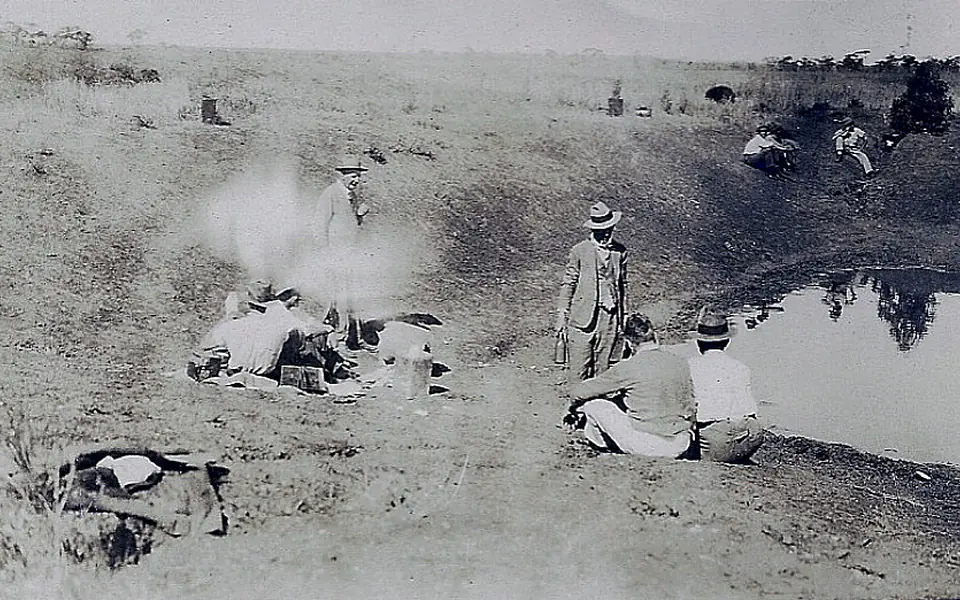
The surviving photographs make the scale of the assignment easier to grasp: a few men with equipment in a rural landscape. The human concerns behind them were livelihoods and pressure on government to act. The biological concerns were animals following food and water through a landscape humans had altered. Remembering both produces a more interesting story than simply awarding a victory to the emus. The episode demonstrates how an apparently forceful response can be poorly matched to a problem whose behavior, distribution, and setting determine what an effective response would require.