A flash caught on paper
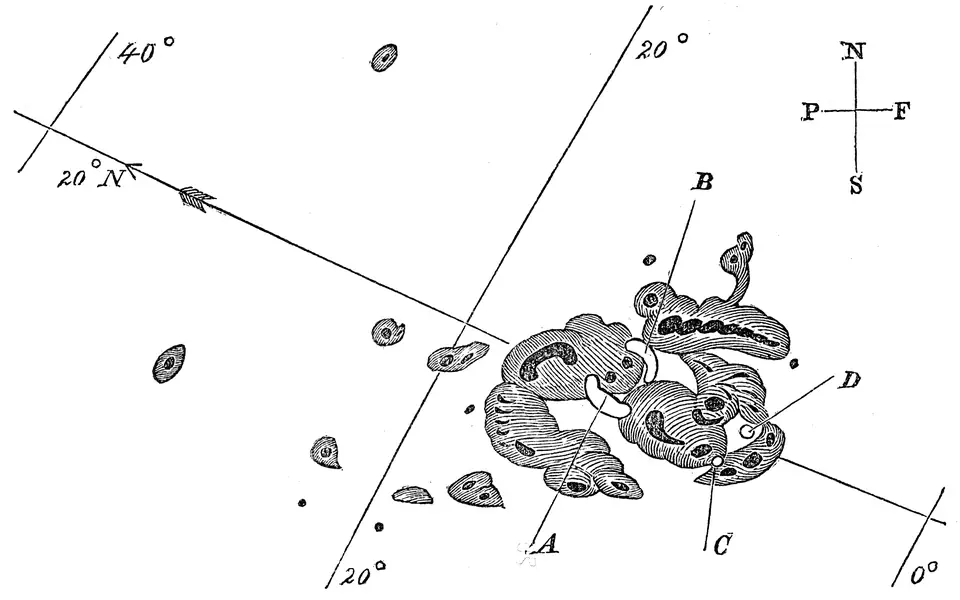
Richard Carrington was carrying out an ordinary observation on the morning of September 1, 1859, when the Sun interrupted his routine. He projected its image onto a prepared surface and recorded the positions of sunspots. Within a large group of dark markings, two patches suddenly became intensely bright. The spectacle lasted only minutes. Carrington tried to summon another observer, then returned to find it already changing. His carefully timed account would become a landmark document, because what happened next made the flash seem less isolated than it first appeared.
His report included a drawing rather than a photograph: dark sunspots surrounded the labeled positions of the bright patches. Another observer, Richard Hodgson, independently saw the unusual appearance and described it to the Royal Astronomical Society. Their accounts were published together. The shared evidence mattered. A transient event that disappeared before most astronomers could inspect it was nevertheless recorded by two people, with observations precise enough to compare with other instruments. Carrington’s name became attached to the event, but he was not the only witness to its solar beginning.
Auroras and unexpected currents
Over the following night, the consequences became visible far from an English observatory. Auroras appeared at unusually low latitudes, with reports extending to the Caribbean. In places where such lights were unfamiliar, the sky itself seemed to be behaving outside its usual rules. Telegraph operators encountered a different kind of disturbance: unwanted currents, unreliable signals, sparks, and shocks. Some lines could even carry messages after their normal batteries were disconnected. The same technology that shrank communication distances was unintentionally acting as an instrument sensitive to a much larger environment.
Today the sequence is understood through space weather. A solar flare is a rapid release of electromagnetic energy, while a coronal mass ejection sends solar material and magnetic field into space. An Earth-directed disturbance can interact with our planet’s magnetic environment. The most severe terrestrial storm associated with the 1859 episode followed the observed flare by roughly seventeen hours. That delay is an important part of the story: the flash did not simply send visible light into a telegraph office. The damaging effects involved the Sun, interplanetary space, and Earth’s changing magnetic field.
Why long wires mattered
Rapid magnetic changes can induce electric fields near the ground and drive currents through long conductors. Telegraph lines supplied exactly such pathways. Their problems were not evidence that the machines had suddenly developed a common mechanical fault. They were symptoms of an external electrical disturbance acting across wide areas. Modern power networks provide other long conducting systems, which is why researchers still study the nineteenth-century event. The effect depends on the changing magnetic field, the ground beneath a network, and the network itself; spectacular auroras alone do not describe every local hazard.
The Carrington Event is often called the greatest recorded magnetic storm, but its size cannot be read from a modern global monitoring network that did not yet exist. Surviving observatory records are incomplete, and some instruments were pushed beyond their recording limits. Researchers reconstruct the event from measurements and historical observations, with uncertainties that should stay visible. The striking evidence does not require a claim that every wire on Earth failed. Reports of both disruption and continued operation show a complex storm affecting particular places and systems in different ways.
Victorian measurements, continuing questions
New work has brought old measurements back into circulation. The British Geological Survey provides digitized magnetograms recorded at Greenwich and Kew during late August and early September 1859. These traces turn an apparently remote Victorian episode into data that researchers can analyze alongside other storms. They also show that the famous September flash sits within a broader period of activity. An archive becomes scientifically useful when its measurements can be recovered, checked, and compared, rather than serving only as an illustration of an extraordinary night.
The lasting importance of the event is the connection it exposed. Carrington saw a brief change on a distant star; operators experienced trouble in machinery built for business and news; observatories recorded disturbed magnetism. Bringing those observations together helped make the Sun’s influence on Earth a problem for physical science. The wires were an early warning that a technological network could have vulnerabilities beyond its immediate surroundings. A few minutes of light and a night of electrical confusion left a record that still helps explain the environment in which our systems operate.