A journey with a changed objective
Apollo 13 began as an expedition to the Moon's Fra Mauro region. Launched on April 11, 1970, it carried commander James Lovell, command module pilot Jack Swigert and lunar module pilot Fred Haise. If the plan had succeeded, two of them would have explored the surface while the third remained in lunar orbit. Instead, the mission became an exercise in making one spacecraft perform jobs for which its separate parts had never been intended. Bringing three people home replaced every scientific objective.
On April 13, an oxygen tank in the service module exploded while the astronauts were traveling toward the Moon. Oxygen was more than a breathing supply: the service module's fuel cells used it, with hydrogen, to generate electricity and water. The failure therefore damaged several essentials together. Warning lights and falling readings had to be interpreted rapidly. When Lovell saw gas escaping into space, the emergency had a visible explanation. The crew and controllers could no longer rely on the normal support system for Odyssey, the command module.
Aquarius becomes a refuge
Aquarius, the lunar module, offered a second set of life-support and propulsion equipment. It became a refuge for all three astronauts, even though its normal lunar task involved only two. Odyssey was powered down to preserve the batteries it would need for atmospheric entry. That choice converted the spacecraft into a sequence of shelters: one module would sustain the crew during the journey, and another would bring them through the final descent. The astronauts could not simply remain in their new refuge until landing, because Aquarius lacked the required heat shield.
The cabin air presented a problem with a surprisingly ordinary physical shape. Lithium hydroxide cartridges removed exhaled carbon dioxide, but the command module's square cartridges did not fit the lunar module's round fittings. Spare chemical capacity existed in the wrong packaging. Ground teams devised an adapter using materials already aboard, including plastic bags, tape and a hose. They tested a procedure and explained it to the crew. The resulting arrangement allowed the command module cartridges to work with the lunar module's system, lowering a dangerous carbon-dioxide buildup.
Managing a route and limited supplies
Each solution also had to respect a limited budget of electricity, water and time. Conserving power meant losing warmth; conserving water affected the astronauts' comfort and condition. Meanwhile, the route itself needed attention. Aquarius's descent engine, intended for landing on the Moon, was used for maneuvers that helped restore a path home and shorten the return. The spacecraft swung around the Moon without landing. The rescue was therefore neither a single dramatic repair nor a wait for help to arrive, but a continuing series of linked decisions.
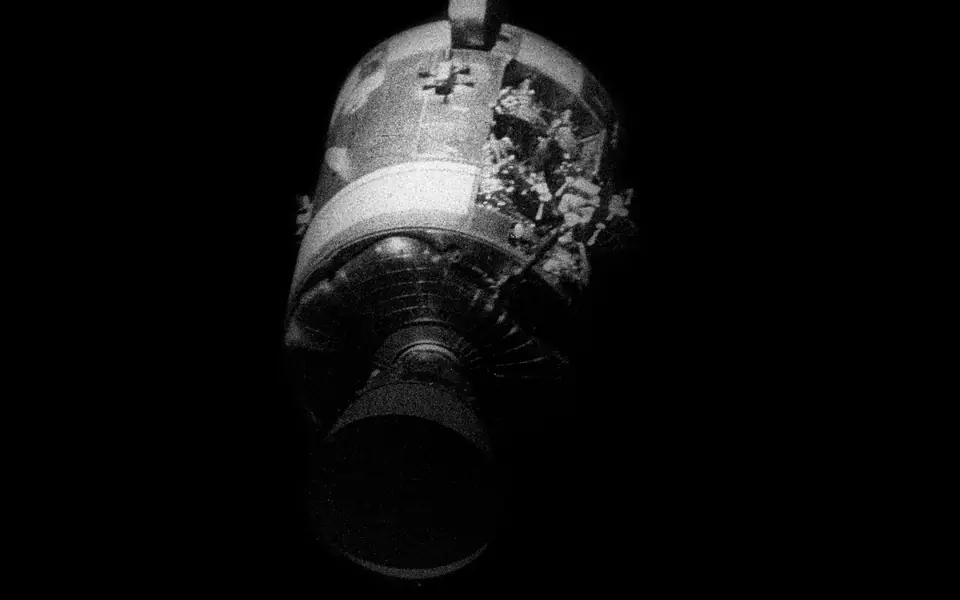
As Earth approached, Odyssey had to be brought back to life with procedures suited to its depleted resources. The crew discarded the damaged service module and then Aquarius. Photographs of the service module revealed a large area of missing structure, showing the scale of the damage that had accompanied the earlier warning lights. Odyssey alone carried the astronauts into the atmosphere. On April 17, parachutes lowered it into the South Pacific, where naval recovery teams retrieved the crew and brought them aboard the USS Iwo Jima.
The investigation after the rescue
Survival was followed by investigation. NASA's review traced the accident to a sequence involving the oxygen tank's history, ground testing and electrical components. Heater thermostats had not been adapted to the higher voltage used by ground equipment, and prolonged heating during an effort to empty the tank damaged internal wiring insulation. The mission's emergency could not be understood by examining only the moment of explosion. Its origins crossed manufacturing, modifications, testing and interpretation of warning signs, making the rescue a lesson in the whole life of a technical system.
Apollo 13 is often remembered through the astronauts' resourcefulness, and rightly so. But their improvisation was supported by controllers, engineers, simulators, communications stations and recovery crews. The adapter worked because people on Earth could test what people in space would build; the return succeeded because limited supplies were treated as an interconnected problem. The mission left an unusual legacy: no lunar samples from its intended landing site, but a detailed demonstration of how preparation and cooperation can extend a spacecraft's capabilities when its original plan has failed.