The historical setting
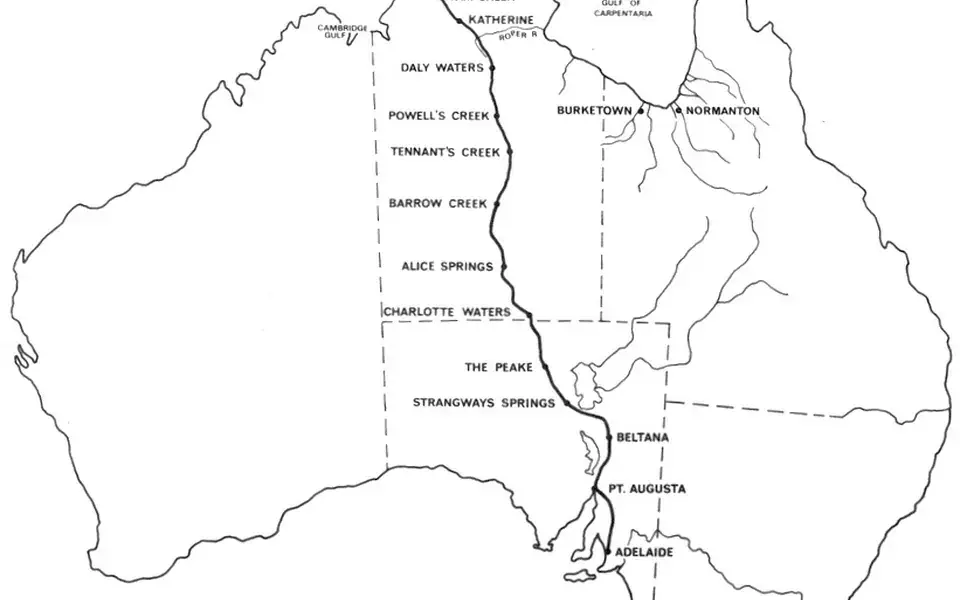
The Australian Overland Telegraph Line was an electrical telegraph system for sending messages the 3200 kilometres (2000 miles) between Darwin, in what is now the Northern Territory of Australia, and Adelaide, the capital of South Australia. Completed in 1872 (with a line to Western Australia added in 1877), it allowed fast communication between Australia and the rest of the world. When it was linked to the Java-to-Darwin submarine telegraph cable several months later, the communication time with Europe dropped from months to hours; Australia was no longer so isolated from the rest of the world. The line was one of the great engineering feats of 19th-century Australia and probably the most significant milestone in the history of telegraphy in Australia.
Conception and competition
By 1855 speculation had intensified about possible routes for the connection of Australia to the new telegraph cable in Java and thus Europe. Among the routes under consideration were either Ceylon to Albany in Western Australia, or Java to the north coast of Australia and then either onto east coast, or south through the centre of the continent to Adelaide. Competition between the colonies over the route was fierce. The Victorian government organised an expedition led by Burke and Wills to cross the continent from Menindee to the Gulf of Carpentaria in 1860. Although the route was traversed, the expedition ended in disaster. The South Australian government recognised the economic benefits that would result from becoming the centre of the telegraph network.
It offered a reward of £2000 to encourage an expedition to find a route between South Australia and the north coast. John McDouall Stuart had meanwhile also been endeavouring to cross the continent starting from the northern Flinders Ranges, and was successful on his sixth attempt in 1862. Stuart had the proposed telegraph line in mind as he travelled across the country, noting the best places for river crossings, sources of timber for telegraph poles, and water supplies.
Construction
The South Australian Superintendent of Telegraphs, Charles Todd, was appointed head of the project, and devised a timetable to complete the immense project on schedule. Todd had built South Australia's first telegraph line and extended it to Melbourne. The contract stipulated a total cost of no more than £128,000 and two years' construction time. He divided the route into three sections, each of 600 miles (970 km): northern and southern sections to be handled by private contractors, and a central section which would be constructed by his own department. The telegraph line would comprise more than 30,000 wrought iron poles, insulators, batteries, wire and other equipment, ordered from England.
The poles were placed 80 m apart and repeater stations separated by no more than 250 km, a major criterion being year-round availability of water. Todd appointed staff to whom the contractors would be responsible: Explorer, John Ross; Surveyor, William Harvey; Overseer of Works, Northern Territory, William McMinn; Sub-Overseer, R. C. Burton; Operators, James Lawrence Stapleton (murdered 1874 at Barrow Creek), and Andrew Howley. Surveyors and Overseers, central portion of line: A. T. Woods, Gilbert McMinn, and Richard Randall Knuckey; Overseer, James Beckwith; Sub-Overseers, J. F.
Running the Overland Telegraph Line
The requirements of nineteenth century telegraphy meant the Overland Telegraph Line required repeater stations, a maximum of 250–300 km apart, to boost the signal. The repeater stations contained two primary batteries: the line was powered by a (c. 120 V) bank of Meidinger cells — a variation of Daniell cell, "recharged" by replacing the electrolyte — as well as Leclanche cells for the local equipment. Although repeater stations have been run by a single telegraphist, usual staffing was four to six, including a station master, telegraphists, and a linesman. The job of a telegraphist was to record each message received, with the time of day, and to re-send (relay) it further along the line. Within the first year of operations 4000 telegrams were transmitted.
Maintenance was an ongoing and mammoth task, with floods often destroying poles, and a range of other incidents disrupting the line. In the 1880s, wooden poles were replaced with Joseph Oppenheimer's patented telescoping poles. The line proved an immediate success in opening the Northern Territory; gold discoveries were made in several places along the northern section (in particular Pine Creek), and the repeater stations in the MacDonnell Ranges proved invaluable starting points for explorers like Ernest Giles, W.