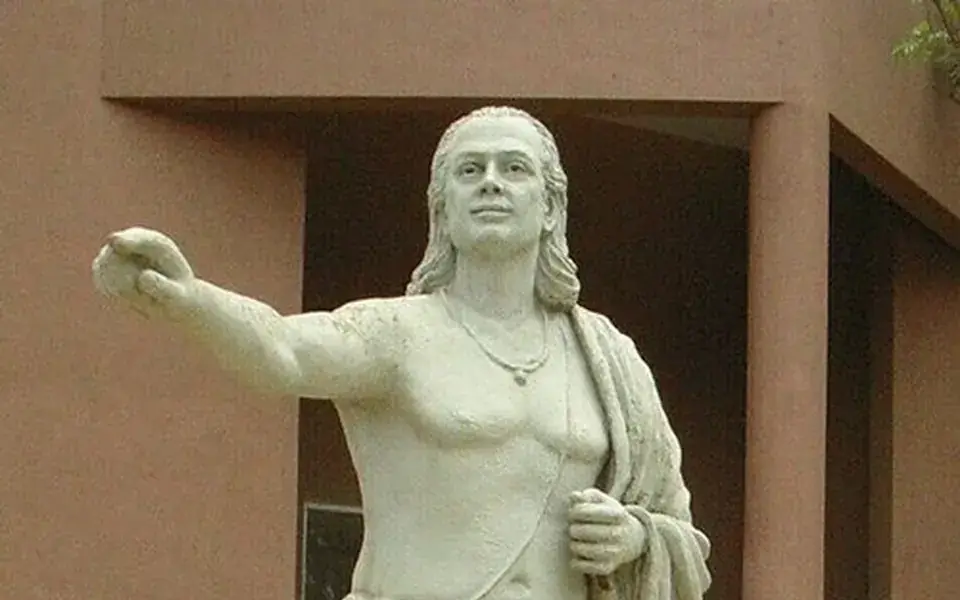
The historical setting
Aryabhata or Aryabhata I (476–550 CE) was the first of the major mathematician-astronomers and early physicist from the classical age of Indian mathematics and Indian astronomy. His works include the Āryabhaṭīya (which mentions that in 3600 Kali Yuga, 499 CE, he was 23 years old) and the Arya-siddhanta. Aryabhata is the author of several treatises on mathematics and astronomy, though Aryabhatiya is the only one which survives. Much of the research included subjects in astronomy, mathematics, physics, biology, medicine, and other fields. Aryabhatiya, a compendium of mathematics and astronomy, was referred to in the Indian mathematical literature and has survived to modern times. The mathematical part of the Aryabhatiya covers arithmetic, algebra, plane trigonometry, and spherical trigonometry.
It also contains continued fractions, quadratic equations, sums-of-power series, and a table of sines. The Arya-siddhanta, a lost work on astronomical computations, is known through the writings of Aryabhata's contemporary, Varahamihira, and later mathematicians and commentators, including Brahmagupta and Bhaskara I.
Place value system and zero
The place-value system, first seen in the 3rd-century Bakhshali Manuscript, was clearly in place in his work. While he did not use a symbol for zero, the French mathematician Georges Ifrah argues that knowledge of zero was implicit in Aryabhata's place-value system as a place holder for the powers of ten with null coefficients. However, Aryabhata did not use the Brahmi numerals. Continuing the Sanskritic tradition from Vedic times, he used letters of the alphabet to denote numbers, expressing quantities, such as the table of sines in a mnemonic form. that translates to: "for a triangle, the result of a perpendicular with the half-side is the area." Aryabhata discussed the concept of sine in his work by the name of ardha-jya, which literally means "half-chord".
For simplicity, people started calling it jya. When Arabic writers translated his works from Sanskrit into Arabic, they referred it as jiba. However, in Arabic writings, vowels are omitted, and it was abbreviated as jb. Later writers substituted it with jaib, meaning "pocket" or "fold (in a garment)". (In Arabic, jiba is a meaningless word.) Later in the 12th century, when Gherardo of Cremona translated these writings from Arabic into Latin, he replaced the Arabic jaib with its Latin counterpart, sinus, which means "cove" or "bay"; thence comes the English word sine.
Motions of the Solar System
Aryabhata described a geocentric model of the Solar System, in which the Sun and Moon are each carried by epicycles. They in turn revolve around the Earth. In this model, which is also found in the Paitāmahasiddhānta (c. 425 CE), the motions of the planets are each governed by two epicycles, a smaller manda (slow) and a larger śīghra (fast). The order of the planets in terms of distance from earth is taken as: the Moon, Mercury, Venus, the Sun, Mars, Jupiter, Saturn, and the asterisms. The positions and periods of the planets was calculated relative to uniformly moving points. In the case of Mercury and Venus, they move around the Earth at the same mean speed as the Sun.
In the case of Mars, Jupiter, and Saturn, they move around the Earth at specific speeds, representing each planet's motion through the zodiac. Most historians of astronomy consider that this two-epicycle model reflects elements of pre-Ptolemaic Greek astronomy. Another element in Aryabhata's model, the śīghrocca, the basic planetary period in relation to the Sun, is seen by some historians as a sign of an underlying heliocentric model.
Eclipses
Solar and lunar eclipses were scientifically explained by Aryabhata. He states that the Moon and planets shine by reflected sunlight. Instead of the prevailing cosmogony in which eclipses were caused by Rahu and Ketu (identified as the pseudo-planetary lunar nodes), he explains eclipses in terms of shadows cast by and falling on Earth. Thus, the lunar eclipse occurs when the Moon enters into the Earth's shadow (verse gola.37). He discusses at length the size and extent of the Earth's shadow (verses gola.38–48) and then provides the computation and the size of the eclipsed part during an eclipse. Later Indian astronomers improved on the calculations, but Aryabhata's methods provided the core.
His computational paradigm was so accurate that 18th-century scientist Guillaume Le Gentil, during a visit to Pondicherry, India, found the Indian computations of the duration of the lunar eclipse of 30 August 1765 to be short by 41 seconds, whereas his charts (by Tobias Mayer, 1752) were long by 68 seconds. Aryabhata's work was of great influence in the Indian astronomical tradition and influenced several neighbouring cultures through translations. The Arabic translation during the Islamic Golden Age (c. 820 CE), was particularly influential.