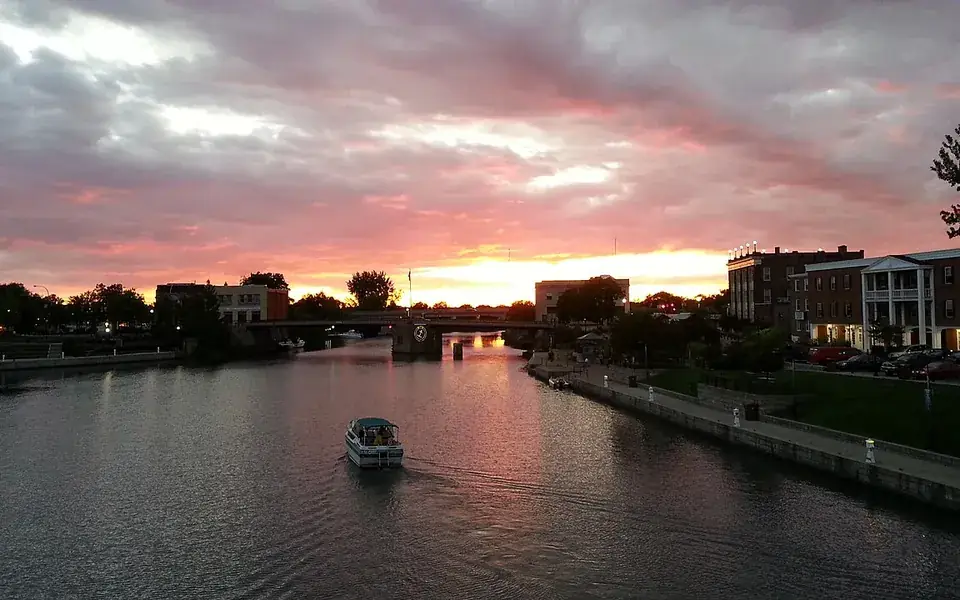
The Erie Canal is a historic canal in upstate New York that runs east–west between the Hudson River and Lake Erie. Completed in 1825, the canal was the first navigable waterway connecting the Atlantic Ocean to the upper Great Lakes above Niagara Falls, vastly reducing the costs of transporting people and goods across the Appalachians. The Erie Canal accelerated the settlement of the Great Lakes region, the westward expansion of the United States, and the economic ascendancy of New York state.
A water route through New York
The Mohawk River (a tributary of the Hudson River) rises near Lake Ontario and runs in a glacial meltwater channel just north of the Catskill range of the Appalachian Mountains, separating them from the geologically distinct Adirondacks to the north. The Mohawk and Hudson valleys form the only cut across the Appalachians north of Alabama. A navigable canal through the Mohawk Valley would allow an almost complete water route from New York City in the south to Lake Ontario and Lake Erie in the west. Via the canal and these lakes, other Great Lakes, and to a lesser degree, related rivers, a large part of the continent's interior and many settlements would be made well connected to the Eastern seaboard.
Among the first attempts made by European colonists to improve upon the future state's navigable waterways was the construction in 1702 of the Wood Creek Carry, or Oneida Carry, a short portage road connecting Wood Creek to the Mohawk River near modern-day Rome, New York. The first documented instance of the idea of a canal to tie the East Coast to the new western settlements via New York's waterways was discussed as early as 1724: New York provincial official Cadwallader Colden made a passing reference in a report on fur trading to improving the natural waterways of western New York.
Digging and completing the canal
The original canal was 363 miles (584 km) long, from Albany on the Hudson to Buffalo on Lake Erie. The channel was cut 40 feet (12 m) wide and 4 feet (1.2 m) deep, with removed soil piled on the downhill side to form a walkway known as a towpath. Its construction, through limestone and mountains, proved a daunting task. To move earth, animals pulled a "slip scraper" (similar to a bulldozer). The sides of the canal were lined with stone set in clay, and the bottom was also lined with clay.
The Canal was built by Irish laborers and German stonemasons. All labor on the canal depended upon human and animal power or the force of water. In 1824, before the canal was completed, a detailed Pocket Guide for the Tourist and Traveler, Along the Line of the Canals, and the Interior Commerce of the State of New York, was published for the benefit of travelers and land speculators. The entire canal was officially completed on October 26, 1825.
The event was marked by a statewide "Grand Celebration", culminating in a series of cannon shots along the length of the canal and the Hudson, a 90-minute cannonade from Buffalo to New York City. A flotilla of boats, led by Governor Dewitt Clinton aboard Seneca Chief, sailed from Buffalo to New York City over ten days. Clinton then ceremonially poured Lake Erie water into New York Harbor to mark the "Wedding of the Waters".
Trade, migration, and everyday travel
The Erie Canal greatly lowered the cost of shipping between the Midwest and the Northeast, bringing much lower food costs to Eastern cities and allowing the East to ship machinery and manufactured goods to the Midwest more economically. To give an example, the cost to transport a barrel of flour from Rochester to Albany dropped from $3 (before the canal) to 75¢ on the canal. New ethnic Irish communities formed in some towns along its route after completion, as Irish immigrants were a large portion of the construction labor force.
A plaque honoring the canal's construction is located in Battery Park in southern Manhattan. Because so many immigrants traveled on the canal, many genealogists have sought copies of canal passenger lists. Canal boats up to 3.5 feet (1.1 m) in draft were pulled by horses and mules walking on the towpath. The canal had one towpath, generally on the north side. When canal boats met, the boat with the right of way remained on the towpath side of the canal. The other boat steered toward the berm (or heelpath) side of the canal.
Packet boats, serving passengers exclusively, reached speeds of up to five miles per hour (8.0 km/h) and ran at much more frequent intervals than the cramped, bumpy stagecoach wagons. These boats, measuring up to 78 feet (24 m) long and 14.5 feet (4.4 m) wide, made ingenious use of space, accommodating up to 40 passengers at night and up to three times as many in the daytime.