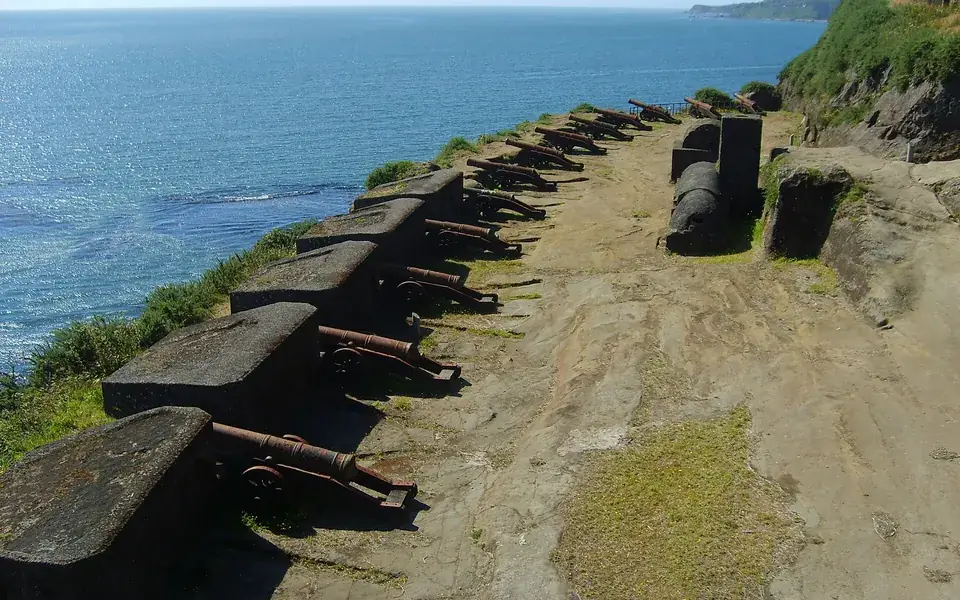
The Fort System of Valdivia (Spanish: Sistema de fuertes de Valdivia) is a series of Spanish colonial fortifications at Corral Bay, Valdivia and Cruces River established to protect the city of Valdivia, in southern Chile. During the period of Spanish rule (1645–1820), it was one of the biggest systems of fortification in the Americas. It was also a major supply source for Spanish ships that crossed the Strait of Magellan.
A contested southern harbor
The first European to visit Valdivia River's estuary was the Genoese captain Juan Bautista Pastene, who took possession of it in 1544 in the name of the Spanish king, Carlos I. He named the river after the Governor of Chile Pedro de Valdivia. Pedro de Valdivia later traveled by land to the river described by Pastene, and founded the city of Valdivia in 1552 as Santa María la Blanca de Valdivia. On 23 December, native Mapuche warriors led by Pelantaro ambushed and wiped out a Spanish column at the Battle of Curalaba. In 1598 a general uprising developed among the Mapuche and Huilliche people of southern Chile.
The subsequent Arauco War was to smolder for over 250 years but its immediate effect was the so-called "Destruction of the Seven Cities": the Spanish cities of Angol, La Imperial, Osorno, Santa Cruz de Oñez, Valdivia and Villarrica were either destroyed or abandoned. In 1600, local Huilliches joined the Dutch corsair Baltazar de Cordes in attacking the Spanish settlement of Castro in Chiloé. While this was an opportunistic assault, the Spanish correctly believed the Dutch could attempt to ally with the Mapuches and establish a stronghold in southern Chile.
Over time the Spanish became aware of actual Dutch plans to establish themselves at the ruins of Valdivia and so attempted to re-establish Spanish rule there before the arrival of the Dutch. These efforts were thwarted in the 1630s by the impossibility of establishing an overland route through the territory of the hostile Mapuches. The ruins of Valdivia, at the head of its splendid natural harbour, remained a tempting target for Spain's enemies.
Rebuilding Spanish defenses
Unaware of the Dutch departure Governor of Chile Francisco López de Zúñiga dispatched Juan de Acevedo in charge of a ship to Valdivia to gather information on April 30, 1644. De Acevedo reached Corral Bay by May noticing that the Dutch were nowhere to be found. Having heard from the now pro-Spanish Mapuche chief Juan Manqueante that the Dutch planned to return, Pedro de Toledo conceived an occupation of Valdivia by a synchronous advance by the Spanish army in Chile by land and by a fleet sent from Peru.
De Toledo ordered 2,000 men to march over land from Central Chile to resettle Valdivia and fortify it. These troops penetrated Mapuche territory following the coast south and reached Toltén River on February 9, 1645. Reaching so far south was a feat in itself since the Spanish had not been around these places in the last 50 years. At this point the army had met considerable harassment from the Mapuches.
The killing of scouting auxiliaries in conjunction with uncertainty regarding the arrival by sea of the Spanish from Peru made López de Zúñiga retreat back north. De Toledo's naval expedition was made up of twenty ships and 1,000 men from El Callao in Peru. The large fleet, which gained a further two ships in Chile, was unprecedented in the region and astounded contemporary observers.
Expansion and military reassessment
In the second half of the 18th century, a thorough plan was carried forward for restoring and improving the fortresses. The engineers José Birt and Juan Garland were commissioned for the task. The defensive complex of Valdivia reached the point of having 17 bastions, with surveillance installations, castles, fortresses and batteries. This complex would exert during the Colony a thoroughly efficacious deterrent effect, since, in fact, it frustrated the raids of the rival powers.
A varied list of 18th-century and early 19th-century authors in Chile, Spain and the rest of Europe concurred on the strategic importance of Valdivia and its harbour. A notable dissident was the Governor of Osorno Juan Mackenna who argued in a 1810 report for diminishing the size of the garrison protecting Valdivia and distribute resources aimed at it elsewhere. This report was rebuked by Manuel Olaguer Feliú, the chief military engineer involved in the designs of the defences of Valdivia.
Military engineer Manuel Olaguer Feliú thought that the fort of Aguada del Inglés, the same place where John Narborough had approached the coast, would be the landing place for an enemy attack on the fort system. For this purpose in Olaguer Feliú's plans this fort had to concentrate most of the troops in case of war. Lord Cochrane's landing on Aguada del Inglés in 1820 validated the plan of Olaguer Feliú