History
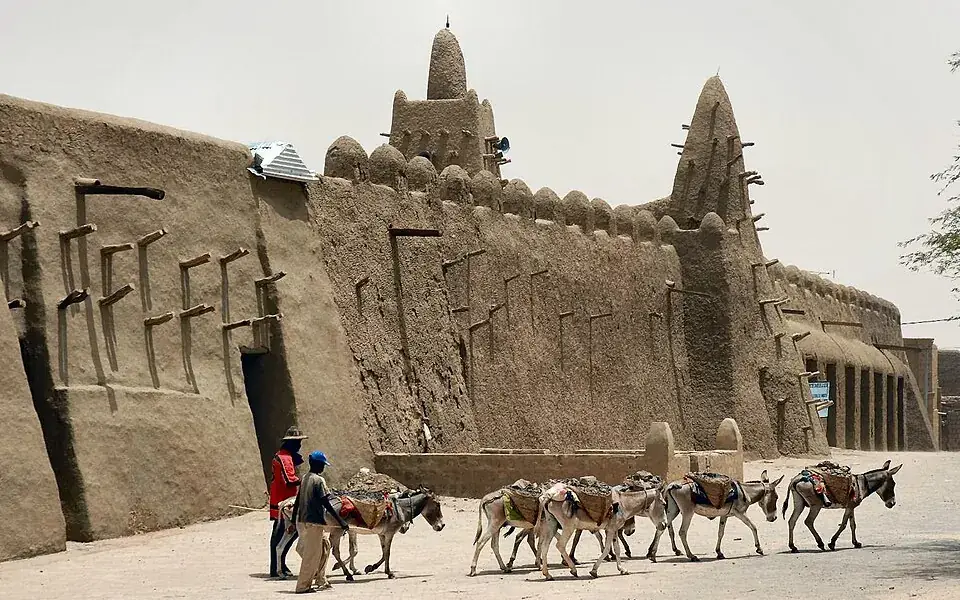
Timbuktu has acquired a reputation in the Western world as an exotic, mysterious place, but the city was once a well known trade center and an academic hotspot of the medieval world. Timbuktu reached its golden age under the Mali Empire in the 13th and 14th centuries. Distinguished Malian Mansa Mūsā brought great fame to the city by recruiting scholars from throughout the Islamic world to travel there, establishing it as a center of learning. The scholars focused not only on Islamic studies, but also history, rhetoric, law, science, and, most notably, medicine.
Mansa Mūsā also introduced Timbuktu, and the Mali Empire in general, to the rest of the medieval world through his Hajj, as his time in Mecca would soon inspire Arab travelers to visit North Africa. Europeans, however, would not reach the city until much later, due to the difficult and lengthy journey, thus garnering the city an aura of mystery.
Salt trade
The wealth and very existence of Timbuktu depended on its position as the southern terminus of an important trans-Saharan trade route; the goods routinely transported across the desert are slabs of rock salt brought from the Taoudenni mining centre in the central Sahara 664 km (413 mi) north of Timbuktu. Until the second half of the 20th century most of the slabs were transported by large salt caravans or azalai, one leaving Timbuktu in early November and the other in late March. The caravans of several thousand camels took three weeks each way, transporting food to the miners and returning with each camel loaded with four or five 30 kg (66 lb) slabs of salt.
The salt transport was largely controlled by desert nomads of the Arabic-speaking Berabich (or Barabish) tribe. Although there are no roads, the slabs of salt are now usually transported from Taoudenni by truck. From Timbuktu the salt is transported by boat to other towns in Mali. Between the 12th and 14th centuries, Timbuktu's population grew immensely due to an influx of Bono, Tuaregs, Fulanis, and Songhais seeking trade, security, or to study.
Centre of learning
Timbuktu was a world centre of Islamic learning from the 13th to the 17th century, especially under the Mali Empire and Askia Mohammad I's rule. The Malian government and NGOs have been working to catalogue and restore the remnants of this scholarly legacy: Timbuktu's manuscripts. Knowledge was gathered in a manner similar to the early, informal European Medieval university model. Lecturing was presented through a range of informal institutions called madrasahs. Nowadays known as the University of Timbuktu, three madrasahs facilitated 25,000 students: Djinguereber, Sidi Yahya and Sankore. These institutions were explicitly religious, as opposed to the more secular curricula of modern European universities and more similar to the medieval Europe model.
However, where universities in the European sense started as associations of students and teachers, West-African education was patronized by families or lineages, with the Aqit and Bunu al-Qadi al-Hajj families being two of the most prominent in Timbuktu – these families also facilitated students in set-aside rooms in their housings. Although the basis of Islamic law and its teaching were brought to Timbuktu from North Africa with the spread of Islam, Western African scholarship developed: Ahmad Baba al Massufi is regarded as the city's greatest scholar.
Manuscripts and libraries
That scholarly inheritance faced a new danger in 2012. Rebels captured Timbuktu on 1 April, and radical Islamist fighters attacked the city's cultural heritage. Manuscripts had been preserved in private household libraries as well as in the state-run Ahmed Baba Institute. Owners and custodians began hiding collections and arranging their evacuation to Bamako. Abdel Kader Haidara, director of the Mamma Haidara Memorial Library and a leader of the manuscript owners' association SAVAMA-DCI, helped persuade families to entrust their collections to the rescue operation.
Between June 2012 and January 2013, rescuers moved the manuscripts in metal chests, keeping individual loads small to avoid attention. Some collections left the city by donkey cart or canoe before continuing by road. The University of Hamburg's preservation project records about 285,000 individual items transported to safety. That figure refers to rescued items from multiple collections, rather than a count of distinct medieval works originally written in Timbuktu. The evacuation saved a vast scholarly inheritance, but moving fragile manuscripts from a dry climate into Bamako's more humid environment created further conservation problems. Improved storage remained essential after the immediate danger had passed.