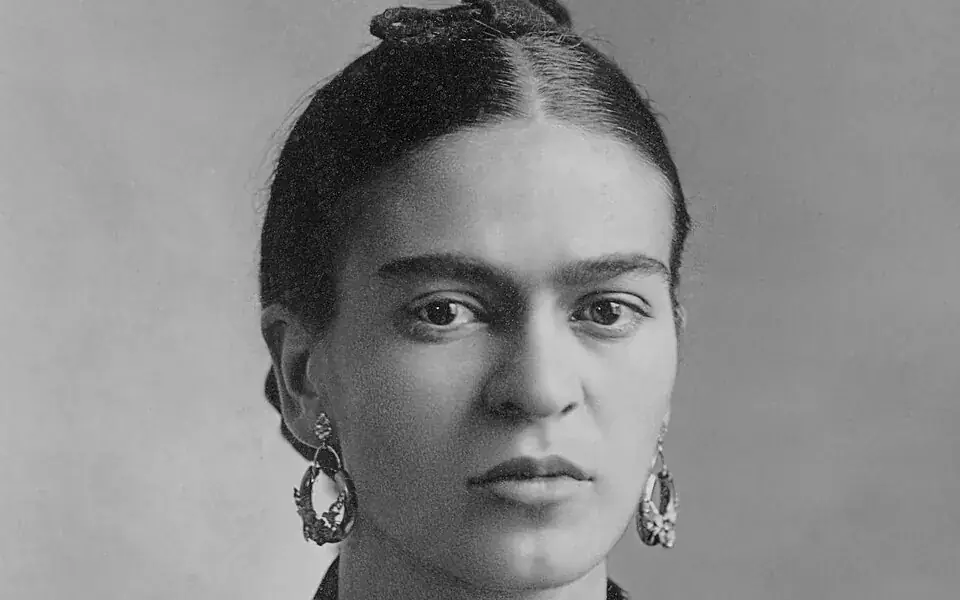
Magdalena Carmen Frida Kahlo y Calderón (6 July 1907 – 13 July 1954) was a Mexican painter known for her many portraits, self-portraits, and works inspired by the nature and artifacts of Mexico. Inspired by the country's popular culture, she employed a naïve folk art style to explore questions of identity, postcolonialism, gender, class, and race in Mexican society. Her paintings often had strong autobiographical elements and mixed realism with fantasy.
Painting after the bus accident
On 17 September 1925, Kahlo and her boyfriend, Gómez Arias, were on their way home from school. They boarded one bus, but they got off the bus to look for an umbrella that Kahlo had left behind. They then boarded a second bus, which was crowded, and they sat in the back. The driver attempted to pass an oncoming electric streetcar. The streetcar crashed into the side of the wooden bus, dragging it a few feet. Several passengers were killed in the accident.
While Gómez Arias only suffered minor injuries, Frida was impaled by an iron handrail that went through her pelvis. She later described the injury as "the way a sword pierces a bull". Kahlo enjoyed art from an early age, receiving drawing instruction from printmaker Fernando Fernández (who was her father's friend) and filling notebooks with sketches. In 1925, she began to work outside of school to help her family. After briefly working as a stenographer, she became a paid engraving apprentice for Fernández.
Fernández was impressed by her talent, although she did not consider art as a career at this time. A severe bus accident at the age of 18 left Kahlo in lifelong pain. Confined to bed for three months following the accident, Kahlo began to paint. She started to consider a career as a medical illustrator, as well, which would combine her interests in science and art.
Travel and international recognition
When Kahlo and her husband, the muralist Diego Rivera, moved to San Francisco in 1930, Kahlo was introduced to American artists such as Edward Weston, Ralph Stackpole, Timothy L. Pflueger, and Nickolas Muray. The six months spent in San Francisco were a productive period for Kahlo, who further developed the folk art style she had adopted in Cuernavaca. In addition to painting portraits of several new acquaintances, she made Frieda and Diego Rivera (1931), a double portrait based on their wedding photograph, and The Portrait of Luther Burbank (1931), which depicted the eponymous horticulturist as a hybrid between a human and a plant.
Although she still publicly presented herself as simply Rivera's spouse rather than as an artist, she participated for the first time in an exhibition, when Frieda and Diego Rivera was included in the Sixth Annual Exhibition of the San Francisco Society of Women Artists in the Palace of the Legion of Honor. Upon returning to Mexico City in 1934 Kahlo made no new paintings, and only two in the following year, due to health complications. In 1937 and 1938, Kahlo’s artistic career was extremely productive. She painted more "than she had done in all her eight previous years of marriage", creating such works as My Nurse and I (1937), Memory, the Heart (1937), Four Inhabitants of Mexico (1938), and What the Water Gave Me (1938). Kahlo and Rivera divorced in 1939 and remarried in 1940.
Identity, symbolism, and self-portraits
Similarly to many other contemporary Mexican artists, Kahlo was heavily influenced by Mexicanidad, a romantic nationalism that had developed in the aftermath of the revolution. The Mexicanidad movement claimed to resist the "mindset of cultural inferiority" created by colonialism, and placed special importance on Indigenous cultures. Before the revolution, Mexican folk culture – a mixture of Indigenous and European elements – was disparaged by the elite, who claimed to have purely European ancestry and regarded Europe as the definition of civilization which Mexico should imitate. Kahlo's artistic ambition was to paint for the Mexican people, and she stated that she wished "to be worthy, with my paintings, of the people to whom I belong and to the ideas which strengthen me". Kahlo's paintings often feature root imagery, with roots growing out of her body to tie her to the ground.
A different image of belonging appears in My Grandparents, My Parents, and I (1936). Kahlo presents herself as a young child standing in the courtyard of her family home, the Casa Azul. She holds a red ribbon that rises through the composition and links her to portraits of her parents and four grandparents. Her parents appear above the house, while the maternal and paternal grandparents occupy the upper corners. Painted in oil and tempera on zinc, the small work combines family portraiture with a Mexican landscape. The arrangement offers a visual account of ancestry, connecting the artist's childhood home with both sides of her family.