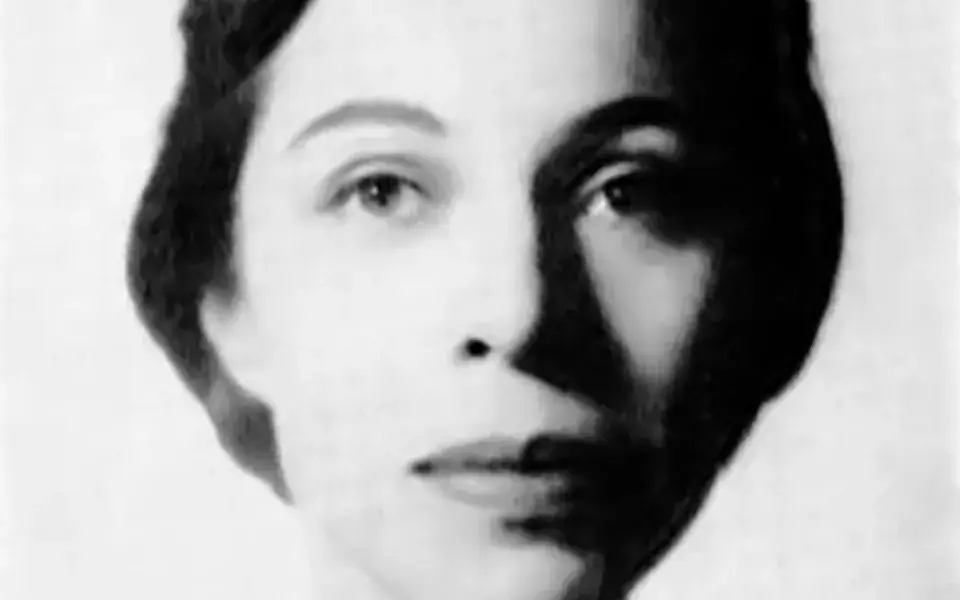
Maria Tallchief, born Elizabeth Marie Tall Chief (𐓏𐒰𐓐𐒿𐒷-𐓍𐓂͘𐓄𐒰 "Two-Standards"; Osage family name: Ki He Kah Stah Tsa, Osage script: 𐒼𐒱𐒹𐒻𐒼𐒰-𐓆𐓈𐒷𐓊𐒷; January 24, 1925 – April 11, 2013), was an Osage ballerina. She was America's first major prima ballerina and the first Native American to hold the rank. Together with Georgian-American choreographer George Balanchine, she is widely considered to have revolutionized American ballet.
An Osage childhood and dance training
Elizabeth Marie Tall Chief was born in Fairfax, Oklahoma, on January 24, 1925, as the third child of Alexander Joseph Tall Chief (1890–1959), a member of the Osage Nation, and his second wife, Ruth (née Porter), of Scottish-Irish descent. Porter had met Alexander Tall Chief, then a widower, while visiting her sister, who was his mother's housekeeper at the time. Elizabeth Marie was known as "Betty Marie" to friends and family.
Tallchief’s paternal great-grandfather, Peter Bigheart, helped negotiate Osage rights to minerals and other resources on reservation land. Oil revenues later enriched members of the Osage Nation. Tallchief recalled a childhood surrounded by her father’s property in Fairfax, including a movie theater and pool hall. The family’s wealth supported opportunities that were unusual for many young dancers of the period.
The family lived in a large brick house on a hill and spent summers in Colorado Springs. Tallchief also described tensions at home, including her father’s drinking and arguments about money. Her father had children from an earlier marriage, making the household’s family relationships more complicated than an image of uncomplicated prosperity might suggest.
A career takes shape
Tallchief graduated from Beverly Hills High School in 1942. She had given up piano and wanted to go to college, but her father was against it. Dancing in the movie was "not gratifying" and Tallchief decided against making a career of it. That summer, family friend Tatiana Riabouchinska asked if Tallchief would like to go to New York City. With Riabouchinska chaperoning, she set off for the city at age 17 in 1942. Once in New York, Tallchief looked up Denham, for whom she had an earlier favorable audition.
Tallchief initially encountered rejection when seeking work with Ballet Russe de Monte Carlo. In the spring of 1944, the choreographer George Balanchine joined the company to work on Song of Norway. His arrival became a turning point in her career. Tallchief admired the clarity and elegance of his choreography and found herself increasingly drawn to his approach to ballet.
Balanchine assigned Tallchief a solo in Song of Norway and, immediately before its premiere, told her that she would also be Alexandra Danilova’s understudy. These responsibilities brought her into a demanding professional setting and helped establish the artistic relationship that became central to her later career.
A leading ballerina and teacher
In 1946, Balanchine joined with arts patron Lincoln Kirstein to establish the Ballet Society, a direct forerunner to the New York City Ballet. Tallchief had six months remaining on her contract with Ballet Russe de Monte Carlo, so she stayed with the company until 1947. When her contract expired, she joined Balanchine, who was in France as guest choreographer at the Paris Opera Ballet. He had been called upon to "save" the famous troupe, but not everyone appreciated his presence. He ignored the company's hierarchy, further angering some dancers.
A group of supporters of Serge Lifar, who was on leave while accusations of aiding the Nazis during World War II were investigated, led a vocal campaign to get rid of Balanchine. After retiring from dancing, Tallchief moved to Chicago, where her husband Buzz Paschen resided. She served as director of ballet for the Lyric Opera of Chicago from 1973 to 1979. In 1974, she founded Lyric Opera's ballet school, where she taught the Balanchine technique.
Explaining her teaching philosophy, she wrote Tallchief argued that innovation in ballet needed to preserve respect for the art and its performers. With her sister Marjorie, Tallchief founded the Chicago City Ballet in 1981. She served as co-artistic director until its demise in 1987. Despite the company failing, the Chicago Tribune called her "a force in the history of Chicago dance," and said she arguably increased the popularity of dance in the city.