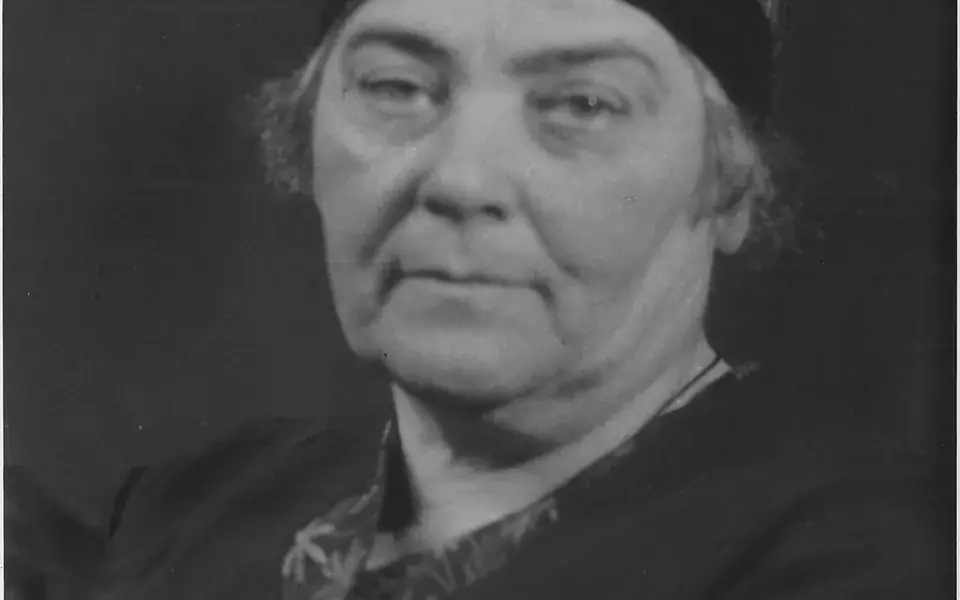
Emily Carr (December 13, 1871 – March 2, 1945) was a Canadian artist who was inspired by the monumental art and villages of the First Nations and the landscapes of British Columbia. She also was a vivid writer and chronicler of life in her surroundings, praised for her "complete candour" and "strong prose". Klee Wyck, her first book, published in 1941, won the Governor General's Literary Award for non-fiction and this book and others written by her or compiled from her writings later are still much in demand today.
Training and early journeys
Born in Victoria, British Columbia, in 1871, the year British Columbia joined Canada, Emily Carr was the second youngest of nine children born to English parents Richard and Emily (Saunders) Carr. The Carr home was on Birdcage Walk (now Government Street), in the James Bay district of Victoria, a short distance from the legislative buildings (nicknamed the 'Birdcages') and the town itself. Today it is a museum and National Historic Site of Canada called Emily Carr House. The Carr children were raised in an English tradition.
Carr’s father believed it was sensible to live on Vancouver Island, a colony of Great Britain, where he could practice English customs and continue his British citizenship. In 1898, at age 27, Carr made the first of several sketching and painting trips to Aboriginal villages. She stayed in a village near Ucluelet on the west coast of Vancouver Island, home to the Nuu-chah-nulth people, then commonly known to English-speaking people as 'Nootka'. Carr was given the Indigenous name of Klee Wyck and she also chose it as the title of her first book.
Carr later recalled that her time in Ucluelet made "a lasting impression on me". In 1907, Carr made a sightseeing trip to Alaska with her sister Alice and decided on her artistic mission of documenting all she could of what she and many others perceived as the "vanishing totems" and way of life of the First Nations.
Experiments and new recognition
Determined to further her knowledge of evolving artistic trends abroad, in 1910 Carr returned to Europe to study. In Montparnasse with her sister Alice, Emily Carr met modernist painter Harry Phelan Gibb with a letter of introduction. Carr enrolled at the Académie Colarossi in Paris, then transferred to private lessons with John Duncan Fergusson and followed him to the Atelier Blanche. After a bout of illness, she joined Gibb and his wife in the small village of Crécy-en-Brie and then St. Efflam, Brittany.
Carr's study with Gibb and his techniques shaped and influenced her style of painting, and she adopted a vibrant colour palette rather than continuing with the more modified colours of her earlier training. Over time Carr's work came to the attention of several influential and supportive people, including (through the intervention of Victoria-born artist Sophie Pemberton in 1921) Harold Mortimer-Lamb and Marius Barbeau, a prominent ethnologist at the National Museum in Ottawa. Barbeau in turn persuaded Eric Brown, Director of Canada's National Gallery, to visit Carr in 1927.
Eric Brown, director of the National Gallery of Canada, invited Carr to exhibit her work at the National Gallery as part of an exhibition on West Coast art. Carr sent 65 oil paintings east (31 were included), along with samples of her pottery and rugs with Indigenous designs. The exhibition, which was largely of First Nations art, included works by Edwin Holgate and A.Y. Jackson as well as Carr, traveled to Toronto and Montreal.
Painting the forest
Carr continued to travel throughout the late 1920s and 1930s away from Victoria. One of her last trips north was in the summer of 1928, when she visited the Nass and Skeena rivers, as well as Haida Gwaii, formerly known as the Queen Charlotte Islands. She went to Yuquot (also known as Friendly Cove) and the northeast coast of Vancouver Island in 1930, and then to Lillooet in 1933.
In the same year she bought a caravan she nicknamed the "Elephant" and had it towed to places she wanted to paint, going to nearby locations such as Goldstream Flats, the Esquimalt Lagoon and elsewhere. Carr suffered her first heart attack in 1937, and another in 1939, forcing her to move in with her sister Alice to recover. In 1940, Carr suffered serious trouble with her heart, and in 1942 she had another heart attack.
With her ability to travel curtailed, Carr's focus shifted from her painting to her writing. The editorial assistance of Carr's great friend and literary advisor Ira Dilworth, a professor of English, enabled Carr to see her own first book, Klee Wyck, published in 1941. Carr is remembered primarily for her painting. She was one of the artists who attempted to capture the spirit of Canada in a modern style.