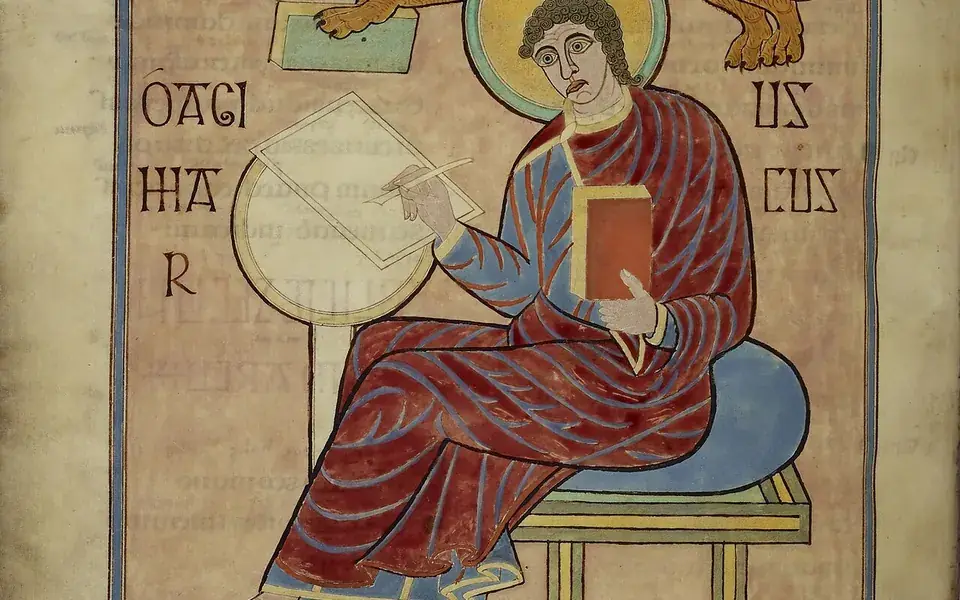
The Lindisfarne Gospels (London, British Library Cotton MS Nero D.IV) is an illuminated manuscript gospel book in the Latin language produced probably around the years 715–720 in the monastery at Lindisfarne, off the coast of Northumberland, which is now in the British Library in London. The manuscript is considered one of the finest works in the unique style of Hiberno-Saxon or Insular art, combining Mediterranean, Anglo-Saxon and Celtic elements.
Commission
The Lindisfarne Gospels is a Christian manuscript, containing the four gospels recounting the life and teachings of Jesus Christ. The manuscript was used for ceremonial purposes to promote and celebrate the Christian religion and the word of God. Because the body of Cuthbert was buried there, Lindisfarne became an important pilgrimage destination in the 7th and 8th centuries, and the Lindisfarne Gospels would have contributed to the cult of St Cuthbert. The gospels used techniques reminiscent of elite metalwork to impress a Northumbrian audience, most of whom could not read, and certainly not understand the Latin text.
According to Aldred's colophon, the Lindisfarne Gospels were made in honour of God and Saint Cuthbert, a Bishop of the Lindisfarne monastery who was becoming "Northern England's most popular Saint". Scholars think that the manuscript was written sometime between Cuthbert's death in 687 and Eadfrith's death in 721. There is a significant amount of information known about Cuthbert thanks to two accounts of his life that were written shortly after his death, the first by an anonymous monk from Lindisfarne, and the second by Bede, a famous monk, historian, and theologian.
Cuthbert entered into the monastery of Melrose, now in lowland Scotland but then in Northumbria, in the late 7th century, and after being ordained a priest he began to travel throughout Northumbria, "rapidly acquiring a reputation for holiness and for the possession of miraculous powers". The Synod of Whitby in 664 pitted the Hiberno-Celtic church against the Roman church regarding the calculation of the date of Easter. The dispute was adjudged by King Oswiu of Northumbria in favour of the Roman church, but many of the leading monks at Lindisfarne then returned to Iona and Ireland, leaving only a residue of monks affiliated to the Roman church at Lindisfarne. Due to increasingly slack religious practice in Lindisfarne, Cuthbert was sent to Lindisfarne to reform the religious community.
Techniques
The Lindisfarne Gospels manuscript was produced in a scriptorium in the monastery of Lindisfarne. It took approximately 5 to 10 years to create. Its pages are vellum, and evidence from the manuscript reveals that the vellum was made using roughly 150 calf skins. The book is 516 pages long. The text is written "in a dense, dark brown ink, often almost black, which contains particles of carbon from soot or lamp black". The pens used for the manuscript could have been cut from either quills or reeds, and there is also evidence to suggest that the trace marks (seen under oblique light) were made by an early equivalent of a modern pencil. Lavish jewellery, now lost, was added to the binding of the manuscript later in the 8th century. Eadfrith manufactured 90 of his own colours with "only six local minerals and vegetable extracts".
There is a huge range of individual pigments used in the manuscript. The colours are derived from animal, vegetable and mineral sources. Gold is used in only a couple of small details. While some colours were obtained from local sources, others were imported from the Mediterranean. The blue was long thought to be ultramarine from Afghanistan, but analysis with Raman microscopy in the 2000s revealed it to be indigo. The medium used to bind the colours was primarily egg white, with fish glue perhaps used in a few places. Backhouse emphasizes that "all Eadfrith's colours are applied with great skill and accuracy, but... we have no means of knowing exactly what implements he used".
The decoration of the manuscript
A manuscript so richly decorated reveals that the Lindisfarne Gospels not only had a practical ceremonial use but also attempted to symbolize the Word of God in missionary expeditions. Backhouse points out that the clergy was not unaware of the profound impression a book such as the Lindisfarne Gospels made on other congregations. The opening words of the Gospel (the incipits) are highly decorated, revealing Roman capitals, Greek and Germanic letters, filled with interlaced birds and beasts, representing the splendour of God's creation. On one page alone, there are 10,600 decorative red dots. Different kinds of pigment are used throughout the manuscript. Red lead and gold were also used for decoration.