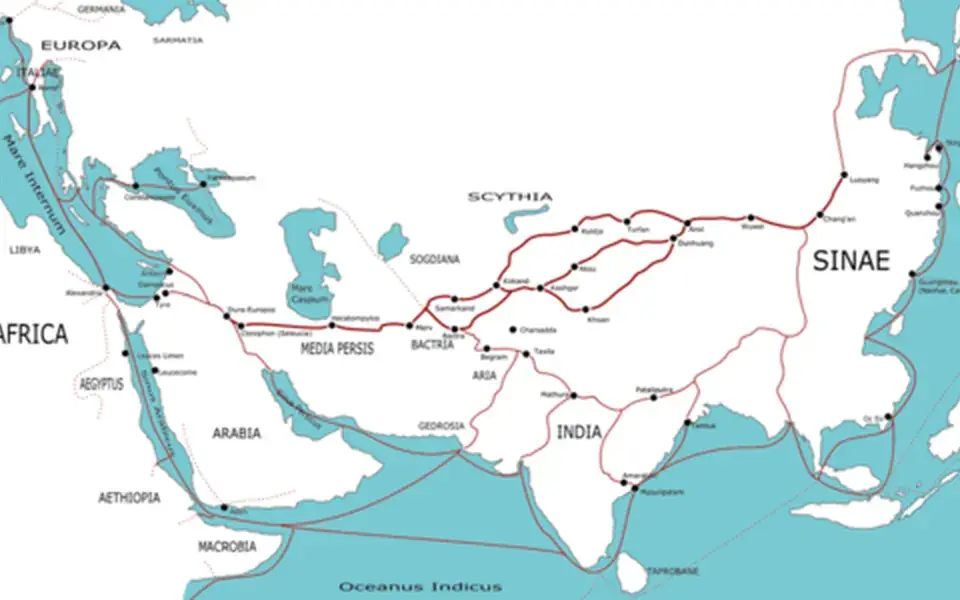
The Maritime Silk Road connected ports across East Asia, Southeast Asia, South Asia, and other regions. Sailors used monsoon winds and accumulated navigational experience to travel between them. Goods, religions, and people often moved together. Routes also changed as ports rose or declined and political conditions shifted, rather than remaining a single fixed sea lane.
Historical background
The Maritime Silk Road or Maritime Silk Route is an ancient maritime trade route in the Indian Ocean and the Western Pacific that connected Southeast Asia, East Asia, the Indian subcontinent, the Arabian Peninsula, eastern Africa, and Europe. It began by the 2nd century BCE and flourished until the 15th century CE. The Maritime Silk Road was primarily established and operated by Austronesian sailors in Southeast Asia who sailed large long-distance ocean-going sewn-plank and lashed-lug trade ships. The route was also utilized by the dhows of the Persian and Arab traders in the Arabian Sea and beyond, and the Tamil merchants in South Asia. China also started building their own trade ships (chuán) and followed the routes in the later period, from the 10th to the 15th centuries CE.
The network followed the footsteps of older Austronesian jade maritime networks in Southeast Asia, as well as the maritime spice networks between Southeast Asia and South Asia, and the West Asian maritime networks in the Arabian Sea and beyond, coinciding with these ancient maritime trade roads by the current era.
The term "Maritime Silk Road" is a modern name, acquired from its similarity to the overland Silk Road. The ancient maritime routes through the Indo-West Pacific (Southeast Asia and the Indian Ocean) had no particular name for the majority of its very long history. Despite the modern name, the Maritime Silk Road involved exchanges in a wide variety of goods over a very wide region, not just silk or Asian exports.
Maritime Silk Road
By around the 2nd century BCE, the prehistoric Austronesian jade and spice trade networks in Southeast Asia fully connected with the maritime trade routes of South Asia, the Middle East, eastern Africa, and the Mediterranean, becoming what is now known as the Maritime Silk Road. Prior to the 10th century, the eastern part of the route was primarily used by Southeast Asian Austronesian traders using distinctive sewn-plank and lashed-lug ships, although Persian and Tamil traders also sailed the western parts of the routes. It allowed the exchange of goods from East and Southeast Asia on one end, all the way to Europe and eastern Africa on the other.
Austronesian thalassocracies controlled the flow of trade in the eastern regions of the Maritime Silk Road, especially the polities around the straits of Malacca and Bangka, the Malay Peninsula, and the Mekong Delta; through which passed the main routes of the Austronesian trade ships to Giao Chỉ (in the Tonkin Gulf) and Guangzhou (southern China), the endpoints (later also including Quanzhou by the 10th century CE). Chinese records misidentified these kingdoms as being "Indian" due to the Indianization of these regions. Secondary routes also passed through the coastlines of the Gulf of Thailand; as well as through the Java Sea, Celebes Sea, Banda Sea, and the Sulu Sea, reconnecting with the main route through the northern Philippines and Taiwan.
The secondary routes also continue onward to the East China Sea and the Yellow Sea for a limited extent. Glass artifacts from India and Egypt that passed through glassworkers in Southeast Asian and South Asian ports have been recovered from graves in the Korean Peninsula (c. 2nd-6th centuries CE), showing the furthest northeastern extent of the Maritime Silk Road.
The main route of the western regions of the Maritime Silk Road directly crosses the Indian Ocean from the northern tip of Sumatra (or through the Sunda Strait) to Sri Lanka, southern India and Bangladesh, and the Maldives. It branches from here into routes through the Arabian Sea entering the Gulf of Oman (into the Persian Gulf), and the Gulf of Aden (into the Red Sea).