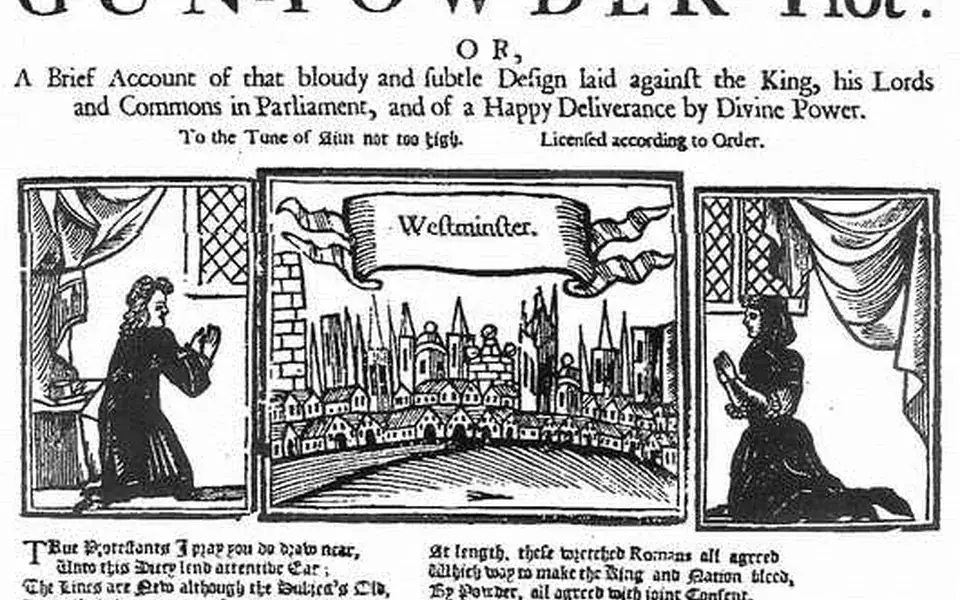
The Gunpowder Plot of 1605, in earlier centuries often called the Gunpowder Treason Plot or the Jesuit Treason, was an unsuccessful attempted regicide against King James VI of Scotland and I of England by a group of English Catholics, led by Robert Catesby.
Initial planning
The first meeting between the five conspirators took place on 20 May 1604, probably at the Duck and Drake Inn, just off the Strand, Thomas Wintour's usual residence when staying in London. Catesby, Thomas Wintour, and John Wright were in attendance, joined by Guy Fawkes and Thomas Percy. Alone in a private room, the five plotters swore an oath of secrecy on a prayer book. By coincidence, and ignorant of the plot, John Gerard (a friend of Catesby's) was celebrating Mass in another room, and the five men subsequently received the Eucharist.
Undercroft
In addition, 25 March was the day on which the plotters purchased the lease to the undercroft they had supposedly tunnelled near to, owned by John Whynniard. The Palace of Westminster in the early 17th century was a warren of buildings clustered around the medieval chambers, chapels, and halls of the former royal palace that housed both Parliament and the various royal law courts. The old palace was easily accessible; merchants, lawyers, and others lived and worked in the lodgings, shops and taverns within its precincts. Whynniard's building was along a right-angle to the House of Lords, alongside a passageway called Parliament Place, which itself led to Parliament Stairs and the River Thames. Undercrofts were common features at the time, used to house a variety of materials including food and firewood.
Whynniard's undercroft, on the ground floor, was directly beneath the first-floor House of Lords, and may once have been part of the palace's medieval kitchen. Unused and filthy, its location was ideal for what the group planned to do. In the second week of June, Catesby met in London the principal Jesuit in England, Henry Garnet, and asked him about the morality of entering into an undertaking which might involve the destruction of the innocent, together with the guilty. Garnet answered that such actions could often be excused, but according to his own account later admonished Catesby during a second meeting in July in Essex, showing him a letter from the pope which forbade rebellion. Soon after, the Jesuit priest Oswald Tesimond told Garnet he had taken Catesby's confession, in the course of which he had learnt of the plot. Garnet and Catesby met for a third time on 24 July 1605, at the house of the wealthy Catholic Anne Vaux in Enfield Chase.
Discovery
The letter was shown to the King on the first of November following his arrival back in London. Upon reading it, James immediately seized upon the word "blow" and felt that it hinted at "some strategem of fire and powder", perhaps an explosion exceeding in violence the one that killed his father, Lord Darnley, at Kirk o' Field in 1567. Keen not to seem too intriguing, and wanting to allow the King to take the credit for unveiling the conspiracy, Salisbury feigned ignorance. The following day members of the Privy Council visited the King at the Palace of Whitehall and informed him that, based on the information that Salisbury had given them a week earlier, on Monday the Lord Chamberlain Thomas Howard, 1st Earl of Suffolk, would undertake a search of the Houses of Parliament, "both above and below".
On Sunday 3 November, Percy, Catesby and Wintour had a final meeting, where Percy told his colleagues that they should "abide the uttermost triall", and reminded them of their ship waiting at anchor on the Thames. By 4 November, Digby was ensconced with a "hunting party" at Dunchurch, ready to abduct Elizabeth. The same day, Percy visited the Earl of Northumberland—who was uninvolved in the conspiracy—to see if he could discern what rumours surrounded the letter to Monteagle. Percy returned to London and assured Wintour, John Wright, and Robert Keyes that they had nothing to be concerned about, and returned to his lodgings on Gray's Inn Road. That same evening Catesby, likely accompanied by John Wright and Bates, set off for the Midlands. Fawkes visited Keyes, and was given a pocket watch left by Percy, to time the fuse, and an hour later Rookwood received several engraved swords from a local cutler.