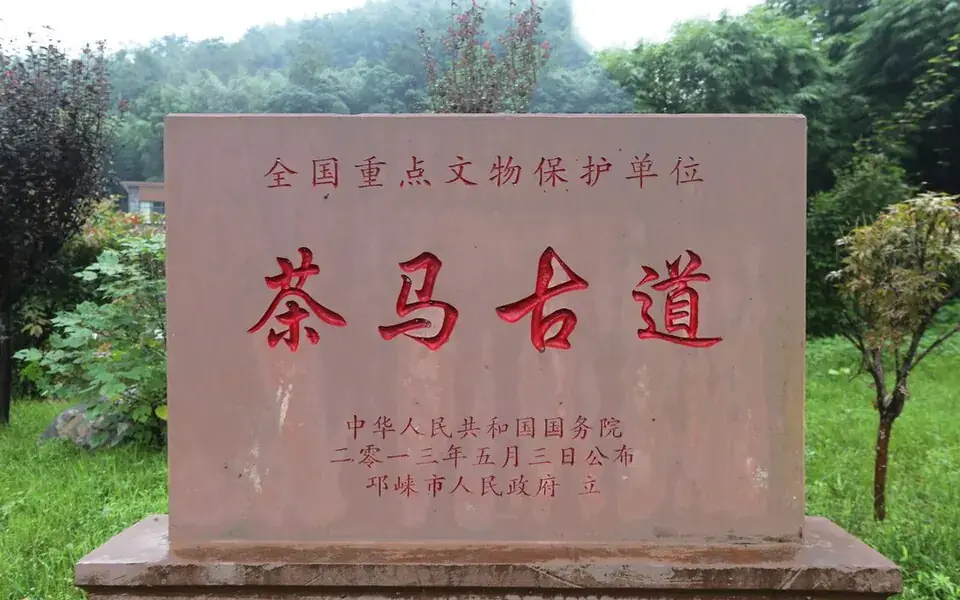
The Tea Horse Road commonly refers to transport and trading routes across southwestern China and neighboring regions, where tea, horses, and other goods moved through mountain networks. There was no single fixed road, and paths varied across regions and periods. Caravans, markets, and the natural environment together shaped trade.
Historical background
The Tea Horse Road or Chamadao, now generally referred to as the Ancient Tea Horse Road or Chamagudao was a network of caravan paths winding through the mountains of Sichuan, Yunnan and Tibet in Southwest China. This was also a tea trade route. It is also sometimes referred to as the "Southern Silk Road" or "Southwest Silk Road."
There are numerous surviving archaeological and monumental elements, including trails, bridges, way stations, market towns, palaces, staging posts, shrines and temples along the route.
"Ancient Tea Horse Road" is a historical concept with a specific meaning. It refers to a major traffic road formed by the exchange of tea and horses between Han and Tibet from the Tang and Song Dynasties to the Republic of China.
Yunnan-Tibet Tea Horse Road
The Yunnan-Tibet Tea Horse Road was formed in the late sixth century AD. It started from Yiwu and Pu'er in Xishuangbanna, the main tea producing area of Yunnan, and entered Tibet through today's Dali Bai Autonomous Prefecture, Lijiang City and Shangri-La, and went directly to Lhasa. Some were also re-exported from Tibet to India and Nepal, which was an important trade route between ancient China and South Asia.
The Ancient Sichuan–Tibet Tea-Horse Road is a part of the Shaanxi–Kangding–Tibet Tea-Horse Road. It starts from Ya'an, the tea producing area of Yazhou in the east, passes through Dartsedo (now Kangding), reaches Lhasa, Tibet, in the west, and finally leads to Bhutan, Nepal and India. More than a thousand kilometres, it is an indispensable bridge and link between ancient Tibet and the mainland.
History
Sichuan and Yunnan are believed to be the first tea-producing regions in the world. The first records of tea cultivation suggest that tea was cultivated on Sichuan's Mount Mengding between Chengdu and Ya'an earlier than 65 BC. Ya'an has been an important hub of tea trading till the 20th century.
From around a thousand years ago, the Tea Horse Road become a trade link from Yunnan to Tibet; and to Central China via Sichuan Province. It is believed that it was through this trading network that tea (typically tea bricks) first spread across China and Asia from its origins in Pu'er county in Yunnan. The route earned the name because of the common trade of Tibetan ponies for Chinese tea, a practice dating back at least to the Song dynasty, when the sturdy horses were important for China to fight warring nomads in the north.
Both people and horses carried heavy loads. Tea porters sometimes carried over 60–90 kg (132-198 lb.), which was often more than their own body weight in tea. Porters were equipped with metal-tipped staffs, both for balance while walking and to help support the load while they rested, so they didn't need to lay the bales down (as illustrated in the photo).
Tanggu Road
Beginning in the Han dynasty, the Tanggu Road was formed by Shaanxi merchants and the ancient tea-horse market in the southwest frontier. Since the government of the Ming and Qing dynasties imposed government control on tea sales, tea sales were divided into regions, and the most prosperous tea and horse trading market was in Kangding.
The site of Guangen Bridge is located in Minjiang Village, Zhen Yuan County and Enle Old Street river bank, built in the early Qing dynasty, the bridge is 188 meters long, with stone piers and wooden frames, and more than 50 tiled houses on both sides. Qing Yongzheng five years (1727) flooding washed away, the Qing dynasty Yongzheng eight years (1730) and the Qing dynasty Daoguang three years (1823), the county Tan on the restoration of the wide grace bridge.
Qing dynasty Daoguang six years (1826), the county Zhang Zhao additional repaired the Guangen Bridge. Qing dynasty Tongzhi's first year (1862), this bridge was burned again.