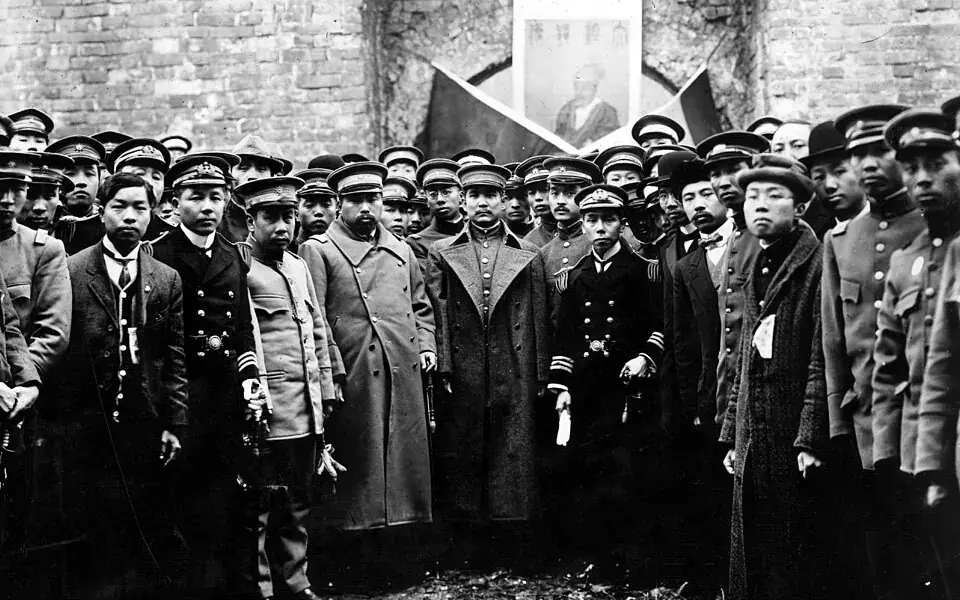
The 1911 Revolution was connected with the Wuchang Uprising and responses in many regions, eventually leading to the Qing emperor's abdication and the establishment of the Republic of China. It was not confined to a single city. Different regions and political forces did not share identical aims. The outcome also depended on negotiations, armies, and changes in local society.
Historical background
The 1911 Revolution, also known as the Xinhai Revolution or Hsinhai Revolution, culminated in the end of China's last imperial dynasty, the Qing dynasty, and led to the establishment of the Republic of China (ROC). The revolution was the culmination of a decade of agitation, revolts, and uprisings. Its success marked the end of Chinese monarchy, the 267-year reign of the Qing, over two millennia of imperial rule in China, and the beginning of China's early republican era.
The Qing had long struggled to reform the government and resist foreign aggression, but conservatives in the Qing court opposed the program of reforms after 1900 as too radical and reformers considered it too slow. Several factions, including underground anti-Qing groups, revolutionaries in exile, reformers who wanted to save the monarchy by modernizing it, and activists across the country debated how or whether to overthrow the Qing dynasty.
The flashpoint came on 10 October 1911 with the Wuchang Uprising, an armed rebellion by members of the New Army. Similar revolts then broke out spontaneously around the country, and revolutionaries in every province renounced the Qing dynasty. On 1 November 1911, the Qing court appointed Yuan Shikai (leader of the Beiyang Army) as prime minister, and he began negotiations with the revolutionaries.
Wuchang Uprising
The Literary Society and the Progressive Association were revolutionary organizations that involved in the uprising that began mainly by a Railway Protection Movement. In the late summer, some Hubei New Army units were ordered to neighboring Sichuan to quell the Railway Protection Movement, a mass protest against the Qing government's seizure and handover of local railway development ventures to foreign powers. Banner officers like Duanfang, the railway superintendent, and Zhao Erfeng led the New Army against the Railway Protection Movement.
The New Army units of Hubei had originally been the Hubei Army, which had been trained by Qing official Zhang Zhidong. On 24 September, the Literary Society and Progressive Association convened a conference in Wuchang, along with sixty representatives from local New Army units. During the conference, they established a headquarters for the uprising. The leaders of the two organizations, Jiang Yiwu and Sun Wu, were elected as commander and chief of staff. Initially, the date of the uprising was to be 6 October 1911. It was postponed because of insufficient preparations.
Revolutionaries intent on overthrowing the Qing dynasty had built bombs, and on 9 October, one of them accidentally exploded. Sun had no direct part in the uprising and was traveling in the United States to recruit more support from overseas Chinese. The Qing Viceroy of Huguang, Rui Cheng, tried to track down and arrest the revolutionaries. The squad leader Xiong Bingkun and others decided not to delay the uprising any longer and launched the revolt on 10 October 1911, at 7:00 p.m.
Nationwide uprisings after Wuchang
After the success of the Wuchang Uprising, many other protests occurred throughout the country for various reasons. Some uprisings declared restoration of Han Chinese rule. Other uprisings were a step toward independence, and some were protests or rebellions against the local authorities. Regardless of the reason for the uprising, the outcome was that all of the provinces renounced the Qing dynasty and joined the republicans.
On 18 December, the North–South Conference was held in Shanghai to discuss issues in the north and the south. The reluctance of foreign financiers to give financial support to the Qing government or the revolutionaries contributed to both sides agreeing to start negotiations. Yuan Shikai selected Tang Shaoyi as his representative. Tang left Beijing for Wuhan to negotiate with the revolutionaries. The revolutionaries chose Wu Tingfang. With the intervention of six foreign powers (the United Kingdom, the United States, Germany, Russia, Japan, and France), Tang Shaoyi and Wu Tingfang began to negotiate a settlement at the British concession.