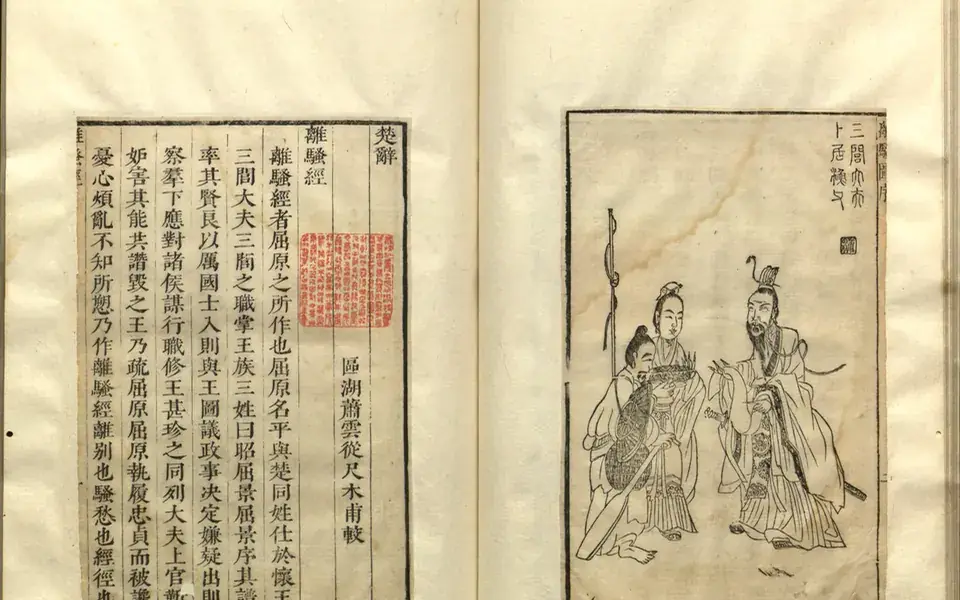
The Songs of Chu preserves poetry associated with the culture of Chu. Fragrant plants, beautiful figures, deities, and distant journeys frequently serve as images for emotion. Qu Yuan is an important author within the collection, whose formation also involved later compilers. The poems combine historical settings with rich literary symbolism.
Historical background
The Chu Ci, variously translated as Verses of Chu, Songs of Chu, or Elegies of Chu, is an ancient anthology of Chinese poetry including works traditionally attributed mainly to Qu Yuan and Song Yu from the Warring States period, as well as a large number of works composed during the Han dynasty several centuries later. The traditional version of the Chu Ci contains 17 major sections, anthologized with its current contents by Wang Yi, a 2nd-century AD librarian who served under Emperor Shun of Han. Classical Chinese poetry prior to the Qin dynasty is largely known through the Chu Ci and the Classic of Poetry.
The Chu Ci was named after a form of poetry that originated in the State of Chu, which was located in what is now central China, but was then in the southern fringe of the Chinese cultural area. The territory of Chu was known for its blend of culture from the Central Plain, or "north", with other cultural influences, associated with the "south". Thus, north Chinese sometimes viewed the Chu as part of "the south", which had a reputation for various exotic features. The Chu Ci verses characteristically strongly feature the presence of the exotic. A Chinese form of shamanism was prominent in Chu, and a large number of the Chu Ci verses describe "spirit journeys".
However, southern influence was extremely insignificant, only limited to the ideas of shamanism and burial objects which were from the south; other than that literature, poetry, clothing and architecture all remained northern.
Other references to the exotic include encounters with various magical or fragrant plants and interaction with various spirits and deities, and travel to various exotic locations, such as the heavens, the ends of the earth, Bactria, and the Mount Kunlun of mythology.
Qu Yuan
The name "Qu Yuan" does not occur in any text prior to the Han dynasty (202 BC – AD 220). According to common tradition, Qu Yuan was an administrative official in the court of King Huai of Chu (r. 328–299 BC) who advocated forming an alliance with the other states against the increasingly dominant power of the Qin kingdom, during the Warring States period; however, his advice was not taken and he was slandered by other officials in court: seeing the corruption of his colleagues and the inability of his king to appreciate his true worth, Qu Yuan went into exile and then finally committed suicide by wading into the Miluo River with a heavy rock, when Qin general Bo Qi sacked the Chu capital Ying in 278 BC, forcing the royal court to relocate with considerable loss of territory. It is also traditionally said that it is in remembrance of the circumstances of Qu Yuan's death that the annual Dragon boat races are held.
During his days of exile, Qu Yuan is thought to have written Li Sao. The authorship, as in many a case of ancient literature, can be neither confirmed nor denied. Written in 373 verses containing 2490 characters, Li Sao is a long Chinese poem.
Authorship and editing
Although Chu ci is an anthology of poems by many poets, Qu Yuan was its central figure, both as author of the Li Sao section and in the persona of protagonist. There are various other authors which are also thought to have written various sections of the Chu Ci, as well as some sections which may derive from some traditional source. Various scholarly sources propose solutions for who wrote what, in the Chu Ci, with more doubt or questions about some sections than others.
Besides the actual authorship of the diverse material of the Chu Ci, another scholarly concern is in regard to the history of who and when these pieces were collected and anthologized into one work, and also what other editorial work was done. Besides the authorship of the actual content, much commentary has been written in regard to the Chu Ci, some of which is traditionally incorporated into the printed editions.