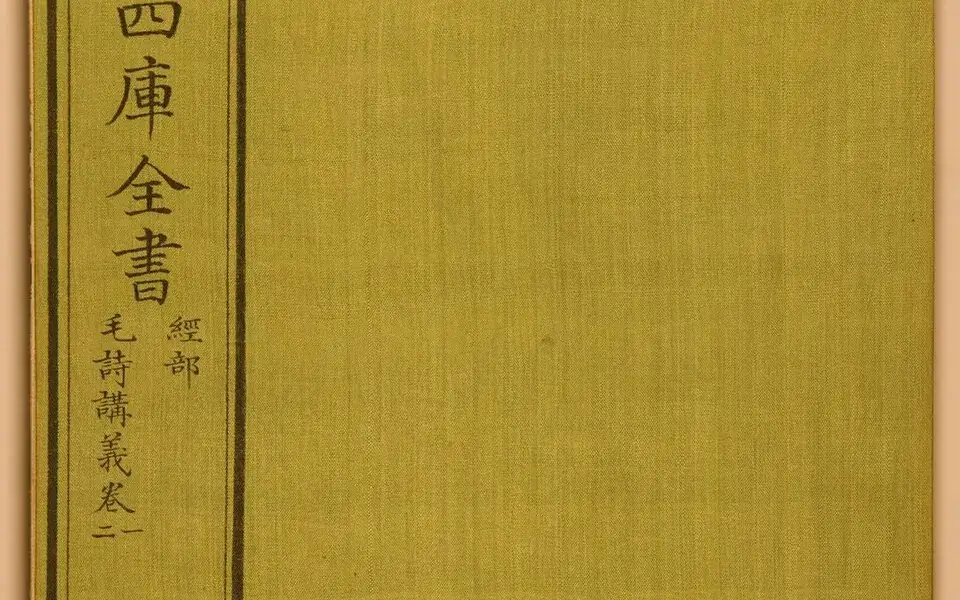
The Complete Library of the Four Treasuries arranged books under Classics, Histories, Masters, and Collections, with accompanying catalog summaries describing and assessing the works. This classification arose from traditional scholarship and does not match modern disciplinary boundaries. Political and cultural judgments in the Qing also shaped which books were included or excluded.
Historical background
The Siku Quanshu, literally the Complete Library of the Four Treasuries, is a Chinese encyclopedia commissioned during the Qing dynasty by the Qianlong Emperor. Commissioned in 1772 and completed in 1782, the Siku quanshu is the largest collection of books in imperial Chinese history, comprising 36,381 volumes, 79,337 manuscript rolls, 2.3 million pages, and about 997 million words. The complete encyclopedia contains an annotated catalogue of 10,680 titles along with a compendium of 3,593 titles. The Siku Quanshu surpassed the 1403 Yongle Encyclopedia created by the previous Ming dynasty, which had been China's largest encyclopedia. Complete copies of the Siku Quanshu are held at the National Library of China in Beijing, the National Palace Museum in Taipei, the Gansu Library in Lanzhou, and the Zhejiang Library in Hangzhou.
The Qianlong Emperor of the Qing dynasty ordered the creation of the Siku Quanshu in 1772. Local and provincial officers were put in charge of locating and collecting important books, and the emperor encouraged owners of rare or valuable books to send them to the capital. At first, few did, because of concerns about the Literary Inquisition, but towards the end of 1772 the emperor issued a decree stating that books would be returned to their owners once the compilation was finished and that the owners would not be punished if their books contained Anti-Qing sentiment. Less than three months after the issue of this decree, four to five thousand books were handed in.
By March 1773, an editorial board composed of hundreds of editors, collators, and copyists had been created in Beijing to gather and review books brought to them. This board included more than 361 scholars, with Ji Yun and Lu Xixiong as chief editors. Around 3,826 scribes copied every word by hand. They were not paid in cash, but each was given a government position after he had transcribed a set number of sections of the encyclopedia. Following its ten-year-long compilation, seven copies were produced of the completed encyclopedia, which were distributed throughout the empire.
Compilation
The initial compilation of the Siku Quanshu started with the Siku Quanshu Zongmu Tiyao bibliography, which was completed by 1773. The first workable drafts were completed in 1781. These included bibliographical information on all the works included in the Siku Quanshu in full as well as a large number of works that are mentioned only by title.
In the course of editing, a large number of corrections were made to local records. Personal documents, often describing the actions of noteworthy local people, were often included in the Annotated Bibliography of the Four Treasuries if their contents could be verified through central government records. In the Siku Quanshu itself, documents that could not be verified were often included by title only. Even officially sponsored writings, such as local gazetteers, were not safe from the scrutiny of the compilers.
Medical knowledge was often documented through case studies, on the model of twenty-five instances in Sima Qian's Records of the Grand Historian, which blended narrative with analysis. Similarly, works on philosophy took Huang Zongxi's writings as their model, though they came to be divided into two types: "archival", meaning scholarly articles, and "cultural", meaning Buddhist koans. Because authors and previous compilers had not considered philosophical works to form part of historical records, the compilers of the Siku Quanshu redefined the classifications in several compilations and set boundaries based on authors' biographies and the purposes of their writings.
Distribution
The Qianlong Emperor commissioned seven copies of the Siku Quanshu. The first four copies were for the emperor himself and were kept in the north, in specially constructed libraries in the Forbidden City, Old Summer Palace, Shenyang, and Chengde. The remaining three copies were sent to the south, where they deposited in libraries in the cities of Hangzhou, Zhenjiang, and Yangzhou. All seven libraries also received copies of the imperial encyclopedia Complete Classics Collection of Ancient China, completed in 1725.