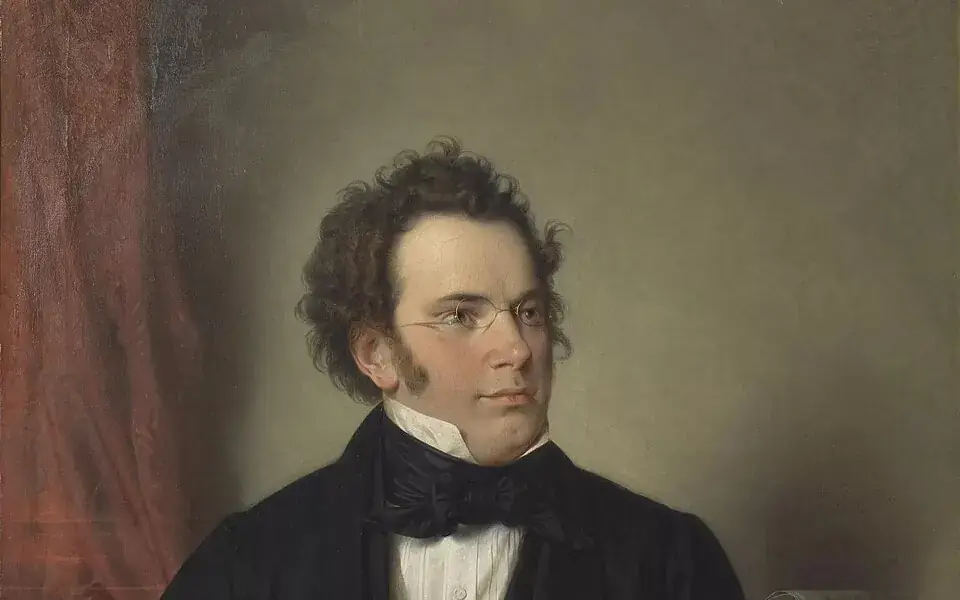
Schubert composed many art songs, joining vocal melody, poetry, and piano parts. The accompaniment often helps create a setting or reveal a character's state of mind. Works such as Erlkonig demonstrate the narrative role of piano rhythms. He also wrote symphonies and chamber music, among other forms, and was not solely a songwriter.
Historical background
Franz Peter Schubert was an Austrian composer of the late Classical and early Romantic eras. He was immensely prolific despite living a short life, leaving behind a vast oeuvre of more than 1,000 compositions, including over 600 Lieder (art song in German) and other vocal works, seven complete symphonies, sacred music, operas, incidental music, and a large body of piano and chamber music. Among these are the songs "Gretchen am Spinnrade", "Erlkönig" and "Ave Maria"; the Trout Quintet; the Symphony in B minor, "Unfinished"; the Symphony in C major, "The Great"; the String Quartet No. 14 in D minor (Death and the Maiden); the String Quintet in C major; the Impromptus for solo piano; the last three piano sonatas; the Fantasia in F minor for piano four hands; the incidental music to the play Rosamunde; the song cycles Die schöne Müllerin and Winterreise; and the song collection Schwanengesang.
In July 1947 the Austrian composer Ernst Krenek discussed Schubert's style, abashedly admitting that he had at first "shared the wide-spread opinion that Schubert was a lucky inventor of pleasing tunes... lacking the dramatic power and searching intelligence which distinguished such 'real' masters as J. S. Bach or Beethoven". Krenek wrote that he reached a completely different assessment after a close study of Schubert's pieces at the urging of his friend and fellow composer Eduard Erdmann.
Krenek pointed to the piano sonatas as giving "ample evidence that Schubert was much more than an easy-going tune-smith who did not know, and did not care, about the craft of composition." Each sonata then in print, according to Krenek, exhibited "a great wealth of technical finesse" and revealed Schubert as "far from satisfied with pouring his charming ideas into conventional moulds; on the contrary he was a thinking artist with a keen appetite for experimentation."
Lieder and art songs
Schubert's most remarkable output was that of his Lied. Leon Plantinga remarks that "in his more than six hundred Lieder he explored and expanded the potentialities of the genre, as no composer before him." Prior to Schubert's influence, Lieder tended toward a strophic, syllabic treatment of text, evoking the folksong qualities engendered by the stirrings of Romantic nationalism.
Antonín Dvořák wrote in 1894 that Schubert, whom he considered one of the truly great composers, was clearly influential on shorter works, especially Lieder and shorter piano works: "The tendency of the romantic school has been toward short forms, and although Weber helped to show the way, to Schubert belongs the chief credit of originating the short models of piano forte pieces which the romantic school has preferably cultivated.... Schubert created a new epoch with the Lied.... All other songwriters have followed in his footsteps."
Among Schubert's treatments of the poetry of Johann Wolfgang von Goethe, his settings of "Gretchen am Spinnrade" (D. 118) and "Der Erlkönig" (D. 328) are particularly striking for their dramatic content, forward-looking uses of harmony, and use of eloquent pictorial keyboard figurations, such as the depiction of the spinning wheel and treadle in the piano in "Gretchen" and the furious and ceaseless gallop in "Erlkönig". He composed music using the poems of myriad poets, with Goethe, Mayrhofer, and Schiller the most frequent, and others, including Heinrich Heine, Friedrich Rückert, and Joseph Freiherr von Eichendorff.
Alex Ross writes of "Gretchen am Spinnrade", "The propulsive, repetitive piano accompaniment, an archetypal feat of tone painting, depicts the mechanical whirl of Gretchen’s spinning wheel as she sings of her uneasy passion."
Of particular note are his two song cycles on the poems of Wilhelm Müller, Die schöne Müllerin and Winterreise, which helped to establish the genre and its potential for musical, poetic, and almost operatic dramatic narrative. The Wiener Theaterzeitung, writing about Winterreise at the time, commented that it was a work that "none can sing or hear without being deeply moved".