Mozart's works commonly bear K or KV numbers from the catalog compiled by Kochel. They were not a uniform numbering system that Mozart personally assigned to every composition.
The catalog has been revised, and dates and attributions can change. Its numbers help researchers and listeners identify individual works among his many compositions.
Historical context
The Köchel catalogue (German: Köchel-Verzeichnis) is a catalogue of compositions by Wolfgang Amadeus Mozart, originally created by Ludwig Ritter von Köchel, in which the entries are abbreviated K. or KV. Its numbers reflect the ongoing task of compiling the chronology of Mozart's works, and provide a shorthand reference to the compositions. For example, according to Köchel's counting, Requiem in D minor is the 626th piece Mozart composed, thus is designated K. 626.
Köchel's original catalogue (1862) has been revised several times. Catalogue numbers from these revised editions are indicated either by parentheses or by superscript: K. 49 (47d) or K. 47d refers to the work numbered 47d in the sixth edition. The catalog was originally chronological, though revisions made chronological ordering of Mozart's works difficult and as of 2024 a new organizational system is used for the ninth version.
History
From the time Köchel published his original catalogue in 1863 (now referred to as K), the dating of Mozart's compositions has been subject to constant revision. Many more pieces have since been discovered, re-dated, or re-attributed, necessitating multiple revised editions of the catalogue. Subsequent editions – especially the third edition (K) by Alfred Einstein (1937), and the sixth edition (K) by Franz Giegling, Gerd Sievers, and Alexander Weinmann (1964) – have reflected attempts to arrange the growing list of works in a more accurate chronological order, according to updated scholarship.
In response to the confusing renumbering between versions, and resistance by users to any further changes, the ninth edition (K) by Neal Zaslaw (2024) explicitly abandoned the goal of chronological ordering. Instead, to be more consistent with past usage, almost all works in the main catalogue that had been included in a previous edition of the main catalogue returned to the oldest number they had been given. Works newly included in the ninth edition's main catalogue were given numbers past 626, up to 721.
Some works in Anh. A have been identified since 1965 as by Leopold Mozart. Many works in Anh. C have since been more reliably assigned to other composers, or to Mozart himself.
Recordings
Recordings of the complete works of Mozart have been issued three times: on the occasion of the bicentenary of Mozart's death in 1991, Philips Classics Records released a 180-CD collection in 45 box sets and each CD in a jewel case, The Complete Mozart Edition, between 1990 and 1991. A selection of 25 CDs from this set, The Best of the Complete Mozart Edition, was published in 1995. The full selection was then released again in 17 box sets as The Compact Complete Mozart Edition in 2000. The Philips collection was made with recordings from world-renowned artists and is of high audio quality. On the occasion of Mozart's 250th birthday in 2006, Brilliant Classics released a single box with 170 CDs, plus one with liner notes to all works and the libretti to vocal works, Mozart Complete Edition.
The author and historical setting
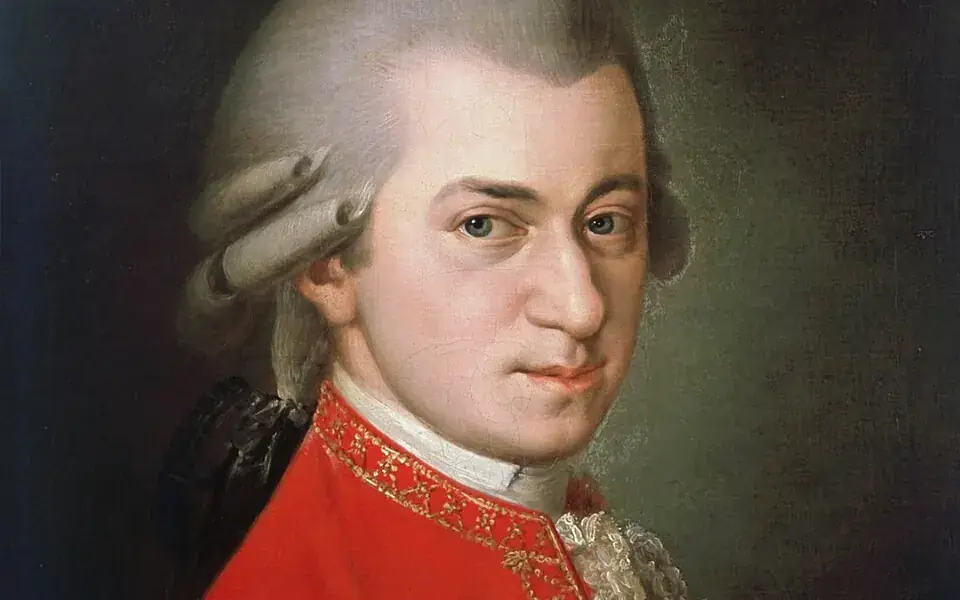
Wolfgang Amadeus Mozart (27 January 1756 – 5 December 1791) was a Classical composer and musician. He completed more than 800 works in his life—including outstanding examples of most of the genres of his time: symphonies, concertos, chamber music, opera and choral music—and is regarded as one of the greatest composers in the history of Western music.
Born in Salzburg, Mozart quickly emerged as a child prodigy under the training of his father Leopold, a skilled pedagogue. At the age of five he was already competent on keyboard and violin, had begun to compose, and had performed before European royalty. His father took him on a grand tour of Europe and then three trips to Italy. At 17 he was a musician at the Salzburg court but grew restless and travelled in search of a better position. A fruitless journey in search of employment (1777–1779) led him to Paris, Mannheim, Munich and eventually back to Salzburg. During this time he wrote his five violin concertos, the Sinfonia Concertante, various masses and the opera Idomeneo.