Vincent van Gogh painted The Starry Night while staying at Saint-Remy for treatment. He combined the view outside his window with memory and imagination, shaping the night sky with swirling lines and vivid colors.
The painting should not be treated as a photographic record of the sky at a single moment. It is connected to his life and artistic explorations during this period.
The asylum
In the aftermath of the 23 December 1888 breakdown that resulted in the self-mutilation of his left ear, Van Gogh voluntarily admitted himself to the Saint-Paul-de-Mausole lunatic asylum on 8 May 1889. Housed in a former monastery, Saint-Paul-de-Mausole catered to the wealthy and was less than half full when Van Gogh arrived, allowing him to occupy not only a second-story bedroom but also a ground-floor room for use as a painting studio.
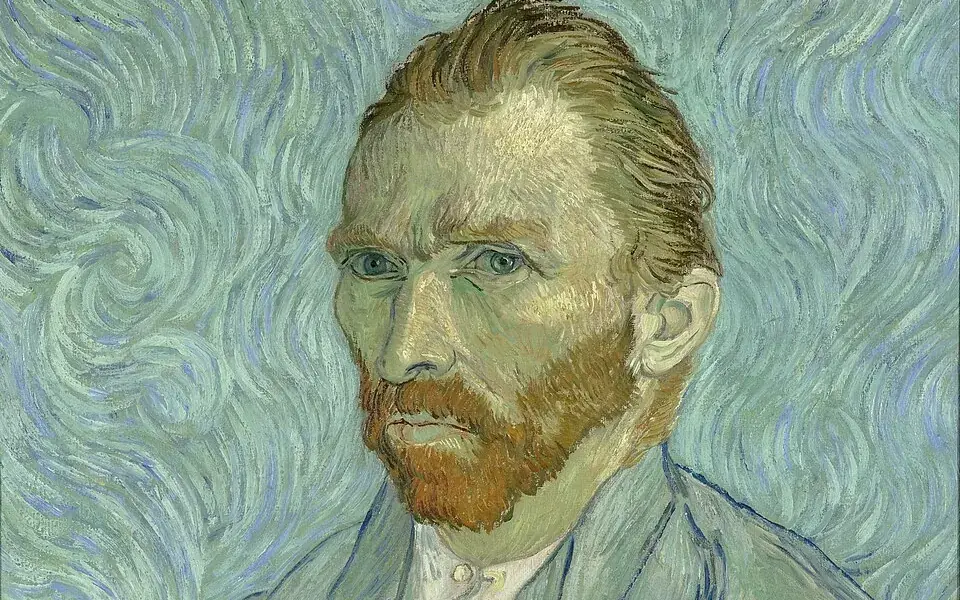
During the year Van Gogh stayed at the asylum in Saint-Rémy-de-Provence, the prolific output of paintings he had begun in Arles continued. During this period, he produced some of the best-known works of his career, including the Irises from May 1889, now in the J. Paul Getty Museum, and the blue self-portrait from September 1889, in the Musée d'Orsay. The Starry Night was painted by around 18 June, the date he wrote to his brother Theo to say he had a new study of a starry sky.
The painting
Although The Starry Night was painted during the day in Van Gogh's ground-floor studio, it would be inaccurate to state that the picture was painted from memory. The view has been identified as the one from his bedroom window, facing east, a view which Van Gogh painted variations of no fewer than twenty-one times, including The Starry Night. "Through the iron-barred window", he wrote to his brother, Theo, around 23 May 1889, "I can see an enclosed square of wheat... above which, in the morning, I watch the sun rise in all its glory."
Van Gogh depicted the view at different times of the day and under various weather conditions, such as the sunrise, moonrise, sunshine-filled days, overcast days, windy days, and one day with rain. While the hospital staff did not allow Van Gogh to paint in his bedroom, he was able there to make sketches in ink or charcoal on paper; eventually, he would base newer variations on previous versions. The pictorial element uniting all of these paintings is the diagonal line coming in from the right depicting the low rolling hills of the Alpilles mountains. In fifteen of the twenty-one versions, cypress trees are visible beyond the far wall enclosing the wheat field. Van Gogh exaggerated their size in six of these paintings, most notably in F717 Wheat Field with Cypresses and The Starry Night, bringing the trees closer to the picture plane.
Also, in addition to that, one of the first paintings of the view was F611 Mountainous Landscape Behind Saint-Rémy, now in Copenhagen. Van Gogh made several sketches for the painting, of which F1547 The Enclosed Wheatfield After a Storm is typical. It is unclear whether the painting was made in his studio or outside. In his 9 June letter describing it, he mentions he had been working outside for a few days. Van Gogh described the second of the two landscapes he mentions he was working on, in a letter to his sister Wil on 16 June 1889. This is F719 Green Wheat Field with Cypress, now in Prague, and the first painting at the asylum he painted en plein air. F1548 Wheatfield, Saint-Rémy de Provence, now in New York, is a study for it.
Two days later, Vincent wrote to Theo stating that he had painted "a starry sky".
The Starry Night is the only nocturne in the series of views from his bedroom window. In early June, Vincent wrote to Theo, "This morning I saw the countryside from my window a long time before sunrise with nothing but the morning star, which looked very big". Researchers have determined that Venus (sometimes referred to as the "morning star") was indeed visible at dawn in Provence in the spring of 1889, and was at that time nearly as bright as possible. So the brightest "star" in the painting, just to the viewer's right of the cypress tree, is Venus.