Hiroshige's The Fifty-three Stations of the Tokaido arranges post stations and road scenes into a series, inviting viewers to experience the weather, people, and terrain of a journey through pictures.
The prints combine observation with artistic arrangement and cannot all be read as exact maps. The series also reflects the travel culture of the Edo period.
Historical context
The Fifty-Three Stations of the Tōkaidō (Tōkaidō Gojūsan-tsugi), in the Hōeidō edition (1833–1834), is a series of ukiyo-e woodcut prints created by Utagawa Hiroshige after his first travel along the Tōkaidō in 1832.
The Tōkaidō road, linking the shōgun's capital, Edo, to the imperial one, Kyōto, was the main travel and transport artery of old Japan. It is also the most important of the "Five Roads" (Gokaidō)—the five major roads of Japan created or developed during the Edo period to further strengthen the control of the central shogunate administration over the whole country.
Even though the Hōeidō edition is by far the best known, The Fifty-Three Stations of the Tōkaidō was such a popular subject that it led Hiroshige to create some 30 different series of woodcut prints on it, all very different one from the other by their size (ōban or chuban), their designs or even their number (some series include just a few prints).
The Hōeidō edition of the Tōkaidō is Hiroshige's best known work, and the best sold ever ukiyo-e Japanese prints. Coming just after Hokusai's Thirty-six Views of Mount Fuji series, it established this new major theme of ukiyo-e, the landscape print, or fūkei-ga, with a special focus on "famous views".
The Tōkaidō
The Tōkaidō was one of the Five Routes constructed under Tokugawa Ieyasu, a series of roads linking the historical capital of Edo with the rest of Japan. The Tōkaidō connected Edo with the then-capital of Kyoto. The most important and well-traveled of these, the Tōkaidō travelled along the eastern coast of Honshū, thus giving rise to the name Tōkaidō ("Eastern Sea Road"). Along this road, there were 53 different post stations, which provided stables, food, and lodging for travelers.
Hiroshige and the Tōkaidō
In 1832, Hiroshige traveled the length of the Tōkaidō from Edo to Kyoto, as part of an official delegation transporting horses that were to be presented to the imperial court. The horses were a symbolic gift from the shōgun, presented annually in recognition of the emperor's divine status.
The landscapes encountered during the journey left a profound impression on the artist, inspiring him to create numerous sketches throughout the trip and upon his return to Edo via the same route. Upon arriving home, he immediately commenced work on the first prints for The Fifty-Three Stations of the Tōkaidō. In the end, he completed a total of 55 prints for the entire series: one for each station along the Tōkaidō, as well as one for both the starting and ending points. But whether he actually visited all the stations and depicted them from his view is subject to academic debate, as some elements in his woodblock prints have been found to actually borrow directly from other works such as the Tōkaidō meisho zue from 1797.
The author and historical setting
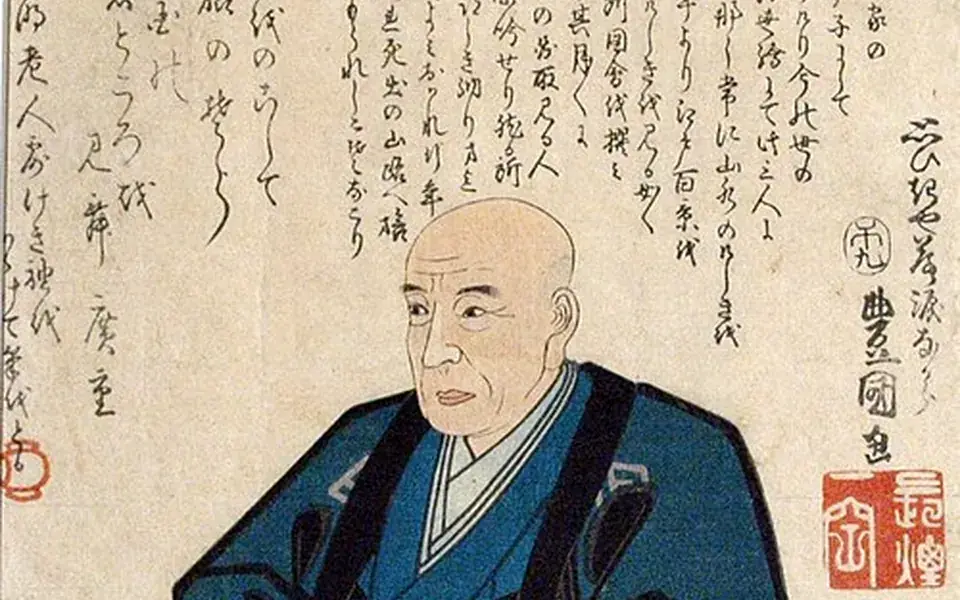
Utagawa Hiroshige or Andō Hiroshige, born Andō Tokutarō (1797 – 12 October 1858), was a Japanese ukiyo-e artist, considered the last great master of that tradition.
Hiroshige is best known for his horizontal-format landscape series The Fifty-three Stations of the Tōkaidō and for his vertical-format landscape series One Hundred Famous Views of Edo. The subjects of his work were atypical of the ukiyo-e genre, whose typical focus was on beautiful women, popular actors, and other scenes of the urban pleasure districts of Japan's Edo period (1603–1868). The popular series Thirty-six Views of Mount Fuji by Hokusai was a strong influence on Hiroshige's choice of subject, though Hiroshige's approach was more poetic and ambient than Hokusai's bolder, more formal prints. Subtle use of color was essential in Hiroshige's prints, often printed with multiple impressions in the same area and with extensive use of bokashi (color gradation), both of which were rather labor-intensive techniques.