Albrecht Durer used woodcuts and engravings to create reproducible images that could be transported, collected, and viewed far from their place of production, unlike a unique oil painting.
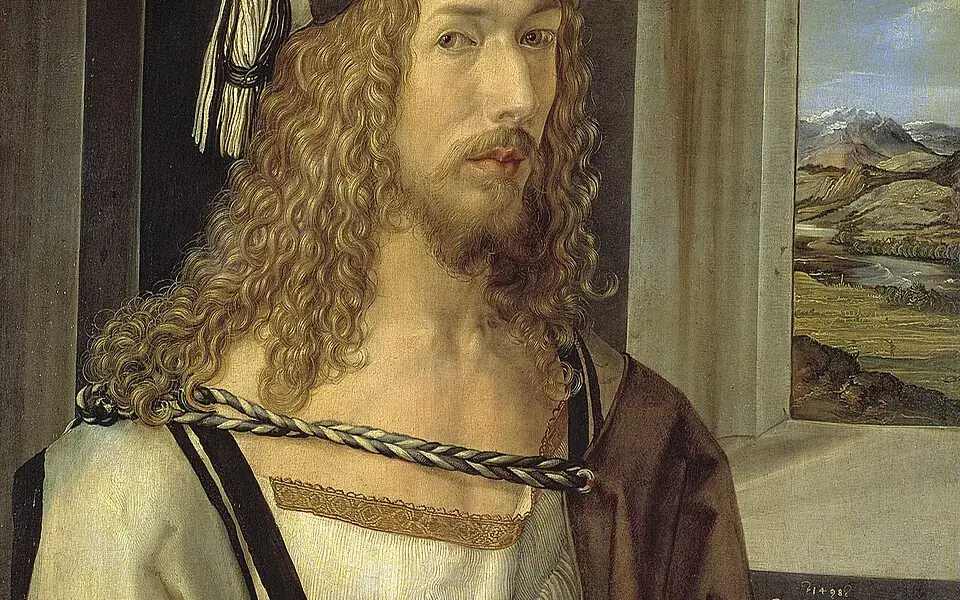
He also studied human proportions and perspective and painted self-portraits. Printmaking combined design, cutting or engraving, and printing, requiring considerable technical skill.
Return to Nuremberg (1495–1505)
On his return to Nuremberg in 1495, Dürer opened his own workshop (being married was a requirement for this). Over the next five years, his style increasingly integrated Italian influences into underlying Northern forms. Arguably his best works in the first years of the workshop were his woodcut prints, mostly religious, but including secular scenes such as The Men's Bath (c. 1496). These were larger and more finely cut than the great majority of German woodcuts hitherto, and far more complex and balanced in composition.
It is now thought unlikely that Dürer cut any of the woodblocks himself; this task would have been performed by a specialist craftsman. However, his training in Wolgemut's studio, which made many carved and painted altarpieces and both designed and cut woodblocks for woodcut, evidently gave him great understanding of what the technique could be made to produce, and how to work with block cutters. Dürer either drew his design directly onto the woodblock itself, or glued a paper drawing to the block. Either way, his drawings were destroyed during the cutting of the block.
His series of sixteen designs for the Apocalypse is dated 1498, as is his engraving of St. Michael Fighting the Dragon. He made the first seven scenes of the Great Passion in the same year, and a little later, a series of eleven on the Holy Family and saints. The Seven Sorrows Polyptych, commissioned by Frederick III of Saxony in 1496, was executed by Dürer and his assistants c. 1500. In 1502, Dürer's father died. Around 1503–1505 Dürer produced the first 17 of a set illustrating the Life of the Virgin, which he did not finish for some years. Neither these nor the Great Passion were published as sets until several years later, but prints were sold individually in considerable numbers.
During the same period Dürer perfected the difficult art of using the burin to make engravings. Most likely he had learned this skill during his early training with his father, as it was also an essential skill of the goldsmith. In 1496 he executed the Prodigal Son, which the Italian Renaissance art historian Giorgio Vasari singled out for praise some decades later, noting its Germanic quality. He was soon producing some spectacular and original images, notably Nemesis (1502), The Sea Monster (1498), and Saint Eustace (c. 1501), with a highly detailed landscape background and animals. His landscapes of this period, such as Pond in the Woods and Willow Mill, are quite different from his earlier watercolours. There is a much greater emphasis on capturing atmosphere, rather than depicting topography. He made a number of Madonnas, single religious figures, and small scenes with comic peasant figures.
Prints are highly portable and these works made Dürer famous throughout the main artistic centres of Europe within a very few years.
The Venetian artist Jacopo de' Barbari, whom Dürer had met in Venice, visited Nuremberg in 1500, and Dürer said that he learned much about the new developments in perspective, anatomy, and proportion from him. To Dürer it seemed that De' Barbari was unwilling to explain everything he knew, so he began his own studies, which would become a lifelong preoccupation. A series of extant drawings show Dürer's experiments in human proportion, leading to the famous engraving of Adam and Eve (1504), which shows his subtlety while using the burin in the texturing of flesh surfaces. This is the only existing engraving signed with his full name.