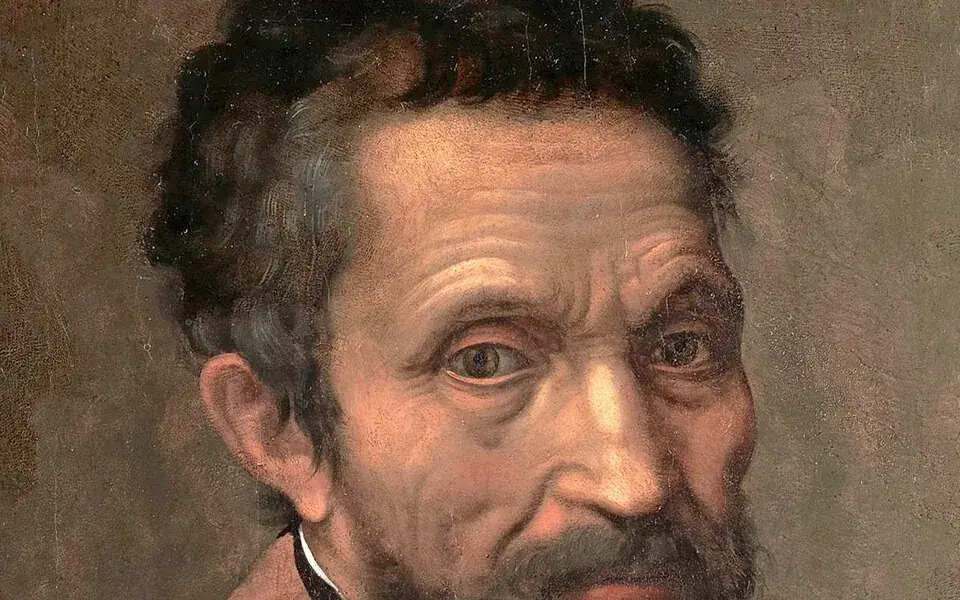
Michelangelo was renowned for sculpture before undertaking the Sistine Chapel ceiling, creating a vast arrangement of images that included scenes from Genesis.
The project required him to solve the challenges of painting high above the floor and arranging its figures. He also designed buildings and wrote poetry, working across several artistic media.
Context and creation
The walls of the Sistine Chapel had been decorated 20 years before Michelangelo's work on the ceiling. Following this, Raphael designed a set of tapestries (1515–1516) to cover the lowest of three levels; the surviving tapestries are still hung on special occasions. The middle level contains a complex scheme of frescoes illustrating the Life of Christ on the right side and the Life of Moses on the left side. It was carried out by some of the most renowned Renaissance painters: Sandro Botticelli, Domenico Ghirlandaio, Pietro Perugino, Pinturicchio, Luca Signorelli, and Cosimo Rosselli. The upper level of the walls contains the windows, between which are painted pairs of illusionistic niches with representations of the first 32 popes.
The original ceiling painting was by Pier Matteo d'Amelia, and had depicted stars over a blue background like the ceiling of the Arena Chapel decorated by Giotto at Padua. For six months in 1504, a diagonal crack in the chapel's vault had made the chapel unusable, and Pope Julius II (Giuliano della Rovere) had the damaged painting removed by Piero Roselli, a friend of Michelangelo.
Julius II was a "warrior pope" who in his papacy undertook an aggressive campaign for political control to unite and empower Italy under the leadership of the Catholic Church. He invested in symbolism to display his temporal power, such as his procession, in which he (in the Classical manner) rode a chariot through a triumphal arch after one of his many military victories. Julius II's project to rebuild St. Peter's Basilica would distinguish it as the most potent symbol of the source of papal power; he ultimately demolished and replaced the original basilica with a grander one intended to house his own tomb. The pope summoned Michelangelo to Rome in early 1505 and commissioned him to design his tomb, forcing the artist to leave Florence with his planned Battle of Cascina painting unfinished.
By this time, Michelangelo was established as an artist; both he and Julius II had hot tempers and soon argued. On 17 April 1506, Michelangelo left Rome in secret for Florence, remaining there until the Florentine government pressed him to return to the pope.
In 1506, the same year the foundation stone was laid for the new St. Peter's, Julius II conceived a programme to paint the ceiling of the Sistine Chapel. It is probable that, because the chapel was the site of regular meetings and Masses of an elite body of officials known as the Papal Chapel (who would observe the decorations and interpret their theological and temporal significance), it was Julius II's intention and expectation that the iconography of the ceiling was to be read with many layers of meaning.
The scheme proposed by the pope was for twelve large figures of the Apostles to occupy the spandrels. Michelangelo negotiated for a grander, much more complex scheme and was finally permitted, in his own words, "to do as I liked". It has been suggested that Augustinian friar and cardinal Giles of Viterbo could have influenced the ceiling's theological layout. Many writers consider that Michelangelo had the intellect, the biblical knowledge, and the powers of invention to have devised the scheme himself. This is supported by Michelangelo's biographer Ascanio Condivi's statement that the artist read and reread the Old Testament while he was painting the ceiling, drawing his inspiration from the words of the scripture, rather than from the established traditions of sacral art.