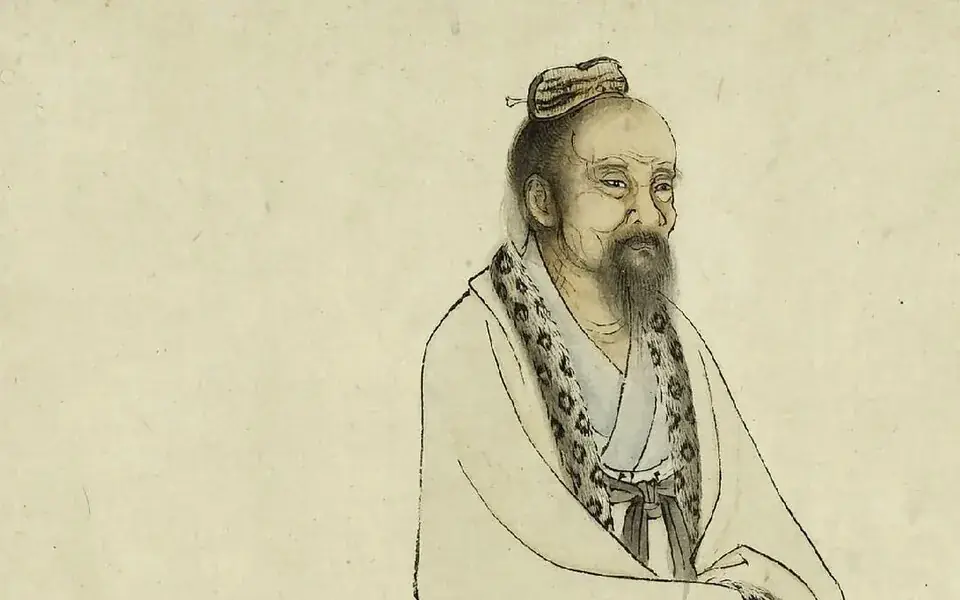
The Zhuangzi uses parables and dialogue to examine life, freedom, and understanding. Stories such as the butterfly dream invite readers to consider the relationship between experience and identity.
The book contains chapters from different periods, so all its contents cannot simply be assigned to one author. Literary form and philosophical discussion are closely intertwined.
Textual history
The only version of the Zhuangzi known to exist in its entirety consists of 33 chapters originally prepared around AD 300 by the Jin-era scholar Guo Xiang (252–312), who reduced the text from an earlier form of 52 chapters. The first 7 of these, referred to as the 'inner chapters', were considered even before Guo to have been wholly authored by Zhuang Zhou himself. This attribution has been traditionally accepted since, and is still assumed by many modern scholars. The original authorship of the remaining 26 chapters has been the subject of perennial debate: they were divided by Guo into 15 'outer chapters' and 11 'miscellaneous chapters'.
Today, it is generally accepted that the outer and miscellaneous chapters were the result of a process of "accretion and redaction" in which later authors " to the scintillating brilliance" of the original inner chapters, although close intertextual analysis does not support the inner chapters comprising the earliest stratum. Multiple authorship over time was a typical feature of Warring States texts of this genre. A limited consensus has been established regarding five distinct "schools" of authorship, each responsible for their own layers of substance within the text. Despite the lack of traceable attribution, modern scholars generally accept that the surviving chapters were originally composed between the 4th and 2nd centuries BC.
Excepting textual analysis, details of the text's history prior to the Han dynasty (202 BC – 220 AD) are largely unknown. Traces of its influence on the philosophy of texts written during the late Warring States period, such as the Guanzi, Han Feizi and Huainanzi, suggest that the Zhuangzi's intellectual lineage had already been fairly influential in the states of Qi and Chu by the 3rd century BC. Sima Qian refers to the Zhuangzi as a 100,000-character work in the Shiji, and references several chapters present in the received text.
Many scholars consider a Zhuangzi composed of 52 chapters, as attested by the Book of Han in 111 AD, to have been the original form of the text. During the late 1st century BC, the entire Han imperial library—including its edition of the Zhuangzi—was subject to considerable redaction and standardization by the polymath Liu Xiang (77–6 BC) and his son Liu Xin (c. 46 BC – AD 23). All extant copies of the Zhuangzi ultimately derive from a version that was further edited and redacted to 33 chapters by Guo Xiang c. 300 AD, who worked from the material previously edited by Liu. Guo stated that he had made considerable edits to the outer and miscellaneous chapters in an attempt to preserve Zhuang Zhou's original ideas from later distortions, in a way that "did not hesitate to impose his personal understanding and philosophical preferences on the text".
The received text as edited by Guo is approximately 63,000 characters long—around two-thirds the attested length of the Han-era manuscript. While none are known to exist in full, versions of the text unaffected by both the Guo and Liu revisions survived into the Tang dynasty (618–907), with the existing fragments hinting at the folkloric nature of the material removed by Guo.
Themes
The principles and attitudes expressed in the Zhuangzi form the core of philosophical Taoism. The text recommends embracing a natural spontaneity in order to better align one's inner self with the cosmic "Way". It also encourages keeping a distance from politics and social obligations, accepting death as a natural transformation, and appreciating things otherwise viewed as useless or lacking purpose. The text implores the reader to reject societal norms and conventional reasoning. The other major philosophical schools in ancient China—including Confucianism, Legalism, and Mohism—all proposed concrete social, political, and ethical reforms. By reforming both individuals and society as a whole, thinkers from these schools sought to alleviate human suffering, and ultimately solve the world's problems.