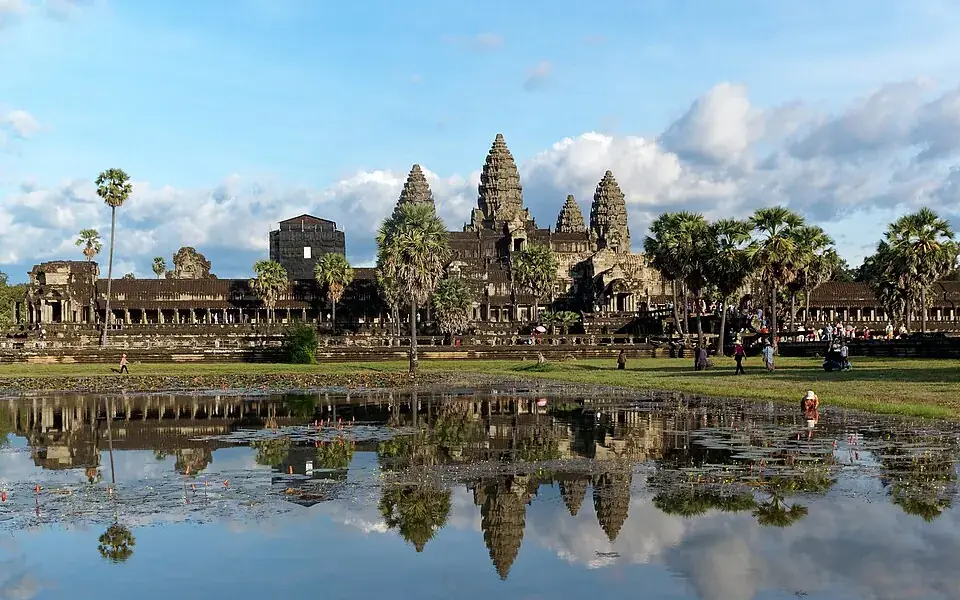
Angkor Wat was initially associated with Hindu worship and gradually became a Buddhist religious site. Its buildings retain groups of towers, galleries, and extensive narrative reliefs.
It forms part of a much larger system of Angkor urban and water-management remains. Understanding the temple involves kingship, religion, engineering, and the regional environment together.
Construction
Angkor Wat was commissioned by the Khmer king Suryavarman II (ruled 1113–c. 1150) in the early 12th century in Yaśodharapura (present-day Angkor), the capital of the Khmer Empire. The construction of the temple commenced in 1122 CE and was completed in 1150 CE. The temple complex was constructed on the suggestion of Divākarapaṇḍita (1040–c. 1120). The temple was dedicated to Hindu god Vishnu and the original religious motifs were derived from Hinduism. It was built as the king's state temple in the capital city. Historians have often thought that Angkor Wat served as a “temple-city,” but modern analyses of the site suggest that it housed a population of between 3,000 and 4,300 residents.
As there are no foundation stela or any contemporary inscriptions referring to the temple's name that have been found, its original name is unknown and it may have been known as Vrah Viṣṇuloka after the presiding deity. The work on the temple ceased after the king's death, leaving some of the bas-relief decoration unfinished.
Buddhist temple
In 1178, approximately 27 years after the death of Suryavarman II, Angkor was sacked by the Chams, the traditional enemies of the Khmer. Thereafter, the Khmer empire was restored by Jayavarman VII, who established a new capital at Angkor Thom and the Bayon as the state temple, situated to the north. The temple was dedicated to Buddhism as the king's wife Indradevi was a devout Mahayana Buddhist who encouraged him to convert. Angkor Wat was therefore also gradually converted into a Buddhist site with many Hindu sculptures replaced by Buddhist art.
After the transformation from a Hindu centre of worship to Buddhism towards the end of the 12th century, Angkor Wat has continued to serve as a Buddhist centre until the present day. Archaeologists have also theorized that Angkor Wat was used as a defensive fortification during this period, with gateway blockages and holes in the outer wall potentially implying the presence of a defensive structure. It is thought that these fortifications would have been constructed alongside the fortifications to the Khmer capital, Angkor Thom, in response to the encroaching threat of the Ayutthaya Empire.
After the Khmer empire's fall to the Ayutthaya in 1431, Angkor Wat continued to be inhabited, with dating showing regular maintenance of the site's ponds during this period. Angkor Wat is unusual among the Angkor temples in that although it was largely neglected after the 16th century, it was never completely abandoned. Fourteen inscriptions dated from the 17th century, discovered in the Angkor area, state that Japanese Buddhist pilgrims had established small settlements alongside Khmer locals. The inscription also tells of Ukondayu Kazufusa, who celebrated the Khmer New Year at Angkor Wat in 1632. Modifications of the temple also occurred in the 17th century, with findings suggesting the demolition of several towers in the mid-1600s.
Site and plan
Angkor Wat is a unique combination of the temple mountain (the standard design for the empire's state temples) and the later plan of concentric galleries, most of which were originally derived from religious beliefs of Hinduism. Angkor Wat also served a practical purpose for the Khmer Empire as well, with its dam and resulting moats serving as both connections to the Angkor water network and a means of storing water between the monsoon and dry seasons of the region.