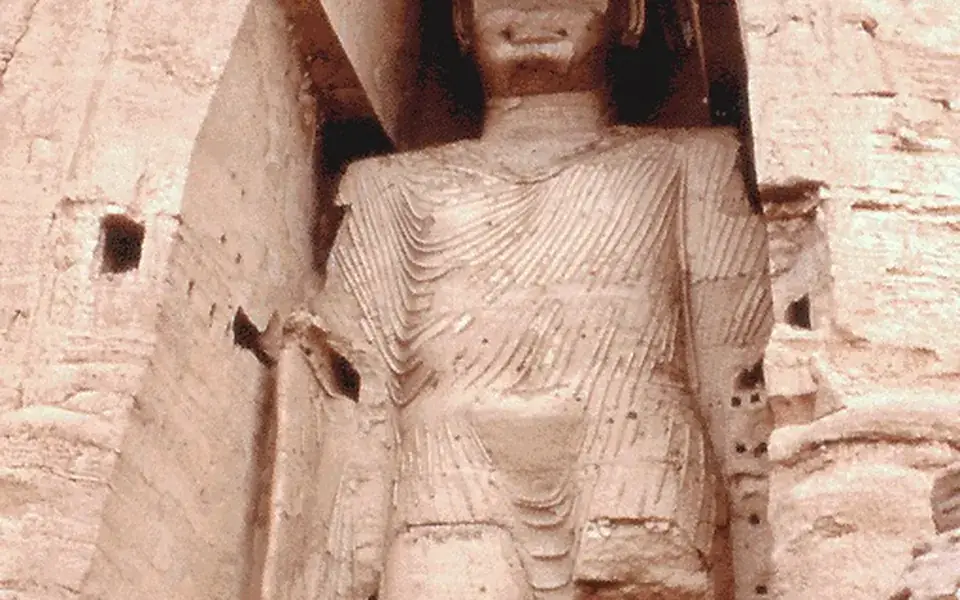
The two colossal Buddhas in the cliffs of Bamiyan, Afghanistan, represented local Buddhist art and exchanges across regions. Their outer surfaces once included modeled and painted materials.
The figures were destroyed in 2001, leaving niches and fragments. Conservation involves preserving fragments, documenting the site, and reconsidering the heritage's meaning.
Commissioning
Bamiyan lies on the Silk Road, which runs through the Hindu Kush mountain region in the Bamiyan Valley. The Silk Road has been historically a caravan route linking the markets of China with those of the Western world. It was the site of several Buddhist monasteries, and a thriving center for religion, philosophy, and art. Monks at the monasteries lived as hermits in small caves carved into the side of the Bamyan cliffs. Most of these monks embellished their caves with religious statuary and elaborate, brightly colored frescoes, sharing the culture of Gandhara.
The two most prominent art works were the giant standing sculptures of the Buddhas Vairocana and Sakyamuni (Gautama Buddha), identified by the different mudras performed. The Buddha popularly called "Salsal" measured 55 meters tall, and "Shah Mama" 38 meters. The niches in which the figures stood are 58 and 38 meters respectively from bottom to top. Before being blown up in 2001, they were the largest examples of standing Buddha carvings in the world (the 8th century Leshan Giant Buddha is taller, but is sitting).
Following the destruction of the statues in 2001, carbon dating of organic internal structural components found in the rubble has determined the two Buddhas were built c. 600 CE, with narrow dates of between 544 and 595 CE for the 38-meter Eastern Buddha, and between 591 and 644 CE for the larger Western Buddha. Recent scholarship has also been giving broadly similar dates based on stylistic and historical analysis, although the similarities with the Art of Gandhara had generally encouraged an earlier dating in older literature.
Historic documentation refers to celebrations held every year attracting numerous pilgrims, with offers being made to the monumental statues. They were perhaps the most famous cultural landmarks of the region, and the site was listed by UNESCO as a World Heritage Site along with the surrounding cultural landscape and archaeological remains of the Bamyan Valley. Their colour faded through time.
Pre-modern era
Chinese Buddhist pilgrim Xuanzang visited the site on 30 April 630, and described Bamyan in the Da Tang Xiyu Ji as a flourishing Buddhist center "with more than ten monasteries and more than a thousand monks". He also noted both Buddha figures were "decorated with gold and fine jewels" (Wriggins, 1995). Intriguingly, Xuanzang mentions a third, even larger, reclining statue of the Buddha. A monumental seated Buddha, similar in style to those at Bamyan, still exists in the Bingling Temple caves in China's Gansu province.
Adjoining caves
Later mural paintings of Bamiyan, dated to the 7th–8th centuries CE, display a variety of male devotees in double-lapel caftans. The works of art show a sophistication and cosmopolitanism comparable to other works of art of the Silk Road, such as those of Kizil, are attributable to the sponsorship of the Western Turks (Yabghus of Tokharistan). The nearby Kakrak caves also have some works of art.
After the destruction of the Buddhas, 50 more caves were revealed. In 12 of the caves, wall paintings were discovered. In December 2004, an international team of researchers stated that the wall paintings at Bamyan were painted between the 5th and the 9th centuries, rather than the 6th to 8th centuries, citing their analysis of radioactive isotopes contained in straw fibers found beneath the paintings. It is believed that the paintings were done by artists travelling on the Silk Road.