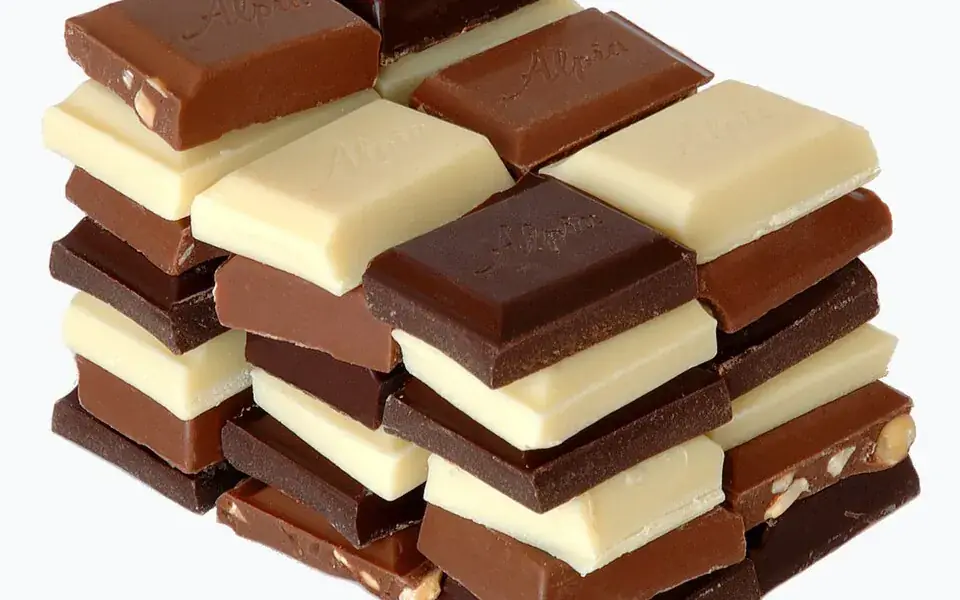
Indigenous peoples of the Americas made drinks from cacao. After cacao reached Europe, drinks with added sugar and other ingredients became popular; solid chocolate developed later.
Cacao beans also served purposes in exchange and ceremony. Changes in grinding, pressing, and refining gradually shaped the texture and production of modern chocolate.
History
The cacao tree was domesticated as early as 5300 BP in South America, in present-day southeast Ecuador, by the Mayo-Chinchipe culture, before it was introduced to Mesoamerica. It is unknown when chocolate was first consumed as opposed to other cacao-based drinks, and there is evidence the Olmecs, the earliest known major Mesoamerican civilization, fermented the sweet pulp surrounding the cacao beans into an alcoholic beverage.
Chocolate was extremely important to several Mesoamerican societies, and cacao was considered a gift from the gods by the Mayans and the Aztecs. The cocoa bean was used as a currency across civilizations and was used in ceremonies, as a tribute to leaders and gods and as a medicine. Chocolate in Mesoamerica was a bitter drink, flavored with additives such as vanilla, earflower and chili, and was capped with a dark brown foam created by pouring the liquid from a height between containers.
Spanish conquistador Hernán Cortés may have been the first European to encounter chocolate when he observed it in the court of Moctezuma II in 1520. It proved to be an acquired taste, and it took until 1585 for the first official recording of a shipment of cocoa beans to Europe. Chocolate was believed to be an aphrodisiac and medicine, and spread across Europe in the 17th century, sweetened, served warm and flavored with familiar spices. Religious orders played a significant role in its dissemination.
It was initially primarily consumed by the elite, with expensive cocoa supplied by colonial plantations in the Americas. In the 18th century, it was considered southern European, aristocratic and Catholic, and was still produced in a similar way to the way it had been produced by the Aztecs.
Starting in the 18th century, chocolate production was improved. In the 19th century, engine-powered milling was developed. In 1828, Coenraad Johannes van Houten patented a hydraulic press that separated cocoa butter from chocolate liquor, enabling the mass production of defatted cocoa powder and creating the foundation for the modern solid chocolate industry. Other developments in the 19th century, including the melanger (a mixing machine), modern milk chocolate, the conching process to make chocolate smoother and change the flavor meant a worker in 1890 could produce fifty times more chocolate with the same labor than they could before the Industrial Revolution, and chocolate became a food to be eaten rather than drunk. As production moved from the Americas to Asia and Africa, mass markets in Western nations for chocolate opened up.
In the early 20th century, British chocolate producers including Cadbury and Fry's faced controversy over the labor conditions in the Portuguese cacao industry in Africa. A 1908 report by a Cadbury agent described conditions as "de facto slavery." While conditions somewhat improved with a boycott by chocolate makers, slave labor among African cacao growers again gained public attention in the early 21st century. In the 20th century, chocolate production further developed, with development of the tempering technique to improve the snap and gloss of chocolate and the addition of lecithin to improve texture and consistency. White and couverture chocolate were developed in the 20th century and the bean-to-bar trade model began.
From nibs to chocolate
Next, the nibs are ground, producing chocolate liquor. The liquor can be further processed into cocoa powder and cocoa butter.
The penultimate process is called conching. A conche is a container filled with metal beads, which act as grinders. The refined and blended chocolate mass is kept in a liquid state by frictional heat. Before conching, chocolate has an uneven and gritty texture. The conching process produces cocoa and sugar particles smaller than the tongue can detect (typically around 20 μm) and reduces rough edges, hence the smooth feel in the mouth. The length of the conching process determines the final smoothness and quality of the chocolate. After the process is complete, the chocolate mass is stored in tanks heated to about 45–50 °C (113–122 °F) until final processing.