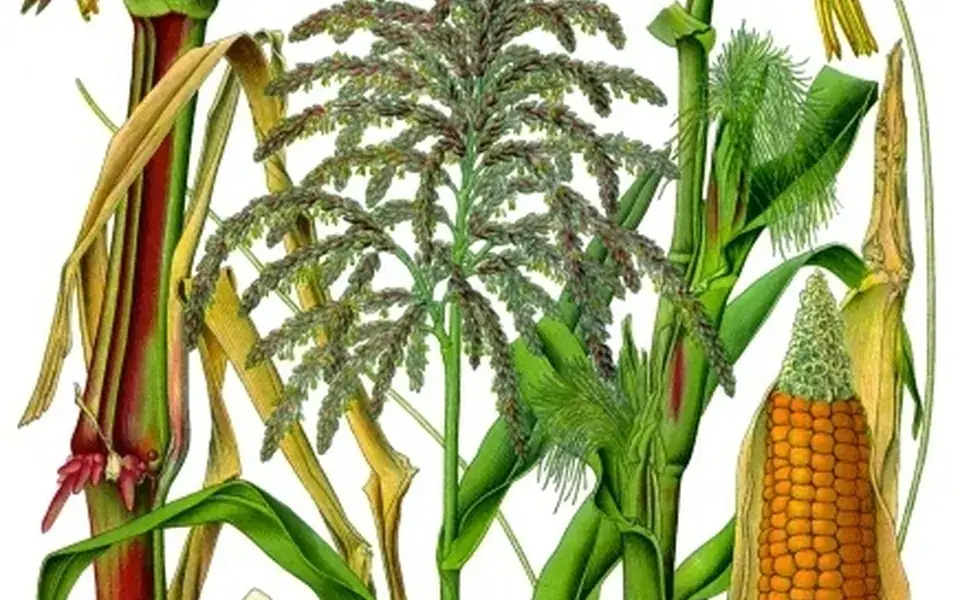
Maize underwent long domestication and selective breeding in the Americas. Its mature ears differ markedly from its wild ancestors, and it later spread to many parts of the world.
Its arrangement of kernels and the structure of its ears reflect agricultural selection. Maize serves as human food, animal feed, and a raw material for industry.
Maize and teosinte
Maize is the domesticated variant of the four species of teosintes, which are its crop wild relatives. Teosinte was likely used by hunter-gatherers because it added security to their food supply, being that it was adaptable to changes in climate and environment. The teosinte origin theory was proposed by the Russian botanist Nikolai Ivanovich Vavilov in 1931, and the American Nobel Prize-winner George Beadle in 1932. The two plants have dissimilar appearance, maize having a single tall stalk with multiple leaves and teosinte being a short, bushy plant. The difference between the two is largely controlled by differences in just two genes, called grassy tillers-1 (gt1, A0A317YEZ1) and teosinte branched-1 (tb1, Q93WI2). In the late 1930s, Paul Mangelsdorf suggested that domesticated maize was the result of a hybridization event between an unknown wild maize and a species of Tripsacum, a related genus; this has been refuted by modern genetic testing.
In 2004, John Doebley identified Balsas teosinte, Zea mays subsp. parviglumis, native to the Balsas River valley in Mexico's southwestern highlands, as the crop wild relative genetically most similar to modern maize. The middle part of the short Balsas River valley is the likely location of early domestication. Stone milling tools with maize residue have been found in an 8,700 year old layer of deposits in a cave not far from Iguala, Guerrero. Doebley and colleagues showed in 2002 that maize had been domesticated only once, about 9,000 years ago, and then spread throughout the Americas.
Maize pollen dated to 7,300 years ago from San Andres, Tabasco has been found on the Caribbean coast. A primitive corn was being grown in southern Mexico, Central America, and northern South America 7,000 years ago. Archaeological remains of early maize ears, found at Guila Naquitz Cave in the Oaxaca Valley, are roughly 6,250 years old; the oldest ears from caves near Tehuacan, Puebla, are 5,450 years old.
Pre-Columbian development
Maize requires human intervention for its propagation. The kernels of its naturally-propagating teosinte ancestor fall off the cob on their own, while those of domesticated maize do not. All maize arose from a single domestication in southern Mexico about 9,000 years ago. The oldest surviving maize types are those of the Mexican highlands. Maize spread from this region to the lowlands and over the Americas along two major paths. The centre of domestication was most likely the Balsas River valley of south-central Mexico. Maize reached highland Ecuador at least 8000 years ago. It reached lower Central America by 7,600 years ago, and the valleys of the Colombian Andes between 7,000 and 6,000 years ago.
The earliest maize plants grew a single, small ear per plant. The Olmec and Maya cultivated maize in numerous varieties throughout Mesoamerica; they cooked, ground and processed it through nixtamalization. By 3000 years ago, maize was central to Olmec culture, including their calendar, language, and myths.
The Mapuche people of south-central Chile cultivated maize along with quinoa and potatoes in pre-Hispanic times. Before the expansion of the Inca Empire, maize was traded and transported as far south as 40° S in Melinquina, Lácar Department, Argentina, probably brought across the Andes from Chile.
Columbian exchange
After the arrival of Europeans in 1492, Spanish settlers consumed maize, and explorers and traders carried it back to Europe. Spanish settlers much preferred wheat bread to maize. Maize flour could not be substituted for wheat for communion bread, since in Christian belief at that time only wheat could undergo transubstantiation and be transformed into the body of Christ.
Maize spread to the rest of the world because of its ability to grow in diverse climates. It was cultivated in Spain just a few decades after Columbus's voyages and then spread to Italy, West Africa, the Philippines and elsewhere. By the 17th century, it was a common peasant food in Southern Europe. By the 18th century, it was the chief food of the southern French and Italian peasantry, especially as polenta in Italy.