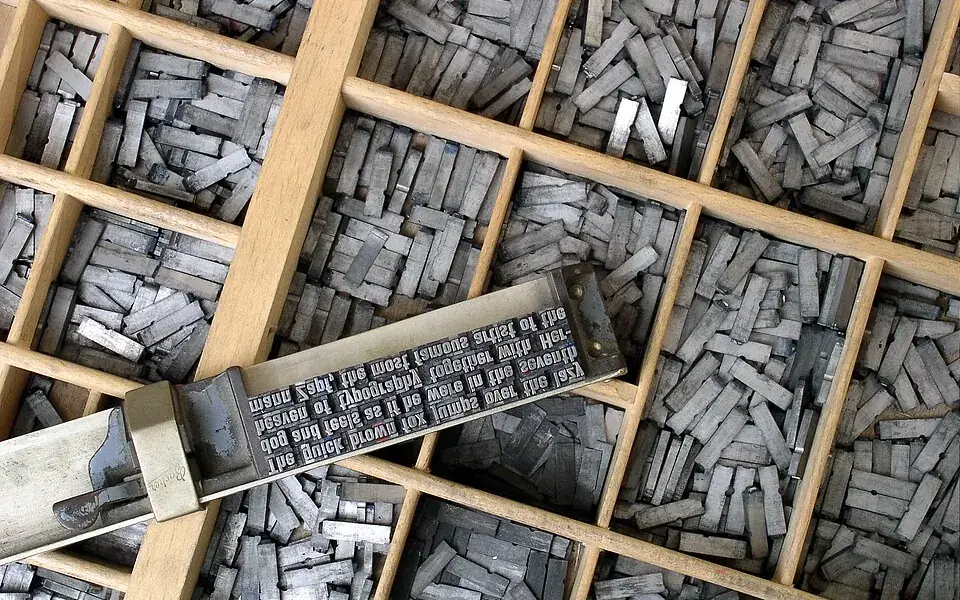
Shen Kuo recorded how Bi Sheng made reusable clay type. After arranging the pieces, printers fixed them with heat, then took them apart for reuse, avoiding the need to carve a whole new block for every page.
Movable-type printing involves making type, setting it, and securing it. The large number of Chinese characters creates particular demands for organizing the type collection.
Ceramic movable type
Bi Sheng (990–1051) developed the first known movable-type system for printing in China around 1040 AD during the Northern Song dynasty, using ceramic materials.
After his death, ceramic movable type may have spread to the Tangut kingdom of Western Xia, where a Buddhist text known as the Vimalakirti Nirdesa Sutra was found in modern Wuwei, Gansu, dating to the reign of Emperor Renzong of Western Xia (r. 1139–1193). The text features traits that have been identified as hallmarks of ceramic movable type such as the hollowness of the character strokes and deformed and broken strokes. The ceramic movable-type also passed onto Bi Sheng's descendants. The next mention of movable type occurred in 1193 when a Southern Song chief counselor, Zhou Bida, attributed the movable-type method of printing to Shen Kuo. However Shen Kuo did not invent the movable type but credited it to Bi Sheng in his Dream Pool Essays. Zhou used ceramic type to print the Yutang Zaji (Notes of the Jade Hall) in 1193.
Further evidence of the spread of movable type appears in the Binglü Xiansheng Wenji (Collected Works of Master Palm) by Deng Su (1091-1132), which references the use of metal frames in movable type printing to print poems. The ceramic movable type was mentioned by Kublai Khan's councilor Yao Shu (1203–1280), who convinced his pupil Yang Gu to print language primers using this method.
The claim that Bi Sheng's ceramic types were "fragile" and "not practical for large-scale printing" and "short lived" were refuted by later experiments. Bao Shicheng (1775–1885) wrote that fired clay moveable type was "as hard and tough as horn"; experiments show that clay type, after being fired in a kiln, becomes hard and difficult to break, such that it remains intact after being dropped from a height of two metres onto a marble floor. The length of ceramic movable types in China was 1 to 2 centimetres, not 2 mm, thus hard as horn. But similar to metal type, ceramic type did not hold the water-based Chinese calligraphic ink well, and had an added disadvantage of uneven matching of the type which could sometimes result from the uneven changes in size of the type during the firing process.
Ceramic movable type was used as late as 1844 in China from the Song dynasty through to the Qing dynasty.
Wooden movable type
Bi Sheng (990–1051) of the Song dynasty also pioneered the use of wooden movable type around 1040 AD, as described by the Chinese scholar Shen Kuo (1031–1095). However, this technology was abandoned in favour of clay movable types due to the presence of wood grains and the unevenness of the wooden type after being soaked in ink.
A number of books printed in Tangut script during the Western Xia (1038–1227) period are known, of which the Auspicious Tantra of All-Reaching Union, which was discovered in the ruins of Baisigou Square Pagoda in 1991 is believed to have been printed sometime during the reign of Emperor Renzong of Western Xia (1139–1193). It is considered by many Chinese experts to be the earliest extant example of a book printed using wooden movable type.
In 1298, Wang Zhen, a Yuan dynasty governmental official of Jingde County, Anhui Province, China, re-invented a method of making movable wooden types. He made more than 30,000 wooden movable types and printed 100 copies of Records of Jingde County, a book of more than 60,000 Chinese characters. Soon afterwards, he summarized his invention in his book A method of making moveable wooden types for printing books. Although the wooden type was more durable under the mechanical rigors of handling, repeated printing wore down the character faces, and the types could only be replaced by carving new pieces. This system was later enhanced by pressing wooden blocks into sand and casting metal types from the depression in copper, bronze, iron or tin. This new method overcame many of the shortcomings of woodblock printing.