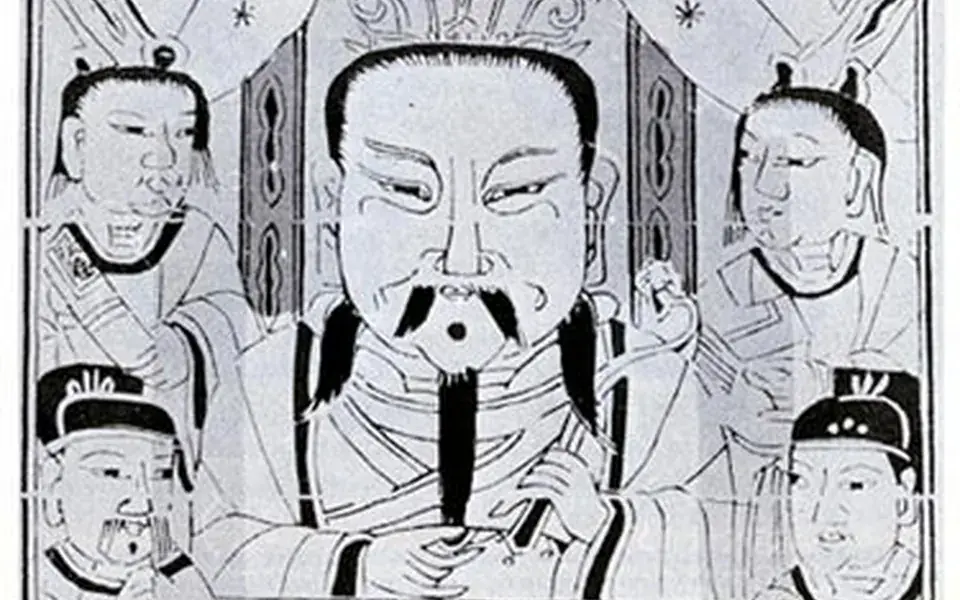
Archaeological evidence of paper predates Cai Lun. During the Eastern Han dynasty, he refined papermaking materials and techniques, so his contribution should not be described as creating the first sheet from nothing.
Bark, hemp waste, and rags were used in papermaking. As the technology spread, paper gradually replaced several heavier or more expensive writing materials.
Materials and the spread of paper
The word "paper" is etymologically derived from papyrus, Ancient Greek for the Cyperus papyrus plant. Papyrus is a thick, paper-like material produced from the pith of the Cyperus papyrus plant which was used in ancient Egypt and other Mediterranean societies for writing long before paper was used in China. Papyrus is prepared by cutting off thin ribbon-like strips of the pith (interior) of the Cyperus papyrus plant and then laying out the strips side-by-side to make a sheet. A second layer is then placed on top, with the strips running perpendicular to the first. The two layers are then pounded together using a mallet to make a sheet. The result is very strong, but has an uneven surface, especially at the edges of the strips. When used in scrolls, repeated rolling and unrolling causes the strips to come apart again, typically along vertical lines. This effect can be seen in many ancient papyrus documents.
Paper with legible Chinese writings on it has been dated to 8 BC. The traditional inventor attribution is of Cai Lun, an official attached to the Imperial court during the Han dynasty (202 BCE – 220 CE), said to have invented paper about 105 CE using mulberry and other bast fibres along with fishnets, old rags, and hemp waste. Paper used as a writing medium had become widespread by the 3rd century and, by the 6th century, toilet paper was starting to be used in China as well. During the Tang dynasty (618–907 CE) paper was folded and sewn into square bags to preserve the flavour of tea, while the later Song dynasty (960–1279 CE) was the first government to issue paper-printed money.
In the 8th century, papermaking spread to the Islamic world, where the process was refined, and machinery was designed for bulk manufacturing. Production began in Samarkand, Baghdad, Damascus, Cairo, Morocco, and then Muslim Spain. In Baghdad, papermaking was under the supervision of the Grand Vizier Ja'far ibn Yahya. Muslims invented a method to make a thicker sheet of paper. This innovation helped transform papermaking from an art into a major industry. The earliest use of water-powered mills in paper production, specifically the use of pulp mills for preparing the pulp for papermaking, dates back to Samarkand in the 8th century. The earliest references to paper mills also come from the medieval Islamic world, where they were first noted in the 9th century by Arabic geographers in Damascus.
Traditional papermaking in Asia uses the inner bark fibers of plants. This fiber is soaked, cooked, rinsed and traditionally hand-beaten to form the paper pulp. The long fibers are layered to form strong, translucent sheets of paper. In Eastern Asia, three traditional fibers are abaca, kōzo and gampi. In the Himalayas, paper is made from the lokta plant. This paper is used for calligraphy, printing, book arts, and three-dimensional work, including origami.
Medieval European papermakers developed moulds using metallic wire, and features such as the watermark were established by around 1300. Hemp and linen rags supplied much of the pulp. Paper entered a writing culture in which parchment was already well established, and its acceptance and production developed over time. European paper mills were operating before the fifteenth-century introduction of movable-type printing. Printing greatly increased demand for an existing product and encouraged further expansion of the industry. The relationship was reciprocal: printers needed a dependable supply of sheets, while papermakers gained a large market for material that could carry many copies of the same text. Much later, cotton rags also became an important source of pulp.
Modern papermaking began in the early 19th century in Europe with the development of the Fourdrinier machine, which produces a continuous roll of paper rather than individual sheets.