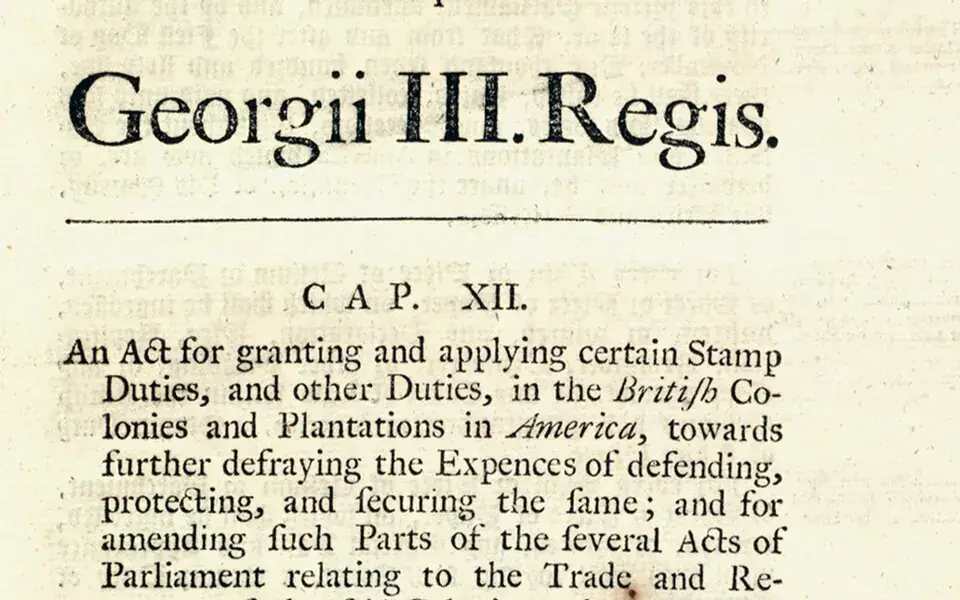
Britain's Stamp Act of 1765 taxed various printed materials and legal documents in its North American colonies. Colonists strongly protested taxation imposed without the consent of their own representatives. Boycotts and political organization widened the dispute. The act was later repealed, but conflict over Parliament's authority and colonial rights continued.
Background
The British victory in the Seven Years' War (1756–1763), known in the United States and elsewhere as the French and Indian War, was won at great financial expense. During the war, the British national debt nearly doubled, rising from £72,289,673 in 1755 to almost £129,586,789 by 1764. Post-war expenses were expected to remain high because the Bute ministry decided in early 1763 to keep ten thousand British regulars in the American colonies, which would cost about £225,000 per year, equal to £39 million today. The primary reason for retaining such a large force was that demobilising the army would put 1,500 officers out of work, many of whom were well-connected in Parliament.
This made it politically prudent to retain a large peacetime establishment, but Britons were averse to maintaining a standing army at home so it was necessary to garrison most of the troops elsewhere.
The outbreak of Pontiac's War in May 1763 led to the Royal Proclamation of 1763 and the added duty of British soldiers to prevent outbreaks of violence between Native Americans and American colonists. 10,000 British troops were dispatched to the American frontier, with a primary motivation of the move being to provide billets for the officers who were part of the British patronage system.
The act
The act was passed by the British Parliament on 22 March 1765 with an effective date of 1 November 1765. It passed 205–49 in the House of Commons and unanimously in the House of Lords.
The highest tax, £10, was placed... on attorney licenses. Other papers relating to court proceedings were taxed in amounts varying from 3d. to 10s. Land grants under a hundred acres were taxed 1s. 6d., between 100 and 200 acres 2s., and from 200 to 320 acres 2s. 6d., with an additional 2s 6d. for every additional 320 acres (1.3 km). Cards were taxed a shilling a pack, dice ten shillings, and newspapers and pamphlets at the rate of a penny for a single sheet and a shilling for every sheet in pamphlets or papers totaling more than one sheet and fewer than six sheets in octavo, fewer than twelve in quarto, or fewer than twenty in folio (in other words, the tax on pamphlets grew in proportion to their size but ceased altogether if they became large enough to qualify as a book).
The high taxes on lawyers and college students were designed to limit the growth of a professional class in the colonies. The stamps had to be purchased with hard currency, which was scarce, rather than the more plentiful colonial paper currency. To avoid draining currency out of the colonies, the revenues were to be expended in America, especially for supplies and salaries of British Army units who were stationed there.
Political responses
Grenville started appointing stamp distributors almost immediately after the act passed Parliament. Applicants were not hard to come by because of the anticipated income that the positions promised, and he appointed local colonists to the post. Benjamin Franklin even suggested the appointment of John Hughes as the agent for Pennsylvania, indicating that even Franklin was not aware of the turmoil and impact that the tax was going to generate on American-British relations or that these distributors would become the focus of colonial resistance.
Debate in the colonies had actually begun in the spring of 1764 over the Stamp Act when Parliament passed a resolution that contained the assertion, "That, towards further defraying the said Expences, it may be proper to charge certain Stamp Duties in the said Colonies and Plantations." Both the Sugar Act and the proposed Stamp Act were designed principally to raise revenue from the colonists. The Sugar Act, to a large extent, was a continuation of past legislation related primarily to the regulation of trade (termed an external tax), but its stated purpose was entirely new: to collect revenue directly from the colonists for a specific purpose.